THE PULCINELLA AT THE TABLE: IN CONVERSATION WITH TUDOR CIURESCU
CONVERSATION BY SELIN KIR
CO-FOUNDER, CURATOR
19 JUNE 2026 — UNITED KINGDOM
There is an artist who will make you wait two years for a rabbit to die of natural causes. Tudor Ciurescu doesn't compromise, not on materials, not on ideas, not on the uncomfortable space where innocence and violence exist simultaneously. Born in Romania, trained in Switzerland, restless everywhere else, his practice moves across taxidermy, PLA cherubs with guns, haunted post-communist swings, and dartboards with Freud's face on them. We spoke with him about anxiety, authority, and why "that will do" was never going to cut it.
You grew up in Romania, trained in Switzerland, did a residency in Belgrade, spent time in Los Angeles, and now live between Lausanne and Milan. That's a lot of different registers of what art is supposed to look like and who it's supposed to be for. Which one shaped you most, and which one did you most have to unlearn?
I like being on the move because it allows me to dream. Wherever I arrive, I eventually try to turn that dream into something tangible.
Moving to Switzerland at twenty-one to study at ECAL probably shaped me the most. It taught me to pay attention to details, structure, and context. I learnt that every decision in a work has consequences, and that precision is a form of respect towards both the work and the viewer.
What I had to unlearn was a mentality I grew up with in Romania, where people often say, "it's good enough" or "that will do." It comes from incredible resourcefulness and decades of having to make things work with very little. I admire that ingenuity, but I realised I no longer wanted to compromise if I could avoid it. I'd rather wait and make something exactly the way I imagine it than settle for an approximation. I'm chasing excellence. Not the kind measured by flawless execution, but by the clarity of the idea.
At the same time, living in Romania shaped the way I see the world. It gave me a dark sense of humour, a certain honesty, and an almost irrational confidence that any obstacle can somehow be transformed into an opportunity. I still carry that with me everywhere I go.
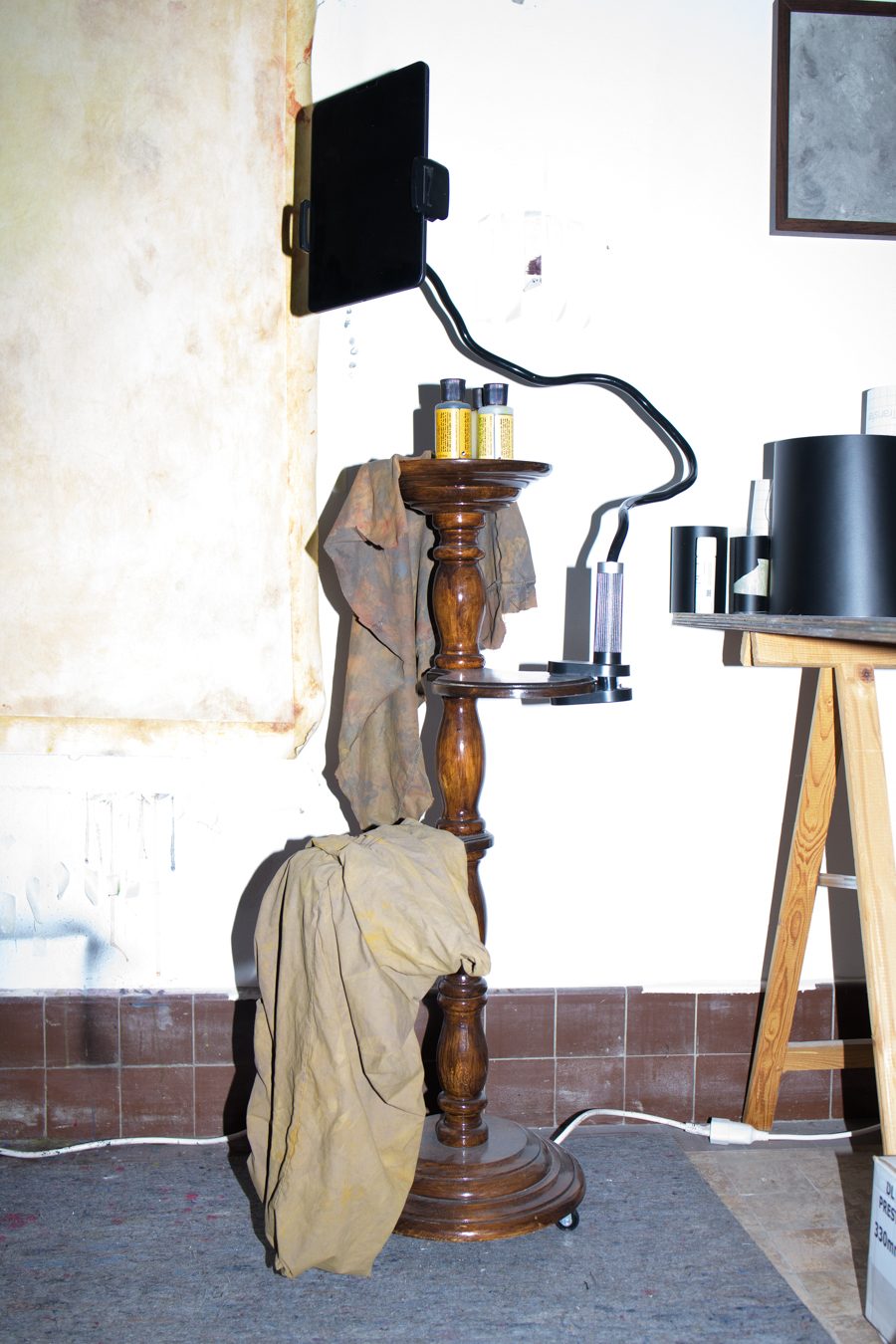
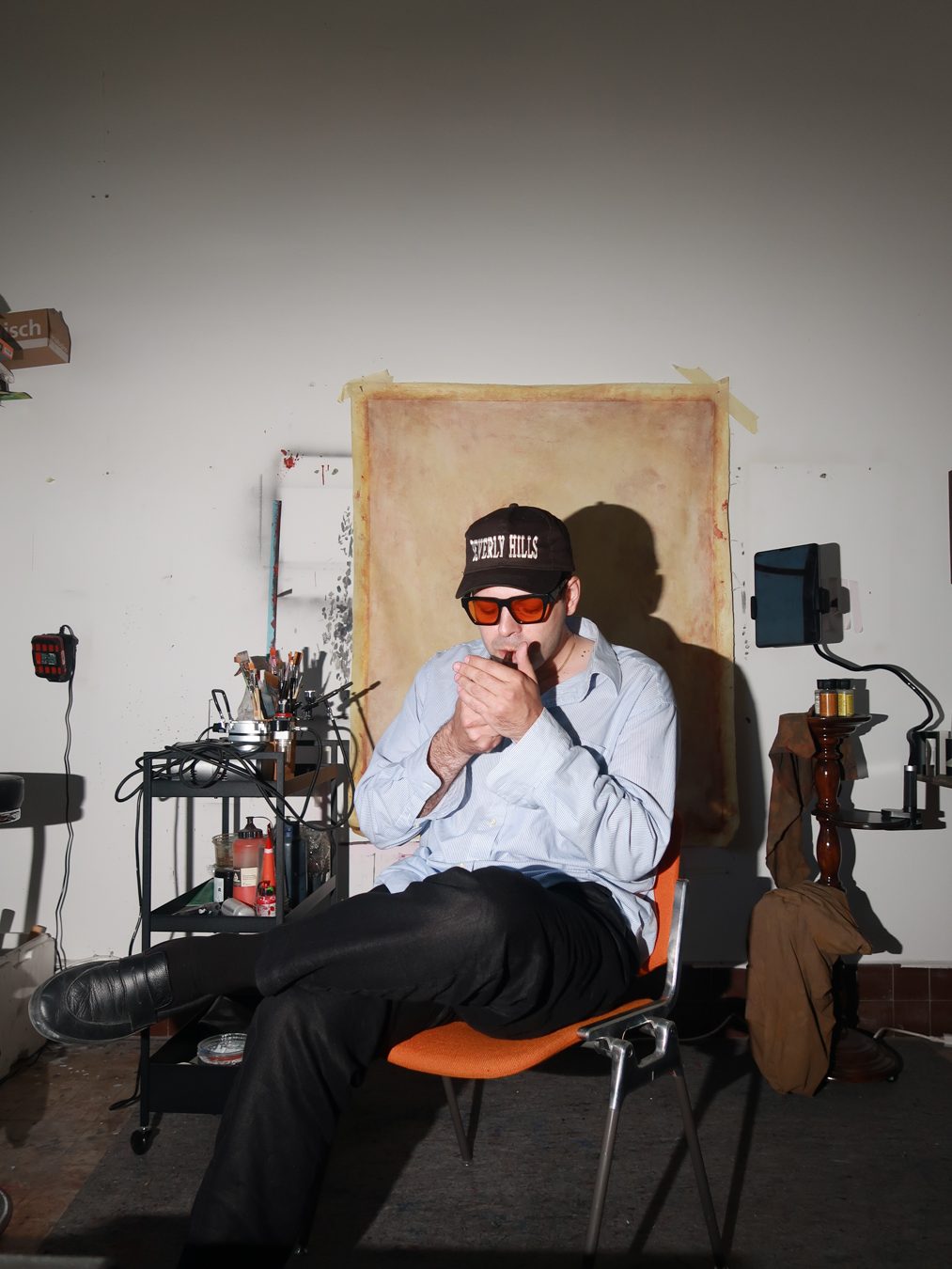
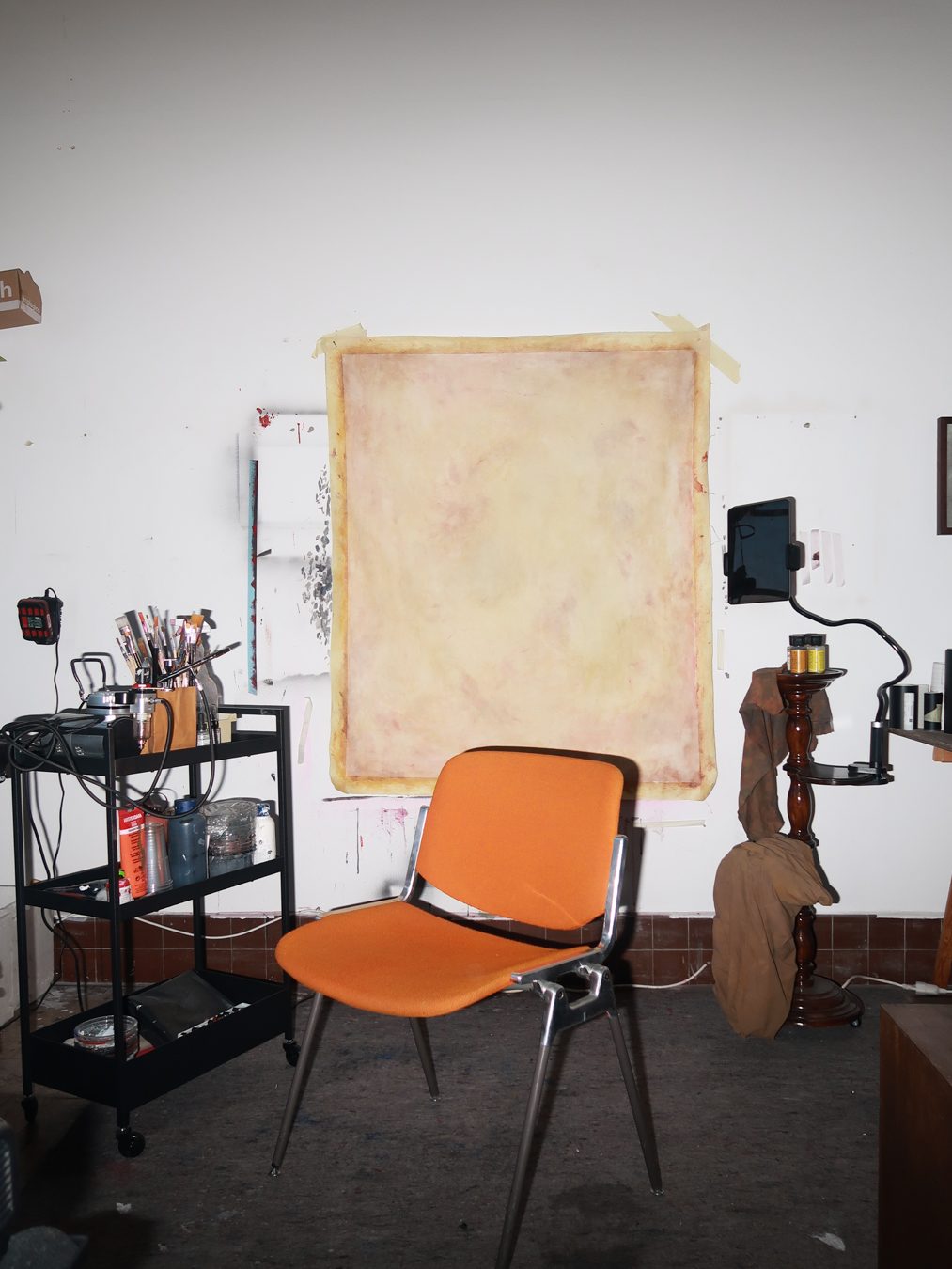
Tudor Ciurescu's studio. Photography by Cesar Axel Aguilar Rodriguez.
TRAUM is a real gas tank that sounds like it's about to explode the moment someone enters the room. You've described the original fear, your grandparents' kitchen tank, as a feeling every visual artist shares right now. What is that shared fear actually about?
The constant anxiety any artist passes through, and I don't think it is a contemporary problem; they probably had anxiety in the Renaissance too.
The gas tank became a metaphor for that constant pressure. It feels as if something could explode at any moment, but that tension is also what keeps the work alive. If I ever stopped feeling it completely, I think I'd become suspicious of my own practice.
The Dream I Still Have is a motorised post-Soviet playground swing with an animatronic figure based on Glenn/Shiftace, the non-gendered character from Chucky, activated only by human presence. Bourgeois had her spiders, Koons had his inflatables, you have a haunted swing from a Romanian courtyard. What do you think childhood actually gives an artist that adulthood can't access any other way?
I think childhood gives you a sense of a unique experience of life, and the constant wonder of finding out new things which, as adults, can hit a plateau. As adults, we encounter similar experiences, unless you're actively looking for new ones.
I was sceptical about working with childhood because it can be a cliché, but in these works I looked for a place of raw honesty. It was a period where I was looking for the incipient moments that gave me the butterflies in the stomach I have now when I think of a new work.
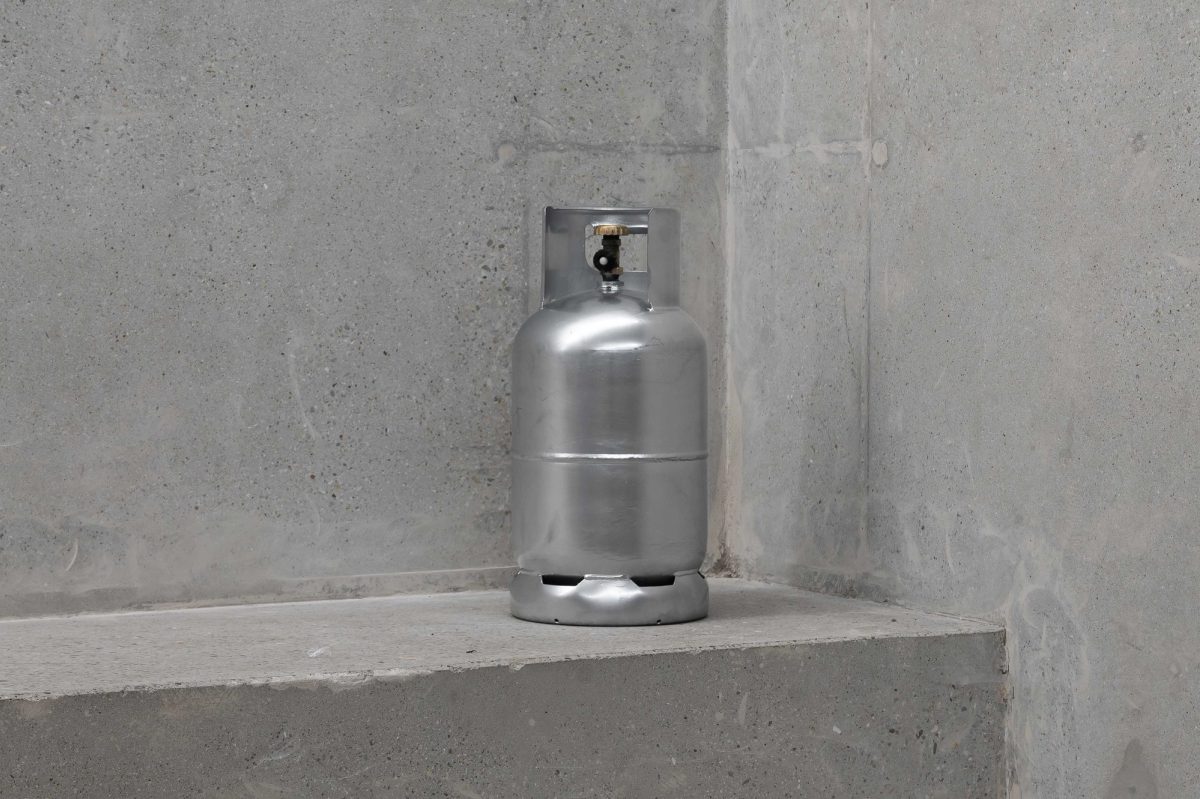
Tudor Ciurescu, TRAUM, Gas tank, arduino, sensors, speakers, 60 x 30 x 20 cm, 2023
"I'm chasing excellence. Not the kind measured by flawless execution, but by the clarity of the idea."
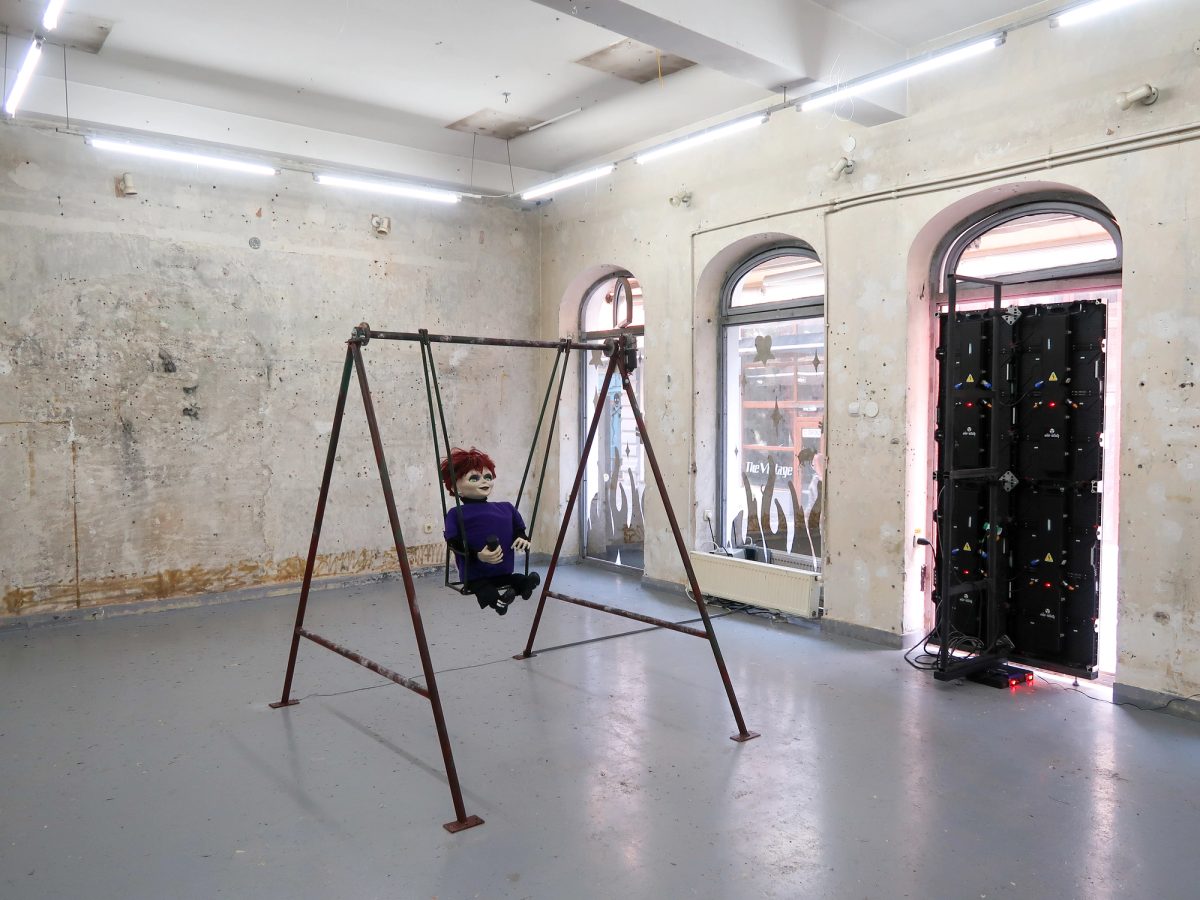
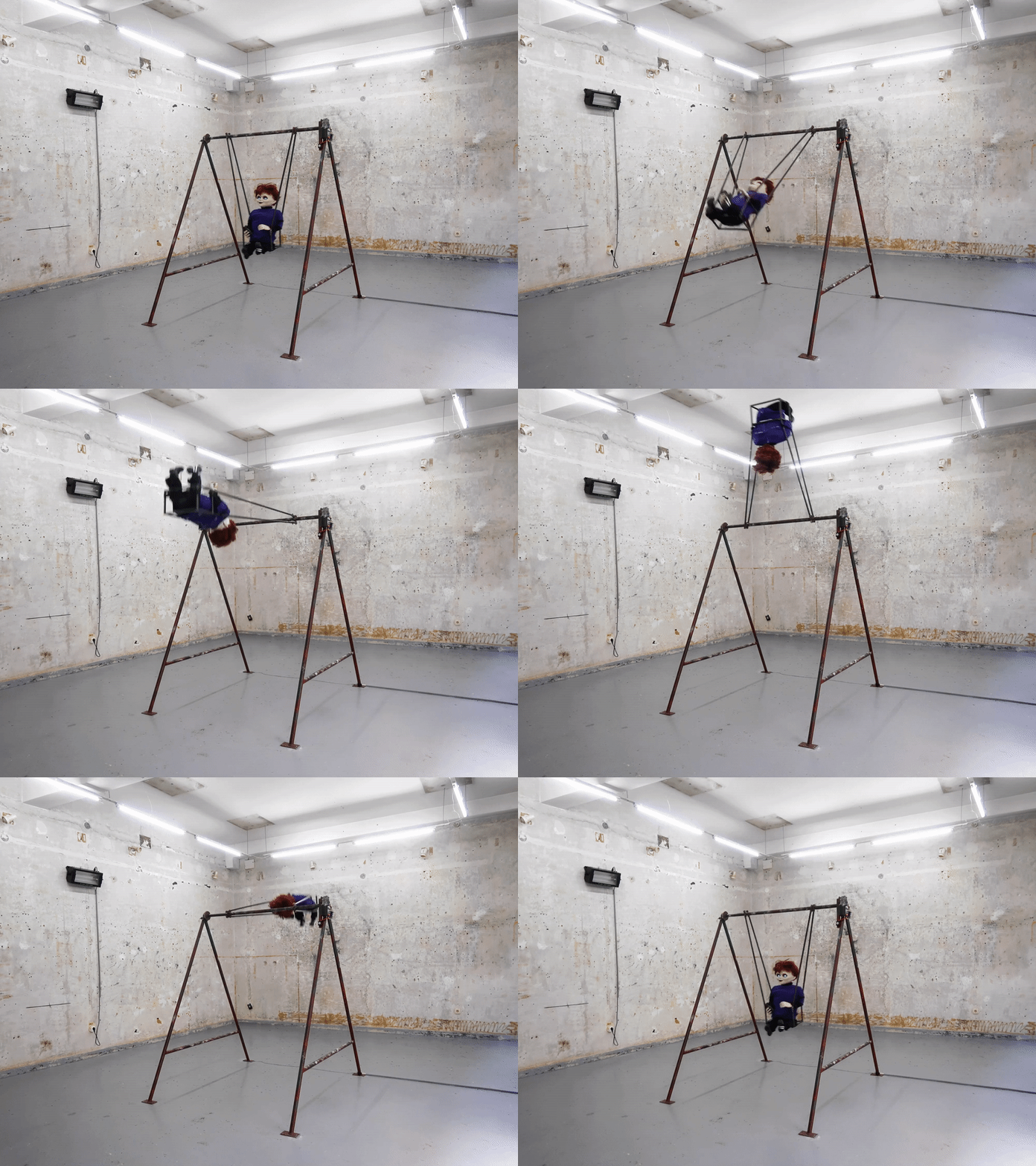
Tudor Ciurescu, The Dream I Still Have
HERUVIM is a baroque cherub rendered in industrial PLA with a gun in each hand, one pointing outward, one at its own head. Sacred imagery in contemporary art usually signals irony, a kind of knowing wink. What is the emotional register you're actually working in when you take a form like that, something that was built to inspire awe, and push it somewhere much darker?
I don't approach sacred imagery ironically. My connection to religious iconography came from realising that these symbols were originally created by artists themselves. They are visual languages that can continue to evolve rather than untouchable images.
With HERUVIM, I wanted to use the Baroque cherub because it carries centuries of associations with innocence. By placing a gun in each hand, one aimed outward and one at its own head, I was interested in a fundamental paradox of the human condition: that humanity is simultaneously destructive towards others and itself. The two guns point in opposite directions, but they ultimately describe the same cycle of violence.
For me, the cherub becomes less a religious figure than a mirror of humanity itself, occupying that uncomfortable space where innocence and violence exist simultaneously.
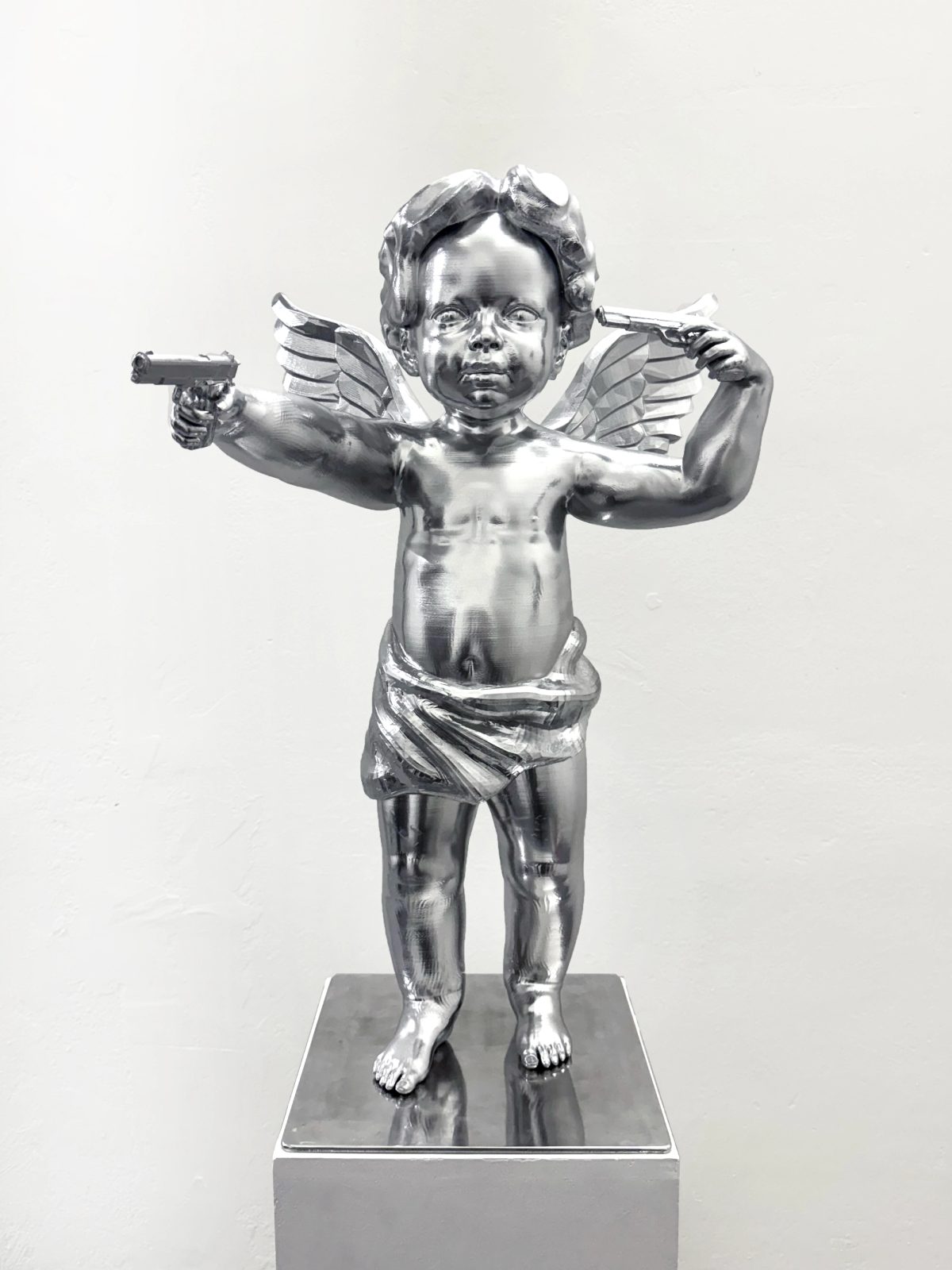
Tudor Ciurescu, HERUVIM, Polylactic acid, stainless steel, 80 x 60 x 15 cm, 2024
S.F. Dartboard has a charcoal portrait mounted as a functional dartboard, with silver-plated darts already embedded in it. There's real aggression there. What's the difference, for you, between violence that illuminates and violence that just provokes?
Since childhood I've had a complicated relationship with authority. And I like to poke at it, sometimes literally.
The reference is from the 1971 film W.R.: Mysteries of the Organism by avant-garde Serbian filmmaker Dušan Makavejev. I found it very interesting that from the '70s, the image of Sigmund Freud, a recurring figure in my practice created this sort of ambivalence, of love and hate.
There's a generation of artists for whom the Western canon feels like a burden, too white, too male, something to dismantle. And then there's another position where it's just an enormous library you're free to raid. Caravaggio, Freud, Commedia dell'arte, Sonic the Hedgehog, WallStreetBets, your reference pool is genuinely strange in how wide it is. Is that breadth a deliberate stance or just what happens when you grew up on the internet?
I wouldn't say I grew up on the internet. I still had a very pre-internet childhood. I spent much more time on the streets than online. I became fascinated with the internet when I was around ten or eleven, writing on blogs and connecting with people from around the world.
For me, the internet wasn't an escape from reality. It was a point of comparison. It felt like looking over a wall as a kid to see what was on the other side. I knew there was something beyond the reality I was living in, and I wanted to be connected to it.
That curiosity has always been there. The internet simply amplified it. I never felt the need to choose between Caravaggio and Sonic the Hedgehog, or Freud and WallStreetBets. They're all products of human culture, and I'm interested in the unexpected conversations that can happen between them.
So I don't think the breadth of my references is a deliberate position against the canon or in favour of the internet. It's just a reflection of how I naturally consume information. I'm endlessly curious, and I tend to move horizontally across disciplines rather than staying within one field. That's where I often find the most interesting connections.
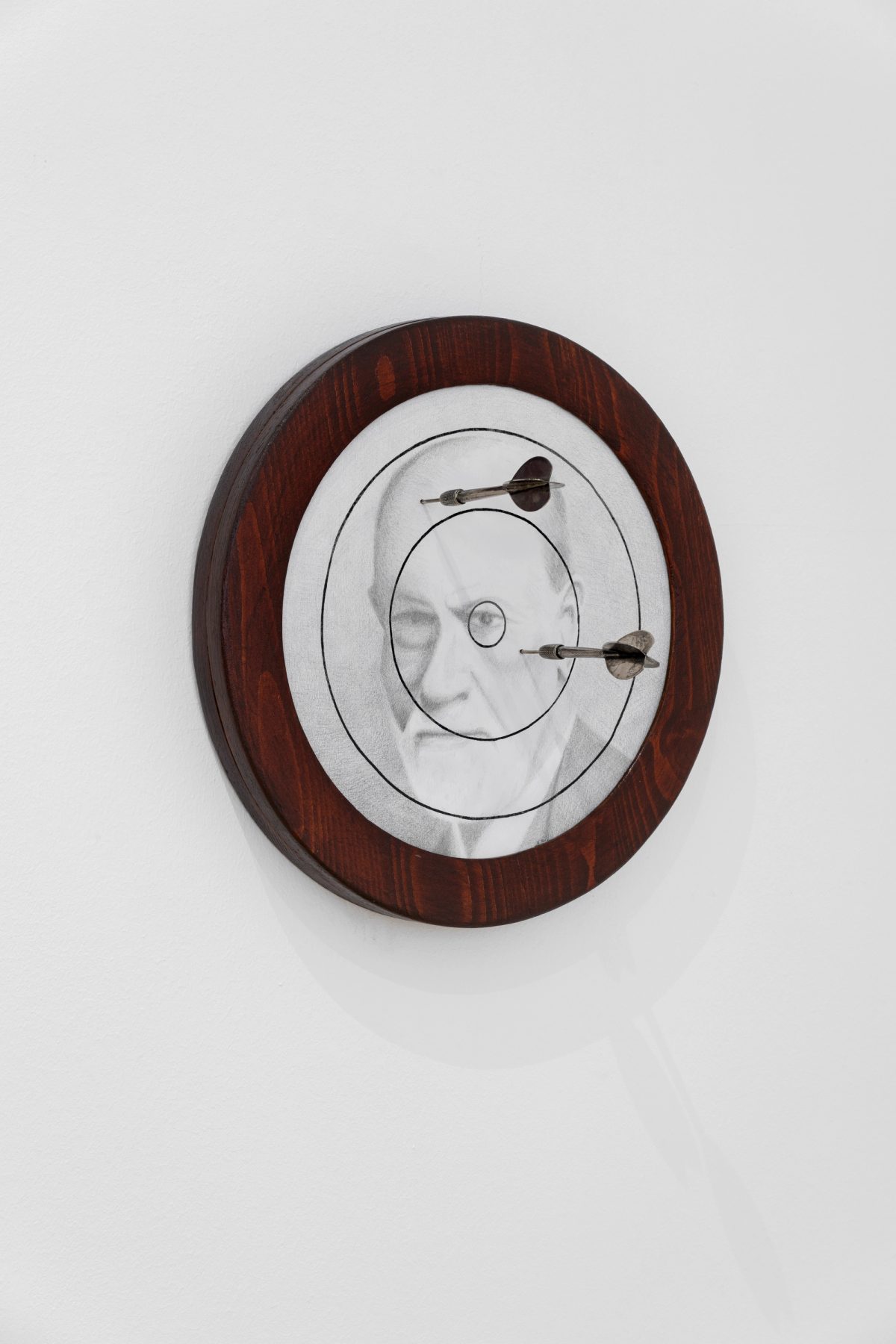
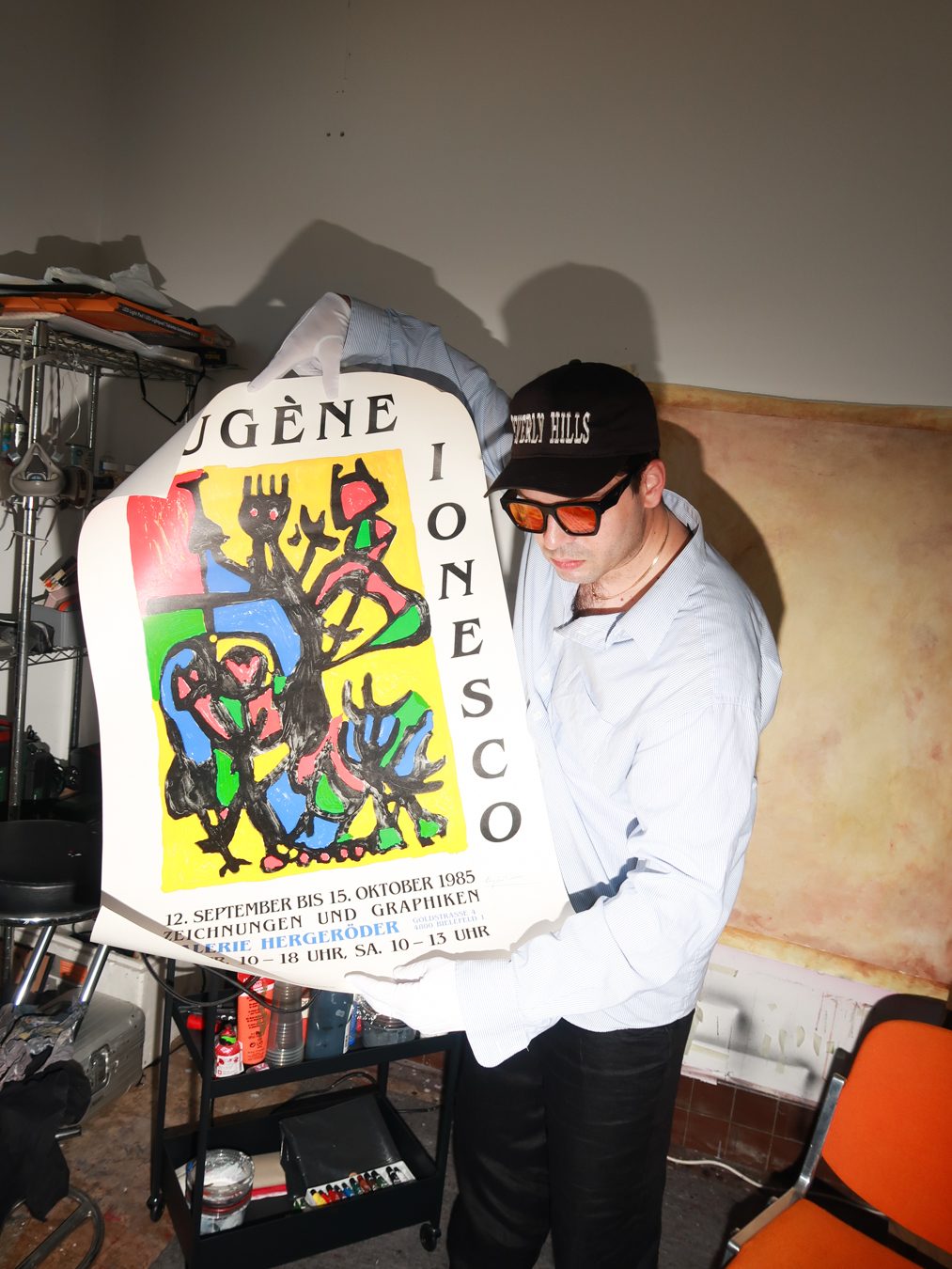
Left: Tudor Ciurescu, S.F. Dartboard, Wood, charcoal on paper, 925 silver plated metal, 33 x 33 x 4 cm, 2026 Right: Tudor Ciurescu in his studio. Photography by Cesar Axel Aguilar Rodriguez.
"Everything I do is connected by an invisible wire."
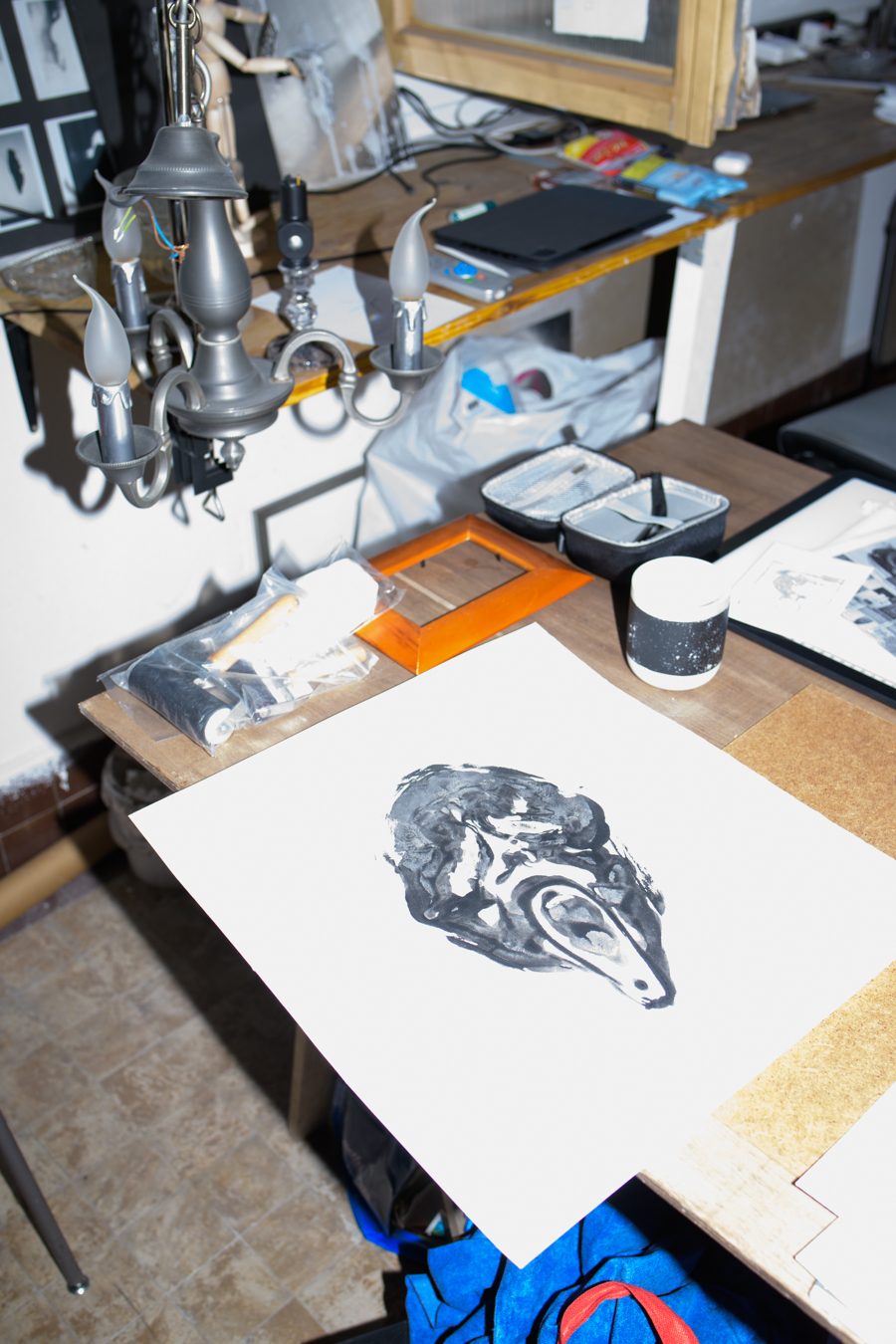
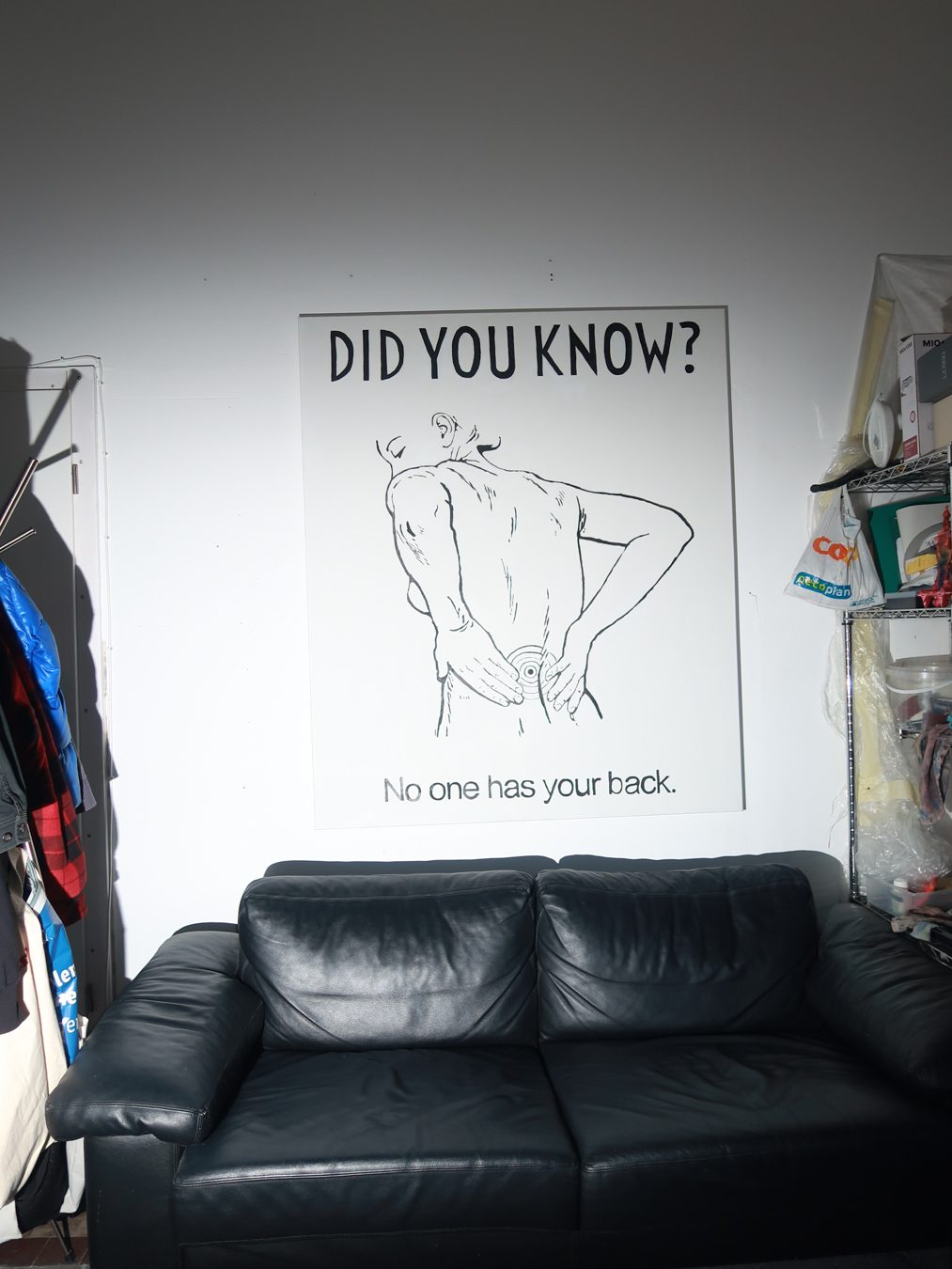
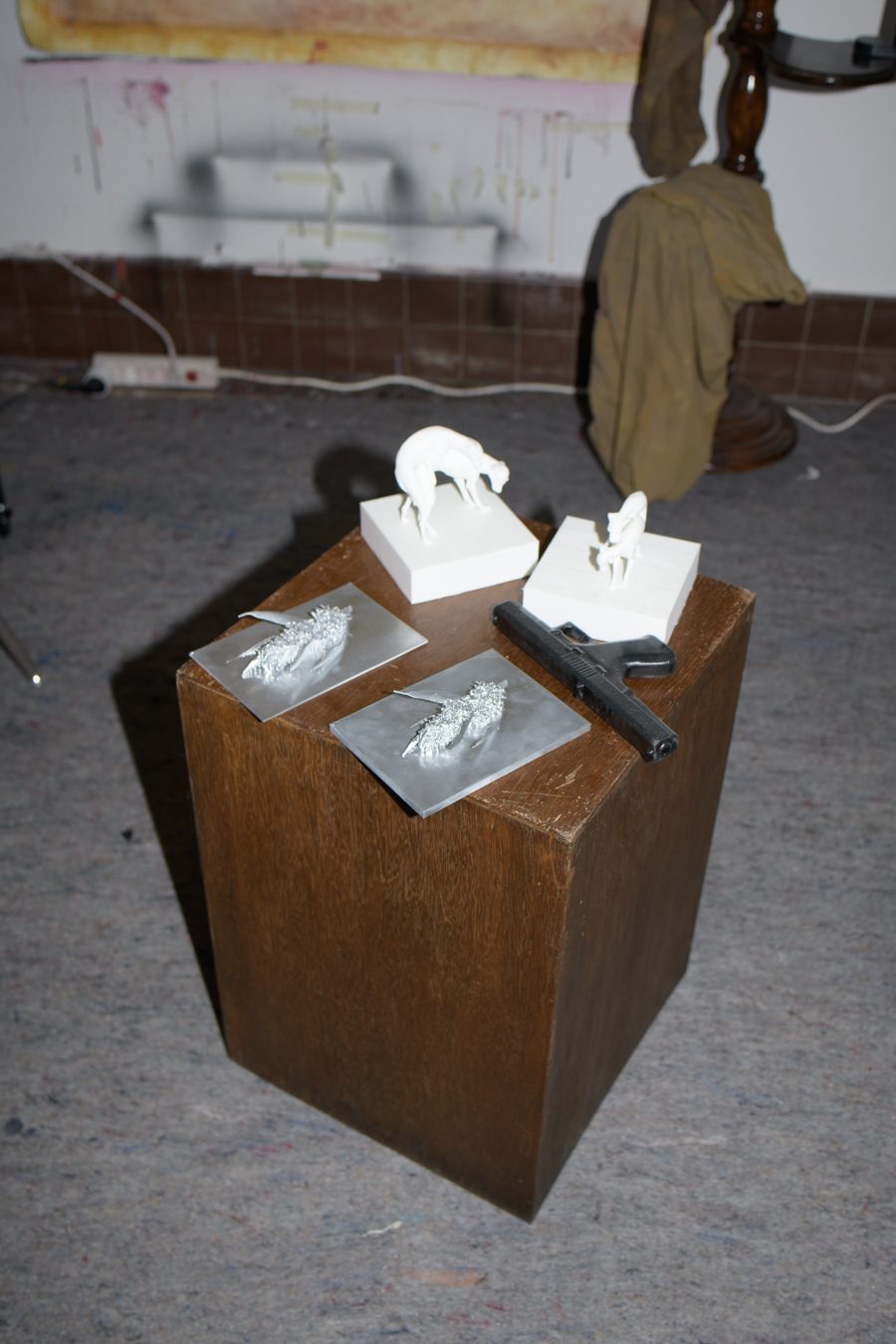
Tudor Ciurescu's studio. Photography by Cesar Axel Aguilar Rodriguez.
L'Eterna Urgenza places two taxidermied white rabbits on a marble-topped wooden cabinet, the animals preserved, the stone cut from something that was already geological time. Both materials are about stopping something from disappearing. What drew you to taxidermy specifically, given everything else you could have used?
I've studied Albrecht Dürer since high school, and he has remained a recurring figure in my practice. His Young Hare is one of those images that never left me. It represents an extraordinary sensitivity towards life, and I wanted to revisit that image from a contemporary perspective.
I often work through opposites and ambivalence. In L'Eterna Urgenza, I imagined these almost angelic rabbits as symbols of fertility, innocence, and continuous reproduction. But if I wanted the work to genuinely address life and death, I felt that using representations wasn't enough. I wanted the discussion to become materially real, so I chose taxidermy.
The process itself became part of the work. It took almost two years because I didn't want any rabbit to be killed for the piece. Together with the taxidermist, we waited for farmers to contact us whenever a rabbit died of natural causes. That waiting introduced an ethical dimension into the work that I consider just as important as the final object.
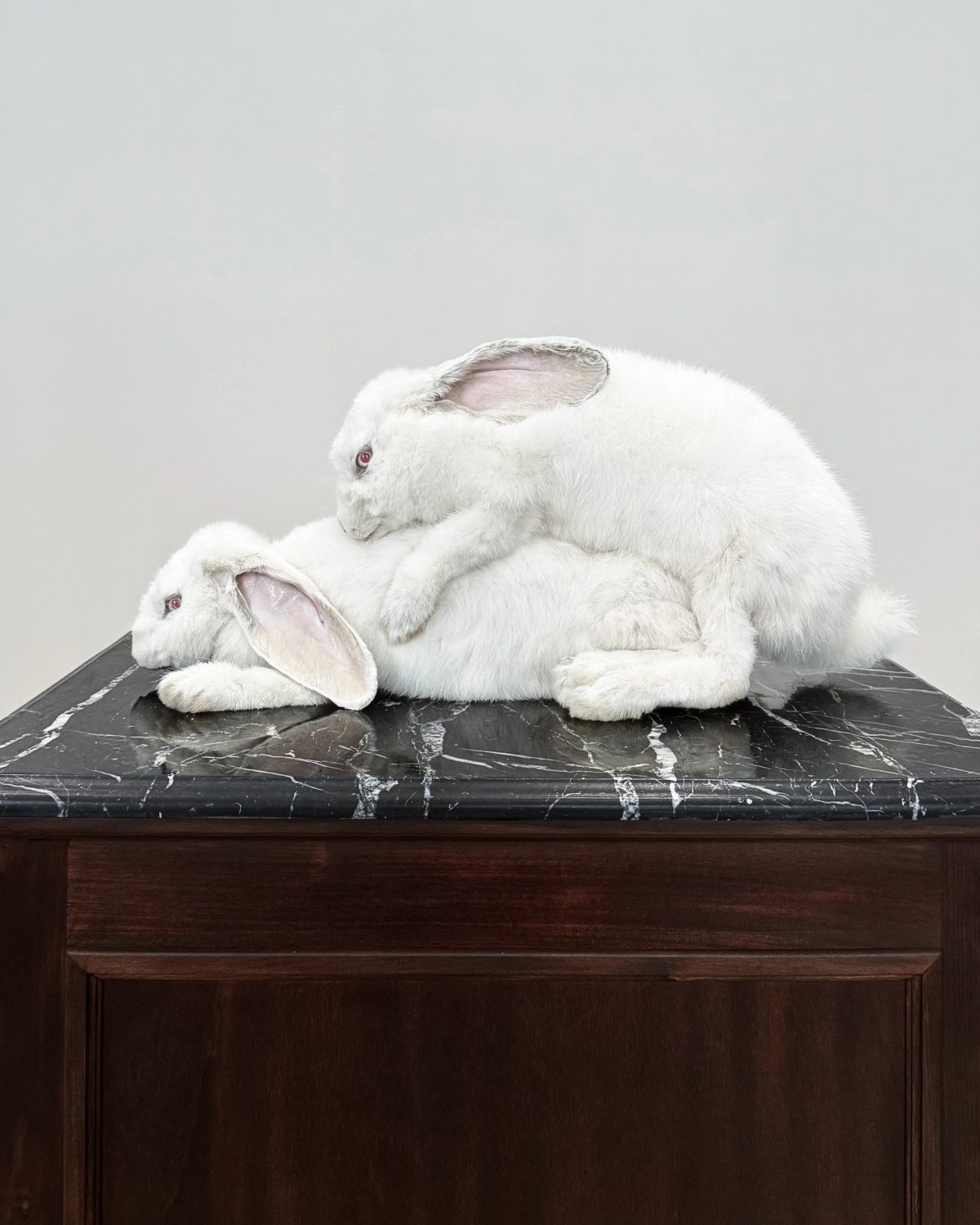
Tudor Ciurescu, L'Eterna Urgenza
Debord wrote Society of the Spectacle describing television. Now we have infinite scroll, algorithmic feeds, TikTok's loop. You've connected the movement of your motorised swing directly to the swipe gesture. Do you think Debord's diagnosis still holds, or has something fundamentally changed about how spectacle captures us?
I think we are no longer just viewers of the spectacle but active participants in it, like an MMORPG game. And post-2016, this game is a highly saturated, monochrome game.
The art market rewards legibility, a consistent visual identity, a story that fits in a press release, a medium collectors understand how to hang. Your practice moves across taxidermy, limestone carving, PLA printing, found objects, sensor-triggered installations, and acrylic painting. How do you think about that pressure, and do you feel it?
I totally feel it. It's a decision I've consciously made, having realised I might bleed in the short term due to my ADHD practice, which is very market-counterintuitive. I like to think long-term and to think of my practice as world-building. I'm confident it will be better than capitalising on some type of work from an early stage of my career. Blame finding out about Mike Kelley very early, haha.
But yes, I know it would've been a much easier path to capitalise on the first thing that brought me validation, but being a skateboarder in formation, I like to keep a fisheye vision and trust the bigger picture of my practice, and that everything I do is connected by an invisible wire.
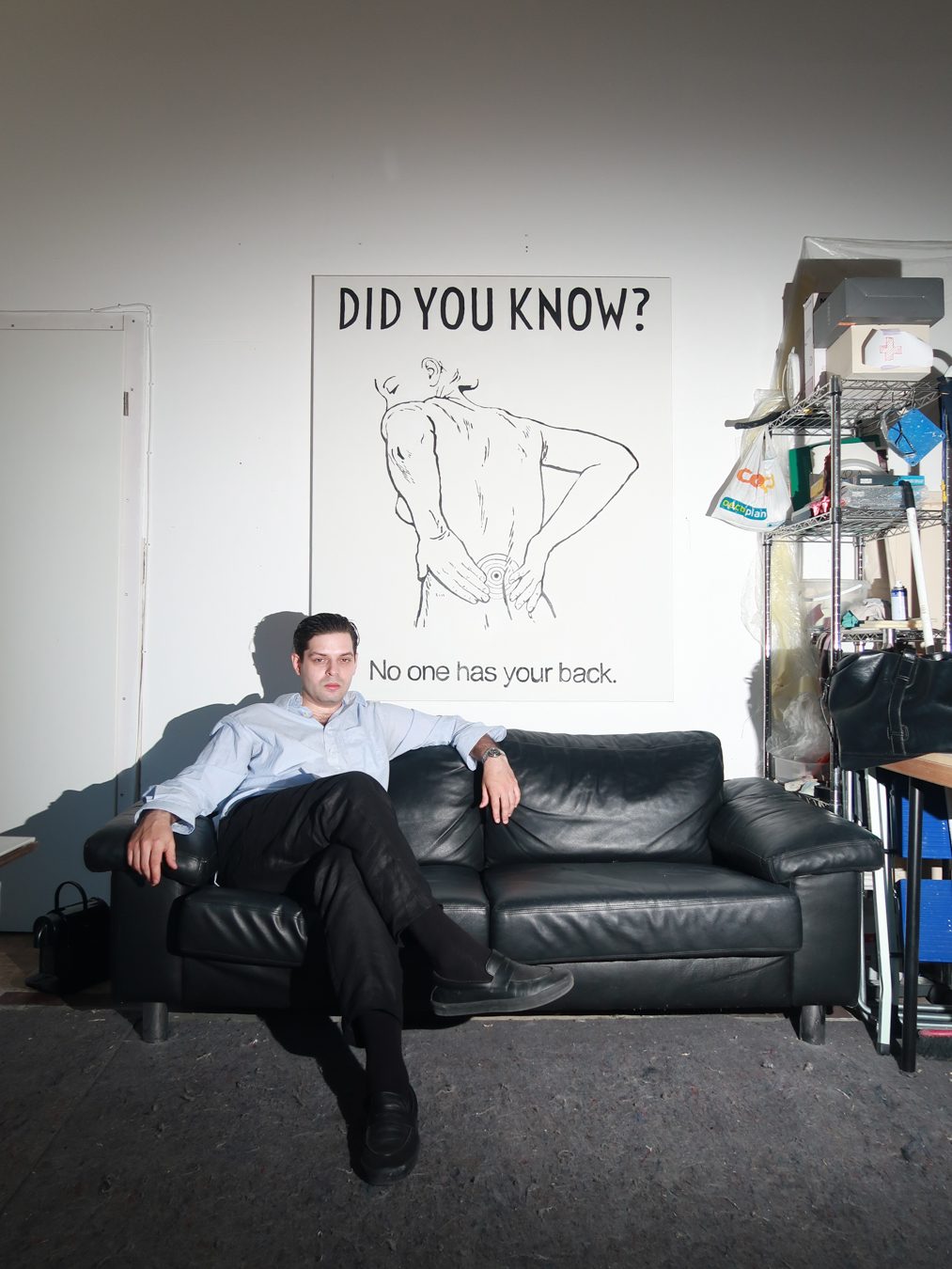
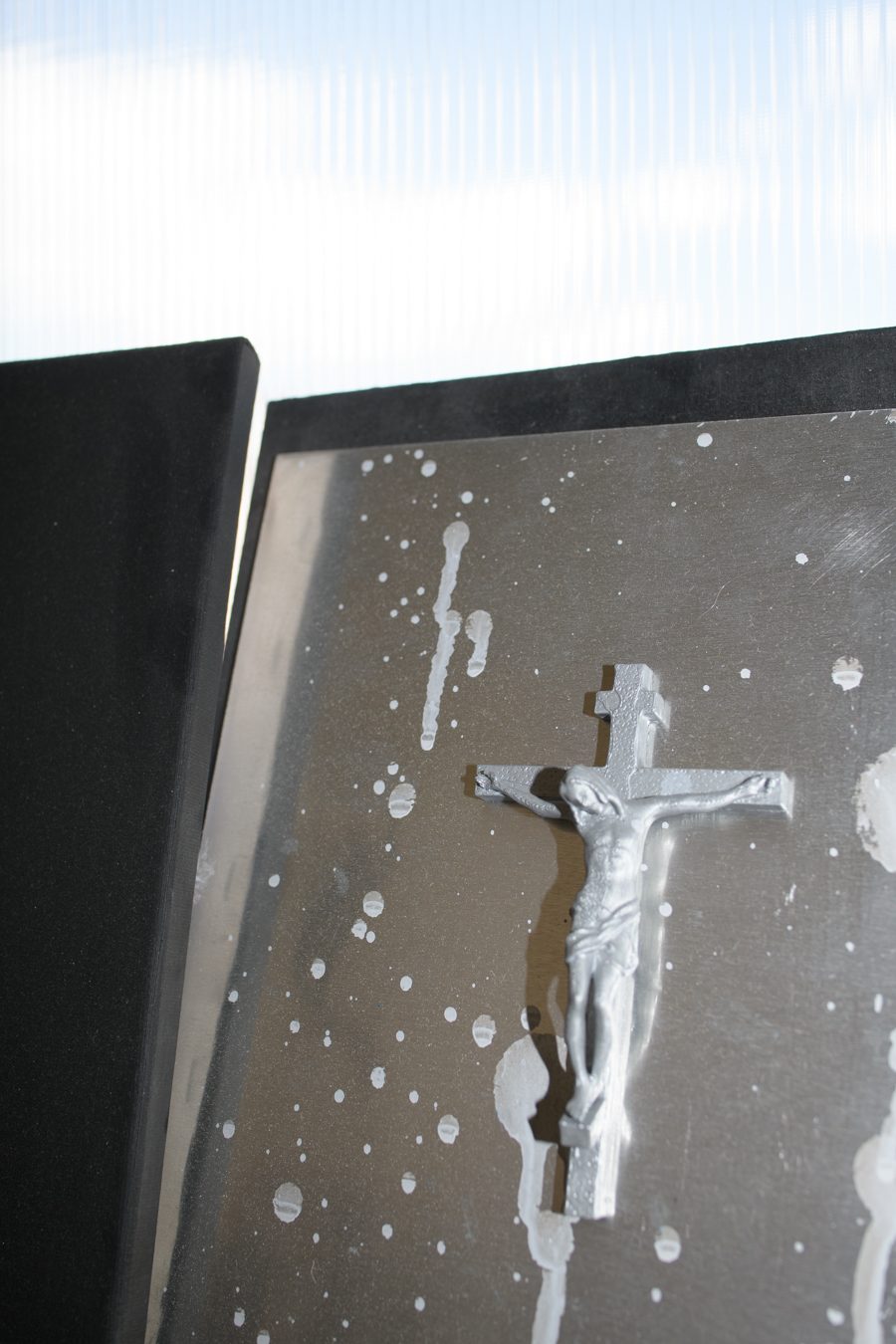
Tudor Ciurescu's studio. Photography by Cesar Axel Aguilar Rodriguez.
"You don't know whether the chair is about to fall or recover its balance, and that uncertainty is exactly where I wanted the work to exist."
PULCINELLA, a found chair tilted back on two legs, a pair of men's leather shoes balanced on its top, is named after the Commedia dell'arte clown, the one who plays the fool but always survives. You're 30, showing across Vienna, Berlin, Rotterdam, San Francisco, nominated for a sculpture prize, work in permanent collections. Does success at this pace feel like fuel, or is there something of Pulcinella in it, performing a precariousness that isn't quite real anymore?
I think any artist who has been at a dinner where they're the only artist in the room knows that feeling. You almost become the entertainer, the Pulcinella of the table. People expect you to perform a certain role, to be the eccentric one, the one with unusual answers. That tension has always fascinated me.
So yes, the work can be seen that way, the constant equilibrium the artist has to maintain.
More broadly, my works often function like screenshots from a film. You're only shown a single frame, while the frame before and the frame after exist in the viewer's imagination. PULCINELLA is one of those suspended moments. You don't know whether the chair is about to fall or recover its balance, and that uncertainty is exactly where I wanted the work to exist.
In that sense, I think the work is completed in the viewer's mind. The object stays the same, but each person brings their own experiences to it. During the opening, one visitor had a very strong emotional reaction because the precarious balance reminded him of a suicide he had experienced in his family. That was never the subject of the work, but it became part of his encounter with it. I find those moments fascinating. Once a work leaves the studio, it begins to accumulate meanings that belong as much to the viewer as they do to me.
Success is relative. I rarely experience it in the present because I'm already thinking about the next work. But if I could show my seventeen-year-old self where I am today after being told by a philosophy teacher that I wouldn't achieve anything in life, I think he'd be pleasantly surprised.
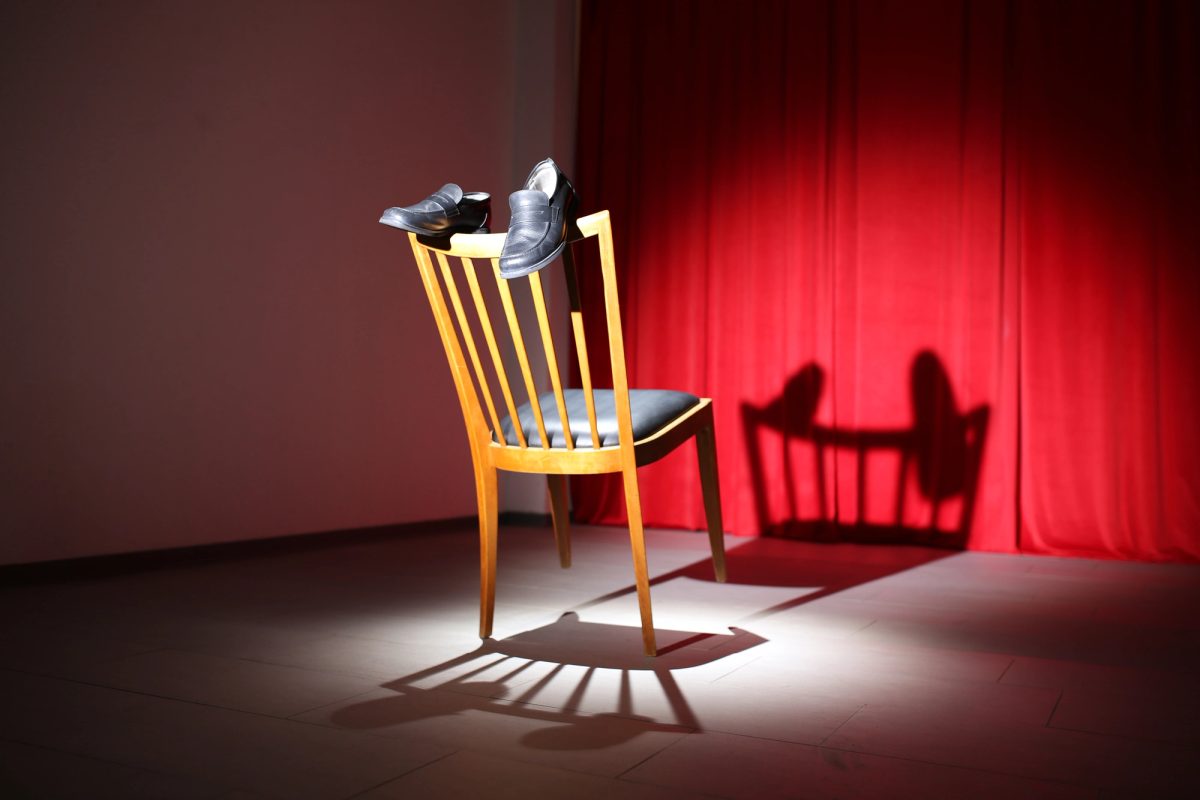
Tudor Ciurescu, PULCINELLA, Found chair, Helvenkso shoes, 2025
FOLLOW TUDOR CIURESCU ON INSTAGRAM AT @TVDOR
Cover Image: Tudor Ciurescu's studio. Photography by Cesar Axel Aguilar Rodriguez.