REALITY IS A SOFT MATERIAL, I RESHAPE AT WILL: IN CONVERSATION WITH IRIS YANG
CONVERSATION BY SELIN KIR
CO-FOUNDER, CURATOR
20 OCTOBER 2025 — UNITED KINGDOM
Iris Yang doesn’t design clothes, she constructs psychic architectures. Her work moves through silk, sound, and shadow to summon something between ritual and seduction, where fashion becomes possession and the body turns to myth. Within her world, emotion is sculpted, time dissolves, and reality bends, not as illusion, but as offering.

Your work seems to channel the occult, layered with theatrical darkness and symbolic weight. Can you tell us who you are, not just as a designer, but as someone who shapes worlds through silhouette, symbolism, and subculture How would you describe your current state, emotionally, physically, and in the space around you?
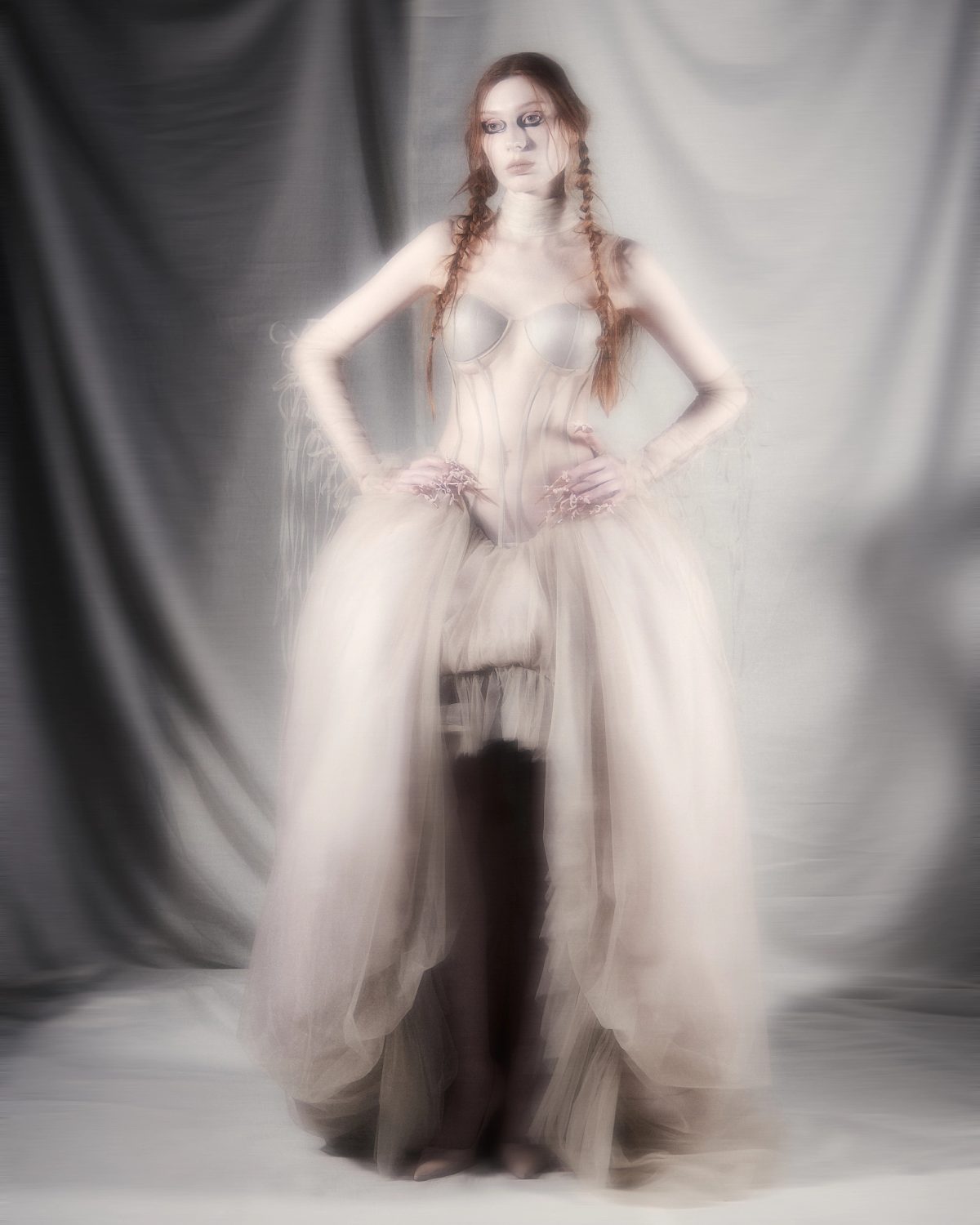
Fashion designe to me, is merely the threshold a point of entry into the architecture of my world. It does not exist alone. It breathes through the layering of styling, light, and sound, forming an immersive rite of passage. What I seek is not the immediacy of visual shock, but the slow erosion of perception A psychological seduction that draws the viewer, unwittingly, into a state I have meticulously constructed. A liminal field, where reality frays and sensation begins to drift.
My current state is unbound by linearity. Emotion, flesh, and space have long ceased to be discrete. I move between constructed visions and tangible surfaces, inhabiting a world shaped like a dream, suspended outside the logic of time and form. Reality is not a constraint, but a soft material I reshape at will a vessel for intrusion, possession, transformation.
I dismantle memory, fantasy, ache, and fixation. Then, with deliberate violence, I recompose them, dragging fragments out from the depths of sleep, forcing them into form. Through fabric, silhouette, and sound, I make them real. And then I demand the world look, until it can no longer look away.


Photos by Juan Chen
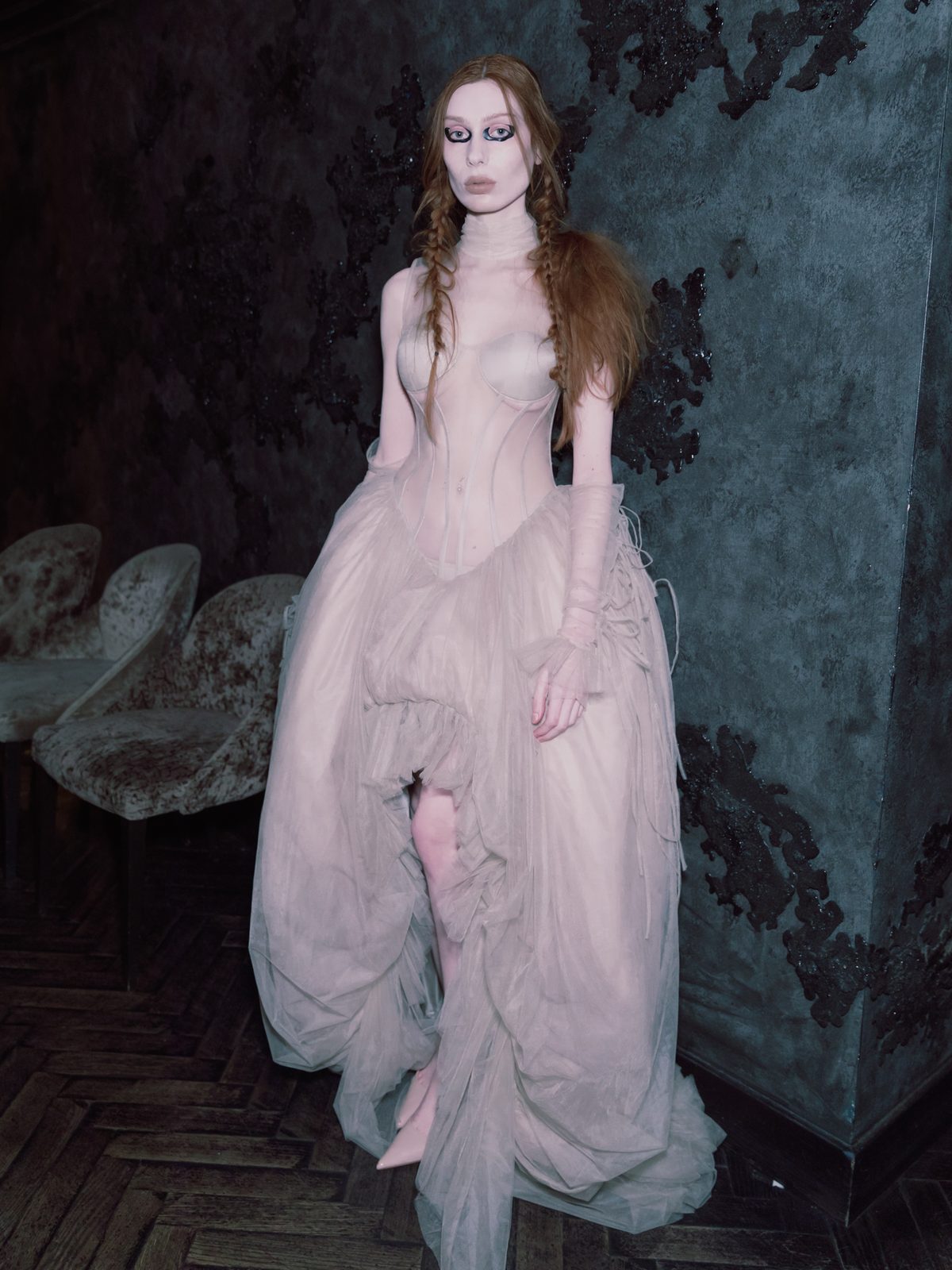
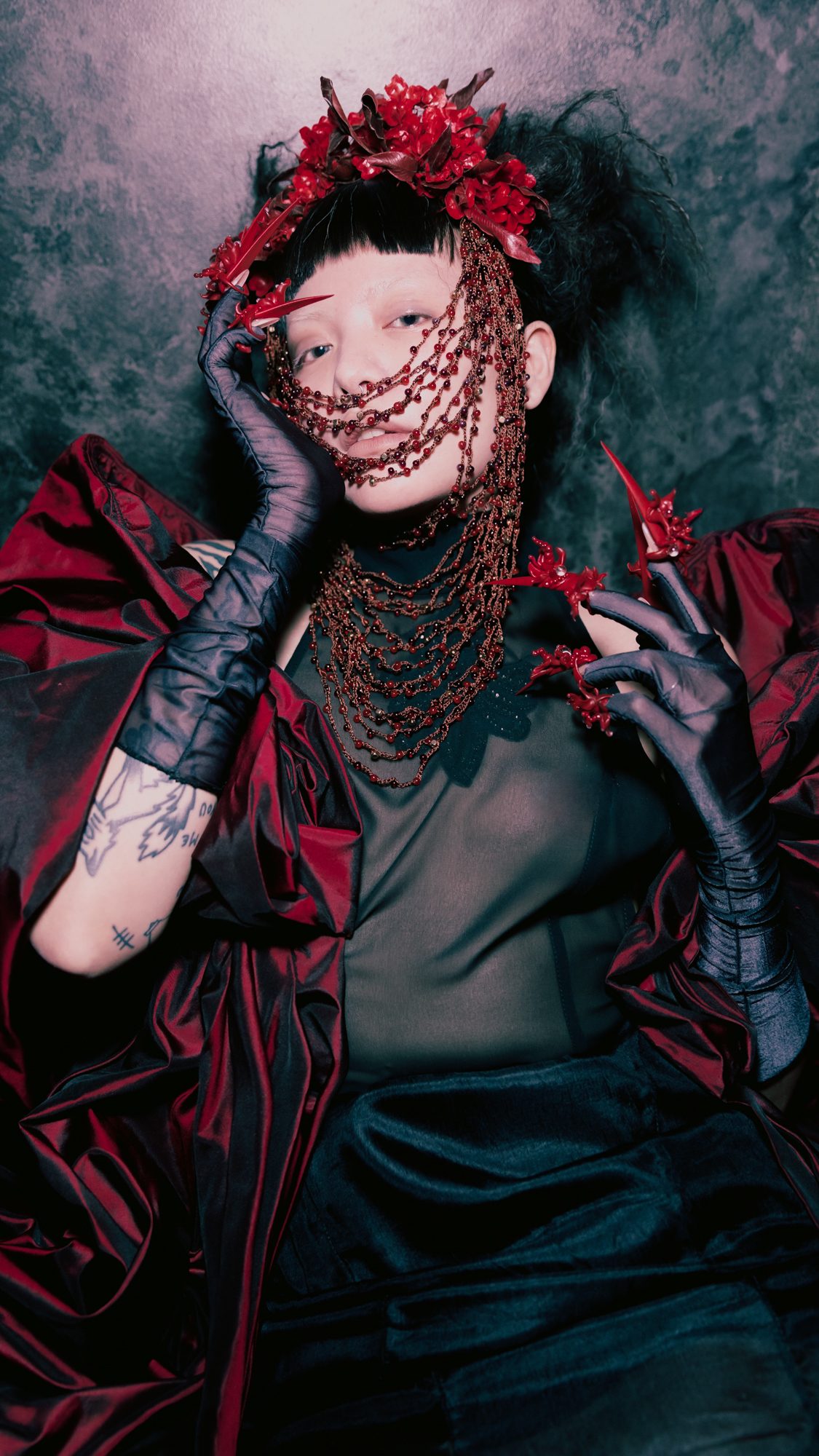
We had the opportunity to witness your most recent runway collection. A procession of spectral silhouettes, each figure moving like a vision summoned from another realm. Every element (garment, hair, nails, gesture) seemed meticulously executed, imbued with a sense of ritual. Could you speak to what you were conjuring with that body of work? What myths, obsessions, or emotional undercurrents were carried through its creation?
That season’s collection emerged from a quiet, persistent calling. I was summoned by Persephone. In myth, she descends into the underworld, becoming the force behind the turning of seasons. But what captivated me was not the tale itself, but the internal metamorphosis she endured: the slow, painful shift from passive sacrifice to sovereign of her own fate. This was never just a myth to me; it was an obsession that echoed through the architecture of my psyche.
Through her, I spoke of my own entanglements, with loss of control, with desire, with resistance and the illusion of choice. Persephone is both: the girl who longs to be rescued, and the goddess who learns to embrace the darkness. I stretched this duality to its furthest tension between pure white and blood red, between restraint and dominance, softness and steel. These were not oppositions, but mirrored reflections, expressions of the war quietly unfolding within.
Emotion, in this body of work, was never still. It simmered beneath the surface, grief that burned slowly, a rage without language, an intimacy with death that refused to be exorcised. I used silk in all its variations to reconstruct this blurred emotional terrain: fragile, translucent, enveloping, yet capable of becoming armor. Every cut was a reopened wound. Every silhouette, a silent invocation, an act of resistance dressed in devotion.

“What I seek is not the immediacy of visual shock, but the slow erosion of perception, a psychological seduction that draws the viewer into a state I’ve meticulously constructed.”
Photos by No One Studio
Is there a fabric or material you keep returning to? What does it hold for you, and what does it allow you to express that others cannot?
Silk is the material I return to most often in my work. It possesses a near-spiritual quality able to hold emotional subtleties that other fabrics simply cannot contain. With variations in weave, density, and tension, silk transforms entirely: it can be light as mist or sharp as a blade. Each shift becomes a kind of lang
What draws me to silk is its deep intimacy with the skin. It doesn’t merely rest on the body, it fuses with it. The boundary between garment and wearer dissolves, turning into resonance. Unlike materials that attempt to shape or control the form, silk listens. It responds, quietly, perceptively to the temperature, humidity, movement, and posture of the one wearing it. It registers presence. And in doing so, it reveals the uniqueness of the wearer, the same garment is never the same on two bodies.
I don’t wish to master silk; I conspire with it. Each garment finds its true form only once it is worn. Silk allows me to translate what cannot be seen: emotion, inner tension, psychological contradictions into something tangible. It resists uniformity and insists on individuality. That quality, to me, is irreplaceable.
“Reality is not a constraint, but a soft material I reshape at will, a vessel for intrusion, possession, transformation."


Can you speak to what your making process looks like? Its rhythm, its mess, its rituals? How does an idea move through you, and into form?
The creative process often begins from a place of intuitive exchange, conversations with witch-like companions, where energy flows freely and the boundary between thought and spirit blurs. Inspiration arrives quietly, like a spell cast mid-sentence. What follows is a phase of fragmentation: psychological disarray mirrored by physical restlessness. Symbols, feelings, and images surge forth, demanding to be captured.
Every element is written down without judgment, raw, instinctive. Research follows, digging into the histories, meanings, and visual roots behind each symbol. Paintings often serve as the visual compass, especially those steeped in mysticism, sacred narratives, or psychological density. These works haunt the imagination, slowly distilling into something that seeks form.
Fabric becomes the next medium of translation. Through draping and structural exploration, thoughts begin to inhabit space. Silk, tension, transparency, weight. all selected to echo the emotional terrain. Yet the garment is never the final destination. It is simply the beginning of a larger world: one inhabited by characters, moods, and constructed realities.
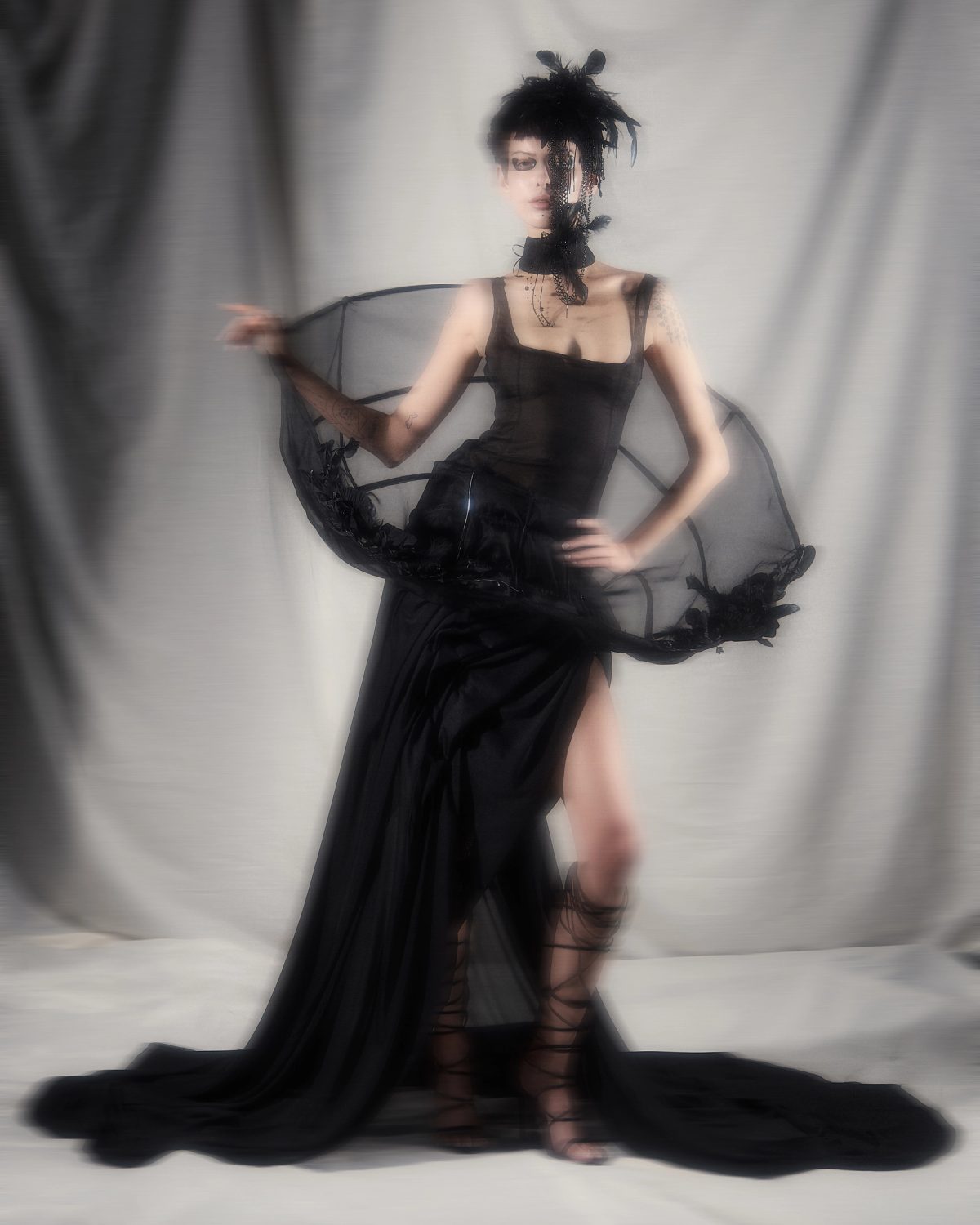
Styling and makeup function as extensions of this architecture. Not decoration, but transformation giving form to the spirits embedded within the garment. At times, these creations step into the night, entering gothic clubs not as performance, but as ritual embodiment. In those spaces, gazes, movement, and atmosphere become part of the work itself. Creation continues beyond the studio, shaped in real time by presence, perception, and the friction between the imagined and the lived.

Photo by Ned Robinson Jones

Photo by Ned Robinson Jones
Creative spaces are charged with objects, energies, and habits that tether us to making. What does your studio or workspace look like? What surrounds you? Habits, sounds, objects, or shadows?
It is a sanctuary for the psyche, a place where both gaze and detachment toward the world are quietly held. The room is filled with carefully chosen objects: paintings, flowers, perfume bottles, and an abundance of crystals and minerals. Nothing is placed without intention. Each item hums with silent resonance, forming an invisible map of energies that shift with time and presence.
A cat, entrusted temporarily by a friend, lives here as well. Quiet and affectionate, it greets every visitor with a gentle ease, offering a kind of social warmth that quietly compensates for a certain discomfort with human interaction. Its presence softens the space, becoming an unspoken extension of what words or gestures often fail to convey.
Along the walls hang unfinished prototypes, failed garments, fractured accessories. These pieces are not discarded, but preserved as echoes, carriers of memory, of unresolved gestures. They often return, subtly guiding the next act of creation.
Night is when the space comes fully alive. In the absence of sound, thought becomes sharpened, deliberate. Music is rarely played. Silence allows the inner frequencies to surface, those unnamed, intuitive signals that pulse beneath language. In that quiet, work begins not as labor, but as invocation.

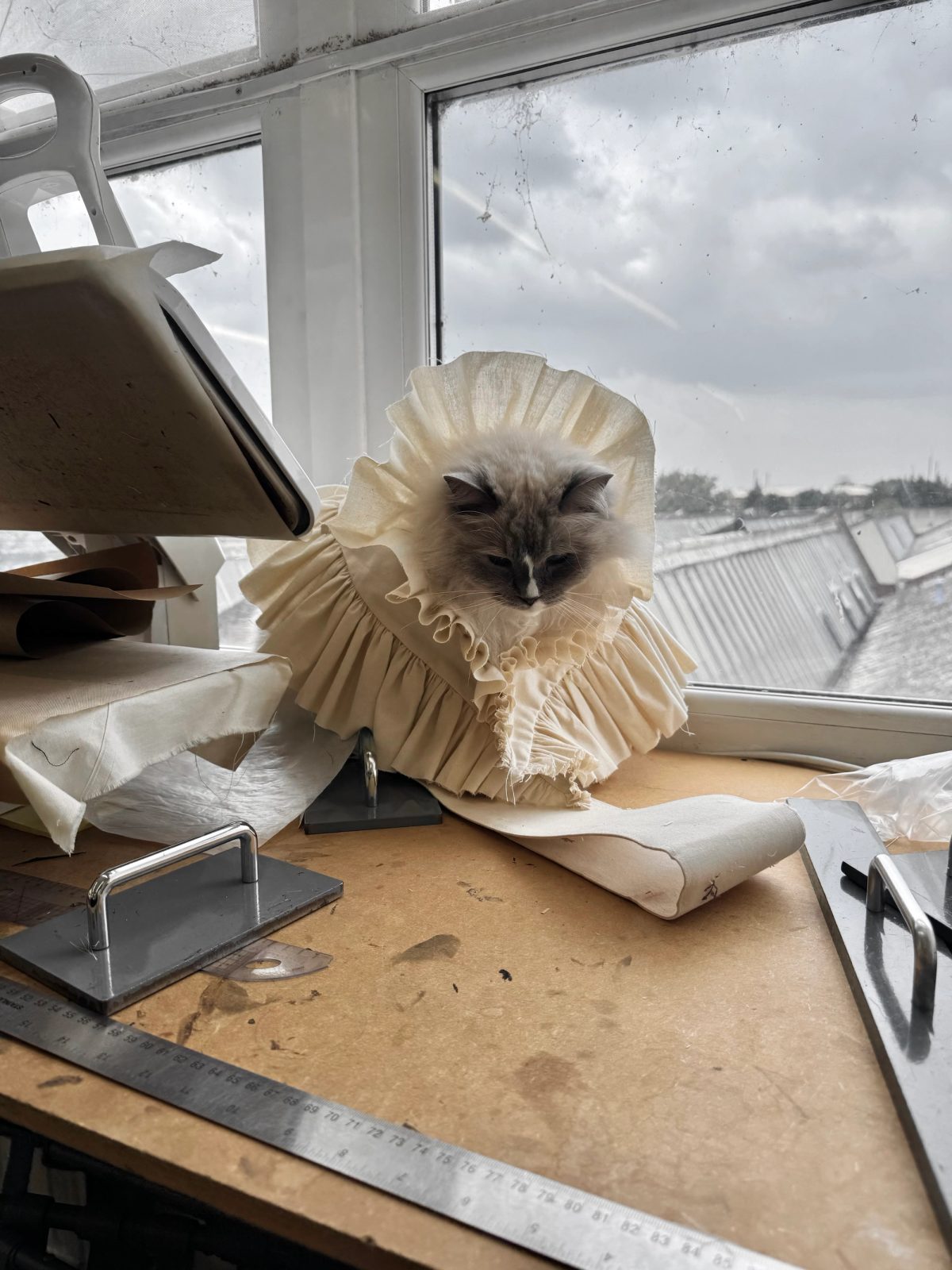

From Iris' Studio
Fashion as an industry often moves at a brutal pace, driven by cycles, expectations, and spectacle. How do you navigate that structure, resist it, reshape it, or move through it on your own terms? Has living and creating in London altered your relationship to the industry, or to your work itself?
I refuse to become a cog in the system. The rhythm, the mechanisms, the expectations, these invisible structures compress creation into something predictable and obedient. I choose to walk alongside them, not in opposition, but in deviation. I don’t reject visibility, but I decide when and how to speak. For instance, I didn’t apply for an official slot at London Fashion Week. Instead, I turned to the tool I trust most - tarot - to choose the moment of unveiling. It’s not rebellion; it’s refusing to live by someone else’s timeline.
The fact that I’m able to continue creating at all is thanks to a circle of people who understand and support what I do. Their presence gives me the space to move at my own pace, to protect the essence of what this work means.
London is a city of extremes. On one side, it offers artistic liberation, space for the radical, the nonlinear, the unclassifiable. On the other, it remains deeply entangled in systems of commerce, in the heavy machinery of the fashion industry. I live in the tension between those two poles, learning to navigate it, to use it. Not by escaping or surrendering, but by building a black box of my own in the space between.


Photos by Juan Chen
“I don’t wish to master silk. I conspire with it.”
Some things in a practice resist language. They remain intuitive, felt, or feral. What part of your work defies explanation? What remains unspeakable, yet central?
I never explain the silence within my work. It is the part that language cannot reach. Each garment holds something that can only be understood through proximity, through wearing, through being enveloped by it. It resists articulation. It lives in sensation, in the quiet dialogue between fabric and skin.
In today’s fashion landscape, dominated by minimalism and commercial clarity, I choose to hold onto something more elusive, designs that are exaggerated, dreamlike, and laced with narrative. Not as a stylistic choice, but as a conviction. What matters most is not just the fabric or silhouette, but the presence of story within each look. Each piece carries with it a sense of tension, of myth, of an incomplete dream, fragments of something unsaid, unresolved, yet undeniably present.
If clothing exists only as product, its life ends the moment it is sold. But if it functions as an entry point into story, as a tool for ritual, as a symbol waiting to be deciphered, it continues to live ,within the wearer, within the observer, within the subconscious. That unspeakable presence, that unnamed force, is the element I protect most fiercely in my work.
What’s currently on your mind or on your table? Any projects, pieces, or ideas you’re spending time with lately?
A recent concept unfolding in my mind is a kind of boundary experiment, an immersive installation that exists somewhere between a runway show and an exhibition. It is not a traditional fashion presentation, nor is it simply an art space. It is a world-building system designed to be passed through. The space itself will take the form of a multidimensional structure. Visitors won’t be entering a “venue,” but rather a projection of my internal cosmos.
This work will include sound and music I compose myself, functioning as a system of sensory control. Sound becomes a passageway, guiding the viewer, often unconsciously, into a state that I have orchestrated. The garments will interact with the installation, light, and scent to form a complete synesthetic environment. The viewer will no longer remain a passive observer, but become a participant, physically and emotionally implicated, or even the one being observed, watched by the space, recorded by the system, governed by emotional architecture.
What I intend is the dissolution of the fashion show format, a collapse of its linear structure of “beginning to end.” Instead, it becomes a psychic web, elastic and entrapping. This is not a display of garments, but the creation of a ritual field, a form of visual and psychological infiltration. Each look no longer exists solely to be seen, but carries its own atmosphere, its own self-awareness, its own agency.
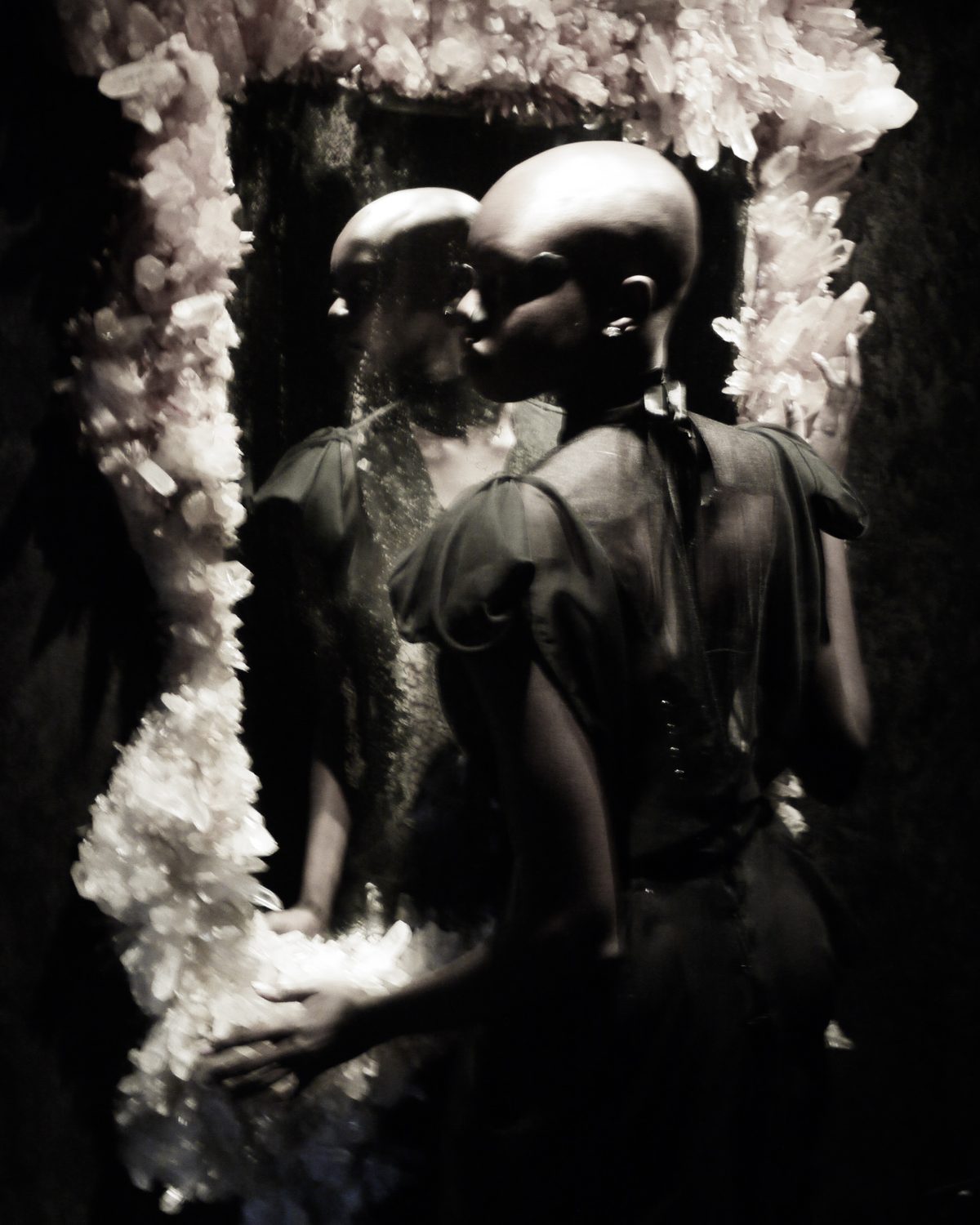
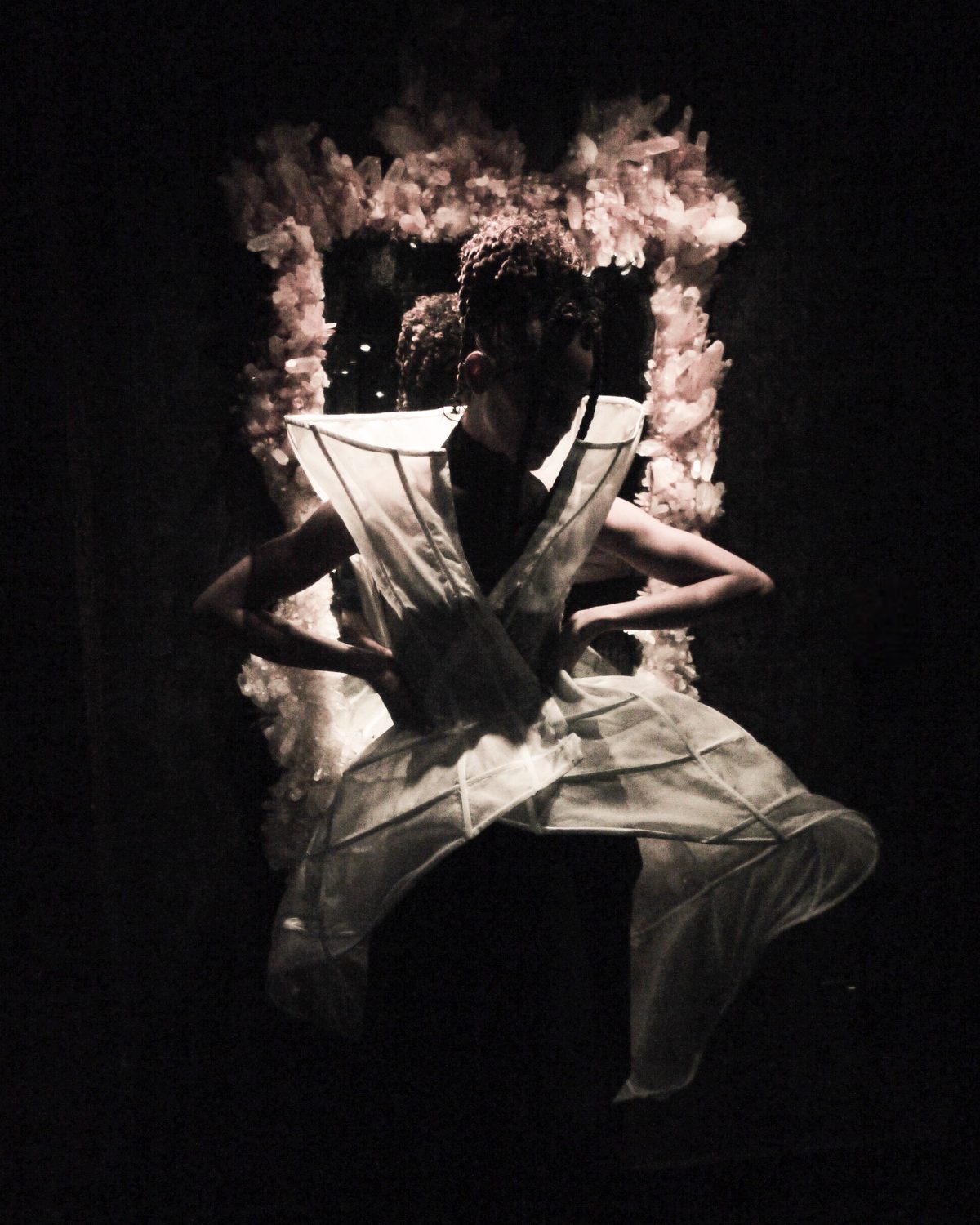
Photo from Saul Rapley
CREDITS:
Creative Director: Iris Yang @iris.yang329
Creative Assistants: Jac Lee @jaclee233 / Aiko @aiko_moemoe Sylvia/ @icantfeel21
Stylist Nini Barbakadze: @_nini_barbakadze_
Stylist Assistant: Phoebe Steen
Key MUA: Bea Sloss @bea.sloss
Key Hair Takumi Horiwaki @taku_hair
Movement Director Maji Claire @majiclaire
Videographer Anna Niamh Patterson: @annaniamhpatterson
NAILS Shyn @shynwenharn
Headpiece Luna @myphalaenopsis