QALB IS TYPING…
ESSAY BY LYDIA GRACE
EDITOR
22 SEPTEMBER 2026 — PARIS, FRANCE
The sign reads:
Polyphonie *0 ouverture @ Motto books’ residency, Ofr, 6 rue des filles du calvaire, 75003
Exhibition/ Gathering
Words, postcards, surprises
[Poetry and wandering WORKSHOP 4pm, Drinks and music 6pm]
I meet Tara at a bookstore opposite the restaurant she works at. It is funny how opportunities corner us: as though each is a butterfly whose wings carry it in the wind. We meet through mutual friends. It’s how we all meet here in Paris, and in all of these sorts of cities like London and Paris and Berlin and all the centres of the world where the butterflies and birds flock to in search of flight. Tara is no flightless creature, I come to learn.
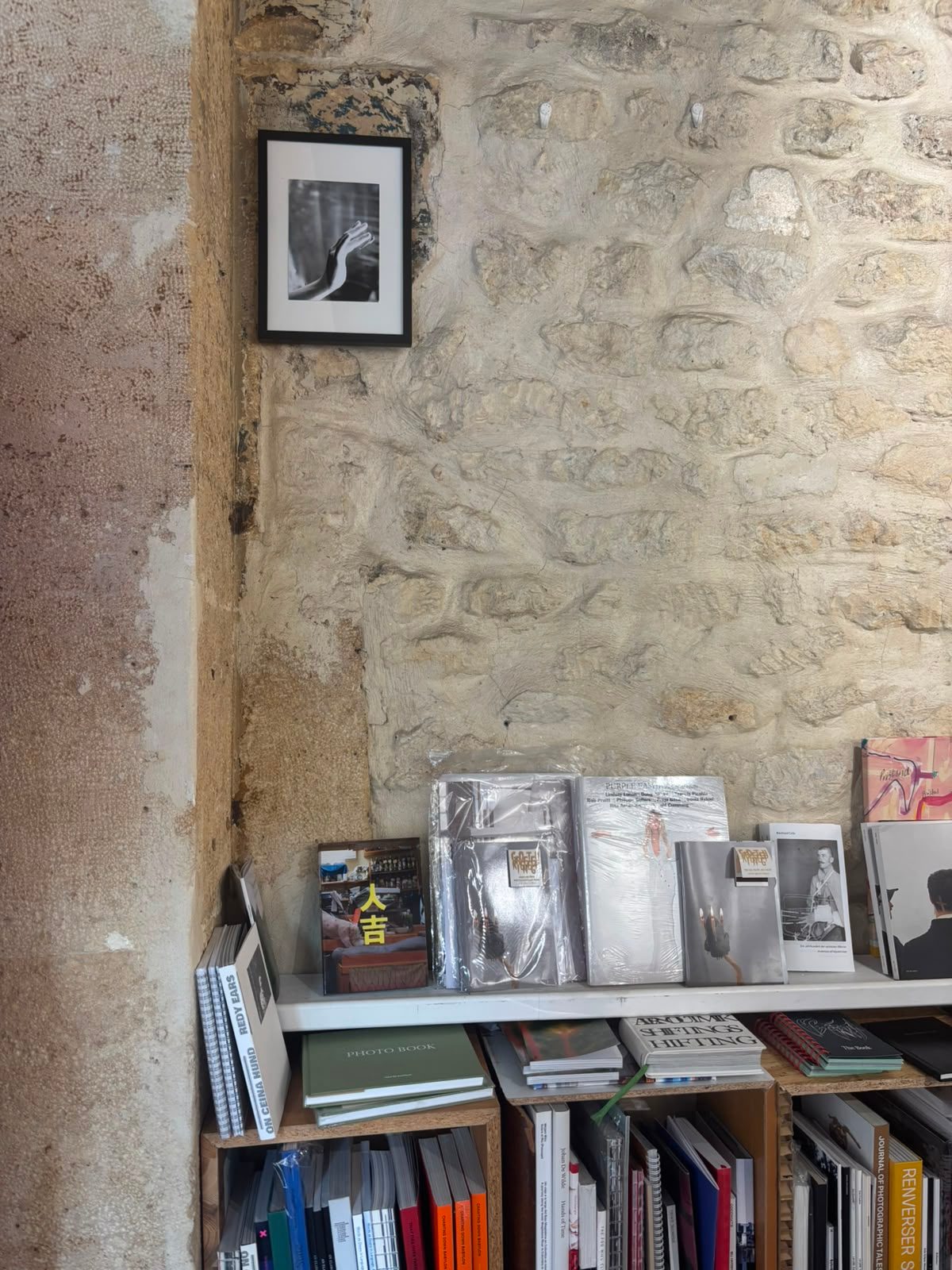
She is exhibiting her work at Motto bookstore. Her wandering fragments of what could be described as a sort of kinetic poetry are strung up across the walls and between the piles of magazines stacked up inside wooden storage crates. The interactive nature with which Motto displays artist exhibitions lends itself effortlessly to the interactive intention behind Tara’s poetry. All of this is so – fluid. The owner of the bookstore is playing a red and pink Master : Myrram cassette by Nazlo Records, and later Tara gets up behind the stereo propped on another wooden crate to mix her music. When I have the chance to ask Tara about the interactions between her music and her poetry, she asks me to treat them separately. I imagine the layered dimensions of different mediums stacking atop one another – rather like the crates in the bookstore. This exhibition feels as though it has a symbiosis with the space it inhabits: the two run in parallel, but not in any vulgar encroaching parasite-eating host way. The strands feel seamless.
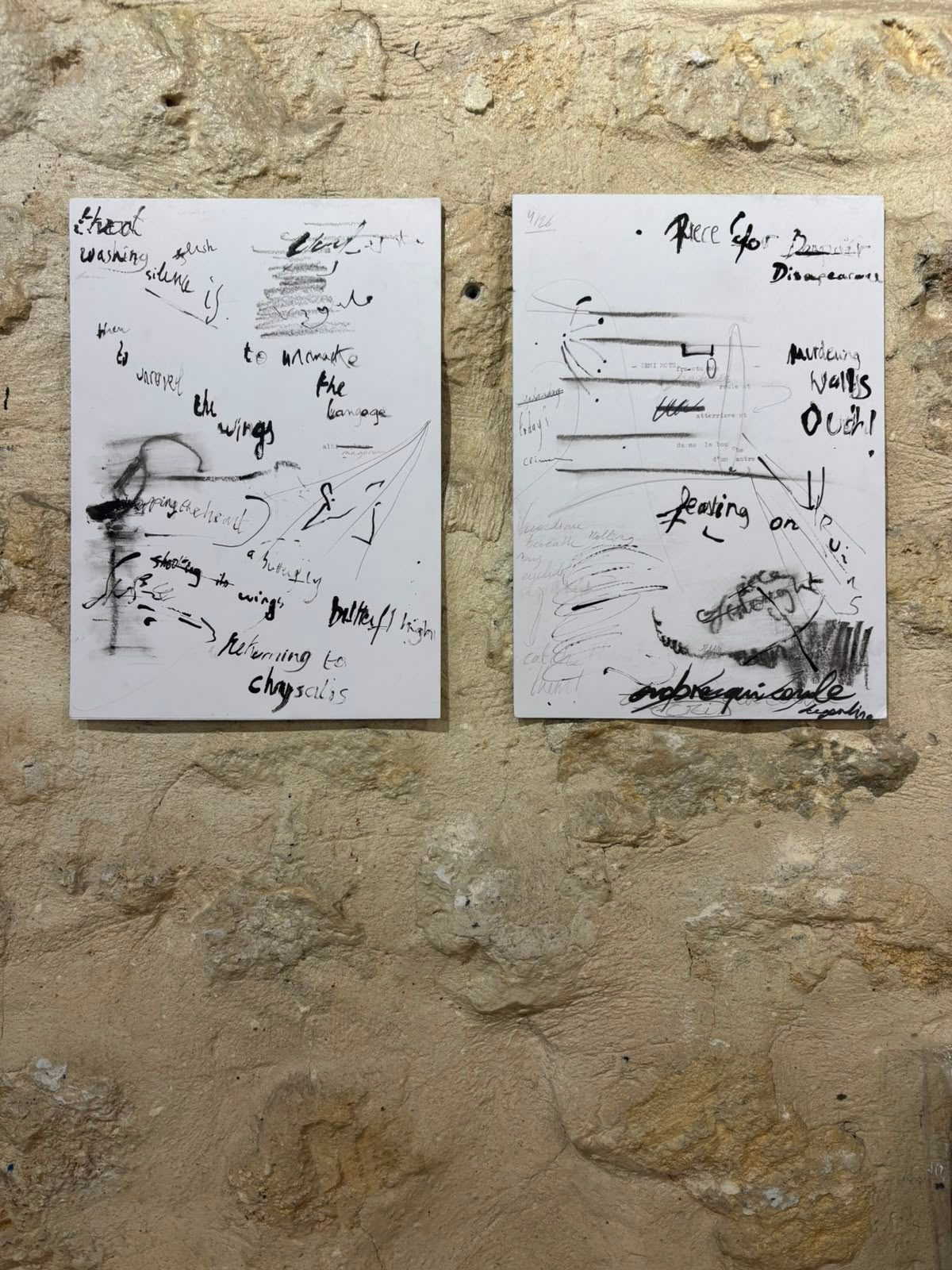
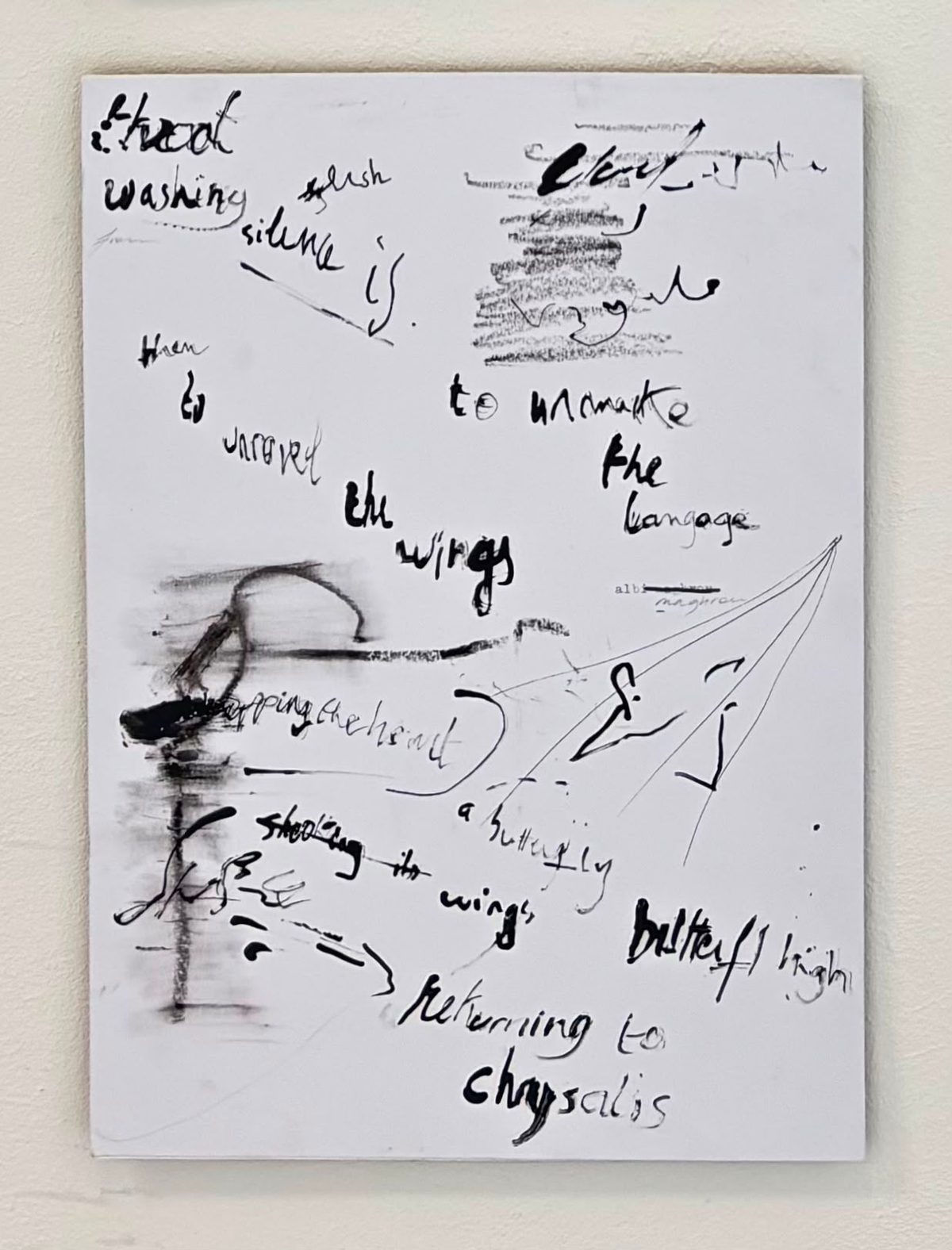
Left: Tara Sammouri Ajami, Meeting wings, 2024
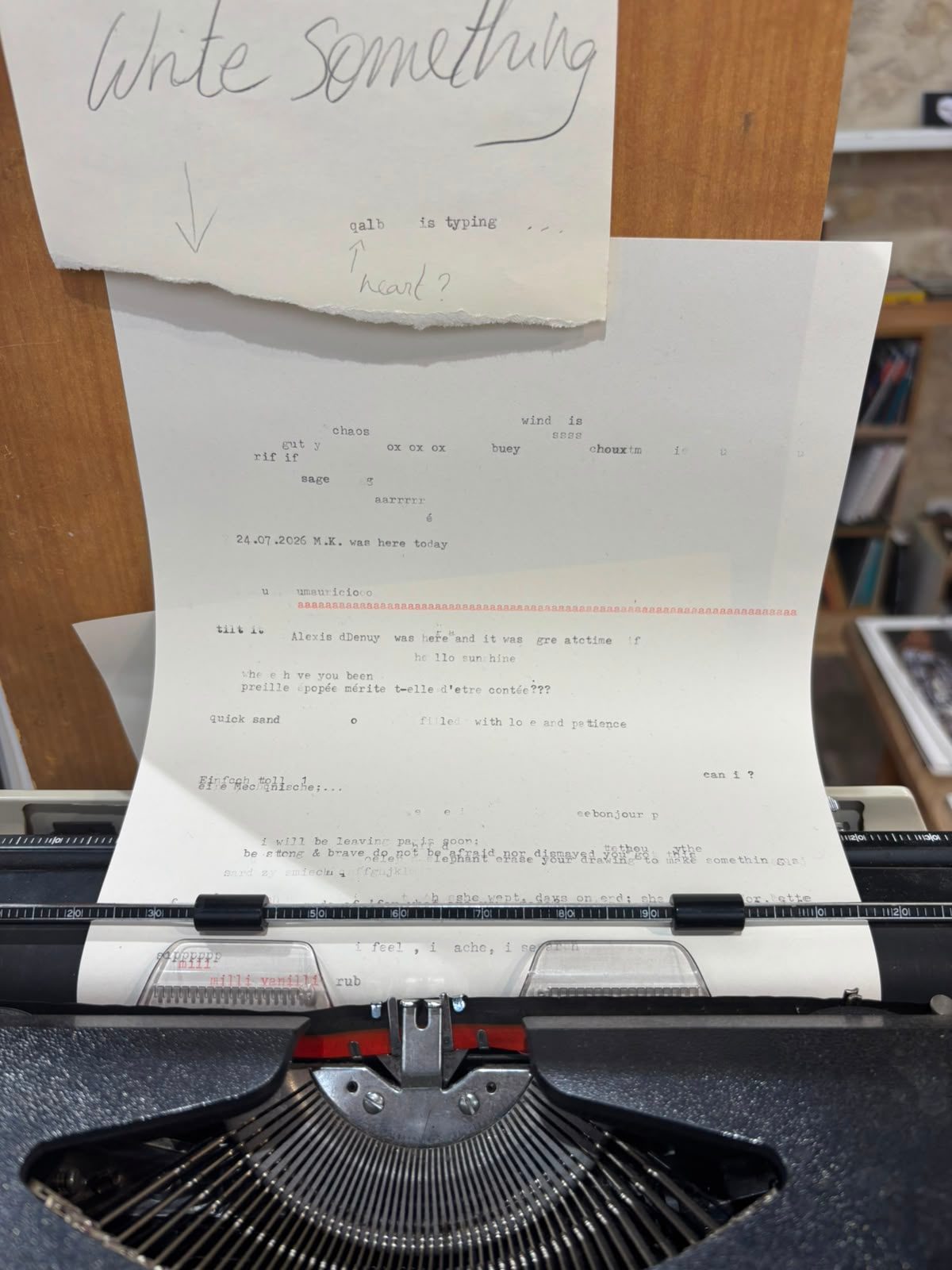
There is a typewriter sitting atop one of the crates of books, which slowly fills with abandoned lines from the people who visit her work during the days Motto are displaying it. This prop serves as the walls of a bathroom stall, where anonymous authors may pluck away at strings and leave the trailing ends to be picked up by whoever is looking to find a thread. We are all weavers – writers. I don’t think we need to call ourselves writers to have this claim. This is something Tara encourages through her work; at the end of the summer, we meet again for coffee. Before I leave, she pulls out a notepad and asks me to draw a line with an interchangeable point de départ and point d’arrivée. She tells me she wants to take Qalb is typing… a step further, and – consistent with the way she embodies her art – trace the route I sketch on her bike. Tara redefines what can be turned into play.
After sitting beneath a photograph of a stone and pulling at various threads of her work during the exhibition, Tara and I set a date in our calendars to discuss her creative practice further. We meet two weeks later, still in the heat of la canicule, at a bar which has become a second home of sorts, between poetry nights and drawing dialogues and discussions with artists such as Tara. There is a man playing guitar on one of the bar stools, half of which wooden, half of which have red leather circular cushions slotted within the ring of wood, all of which are rickety. He’s playing melodies over the DJ radio station playing behind the bar, and I am taken back to Tara mixing on top of her poetry exhibits. Everything is cyclical if you meet the right people – and the right people who make you look. I order an allongé and start scrawling some questions to ask about her work. Why are the butterflies returning to the chrysalis? Is this some form of un-birthing? Can one un-birth themselves? I try not to project my own thoughts on existence and births onto her work. It feels counter to her free-spirited intentions.
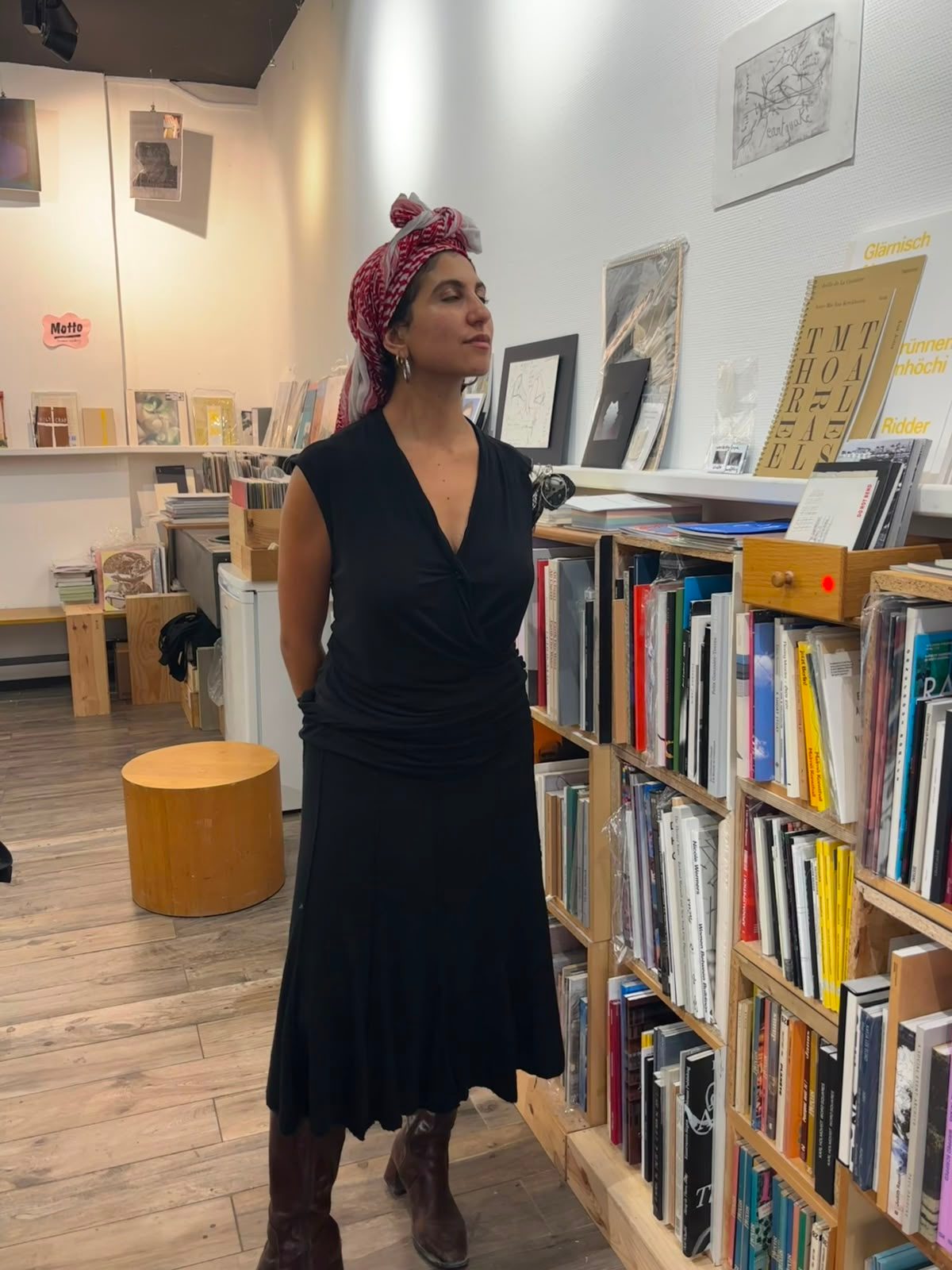
Tara interrupts me with a gentle tap on the shoulder. She is wearing her butterfly pin as though part of her creative uniform. I wonder if this is a conscious choice whilst her work is on display at Motto. Tara embodies her art in such a way. I wonder what the artist’s uniform is; I think we all have one in a way. At the exhibition, the bookseller beckoned her over to discuss her art as I studied the works on the walls between the books on the shelves, trying to decipher what precisely the photograph of stones was. I had initially postulated tree bark, as I traced the concentric lines, one inside the next, with my eyes. By design or happy accident, the first thing I noticed was this flapping butterfly sitting between her dark curls, as she came over and we both looked up at the piece, smiling and exchanging interpretations of the lines and dots. Perhaps it is the viewer who dresses the artist in their creative uniform.
Today, she is wearing it on the side of her top. She tells me she made it from a curtain, and I study the wire bent around in the shape of the wings, with black sheer fabric filling the spaces, and glass beads making up the insect body. It suits her.
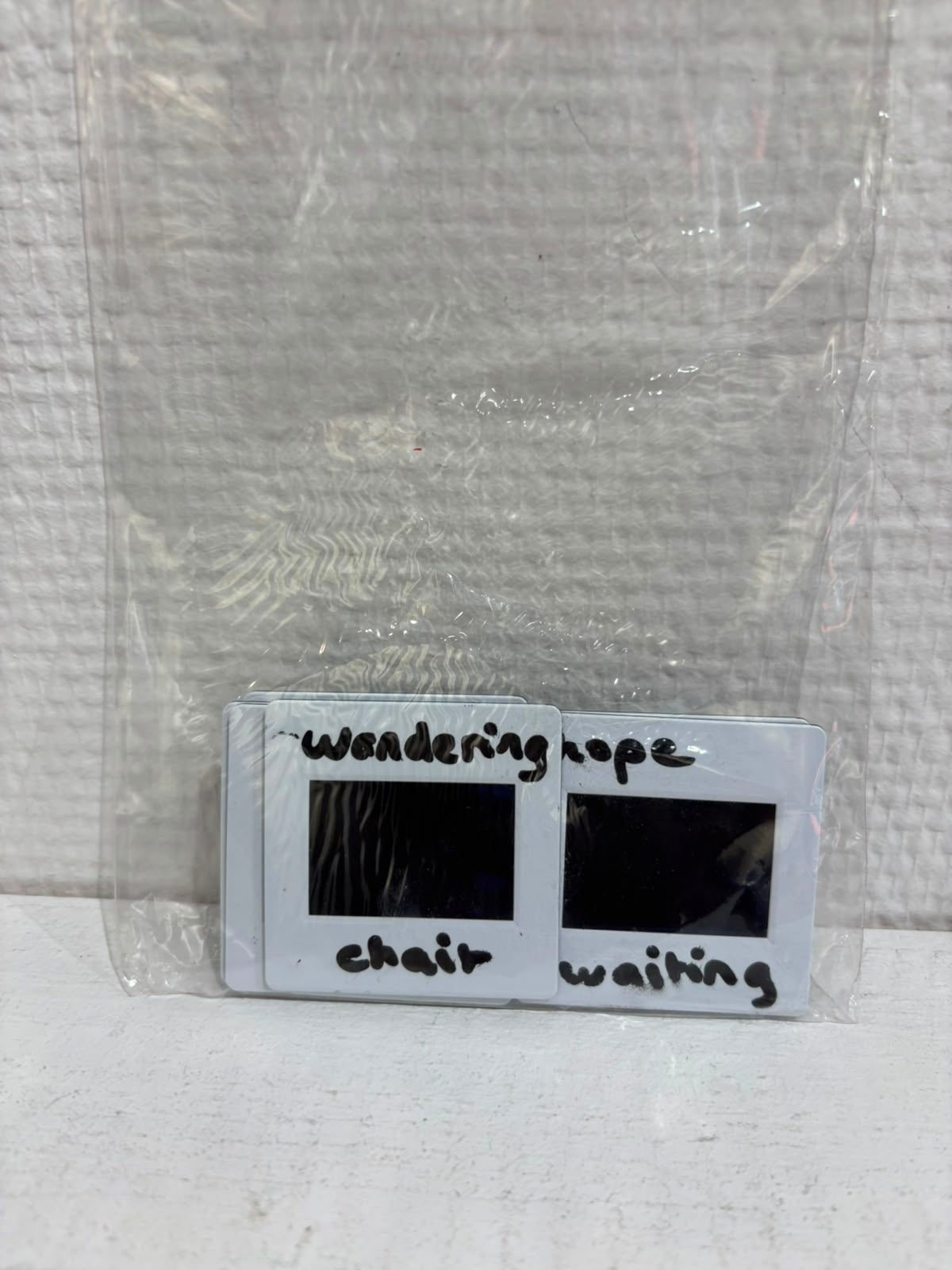
I tell Tara not to prepare anything; the discussion we initially had at Motto felt liberated and I wanted to re-create it, despite knowing that serendipity is not something one can go searching for. Serendipity is one of the words Tara has slashed in her pieces, ironically or not. Tara speaks about her creative process as something which involves collecting things. I tell her about magpies; how they collect shiny things like metal and jewellery. It is interesting that humans have been constructing jewellery to adorn their bodies with for many years, and not solely out of decoration. I wonder what attracts the magpie to things which glint in the sunlight. A lot of Tara’s creative practice mimics the activity of a magpie – collecting shiny items to bring back to the nest. I wonder whether these objects are conscious in their allowing of themselves to shimmer in the sun. Hearing Tara speak of her artistic process for Qalb is typing…, I feel as though I am taking flight with her and collecting clues to her work. None of the answers we arrive at are right or wrong, and she encourages me to reconstruct the language she has deconstructed, as though she has invited me over for dinner and opened the fridge door to a selection of peculiar ingredients, up to me to turn into a meal for us to share. A communion of sorts.
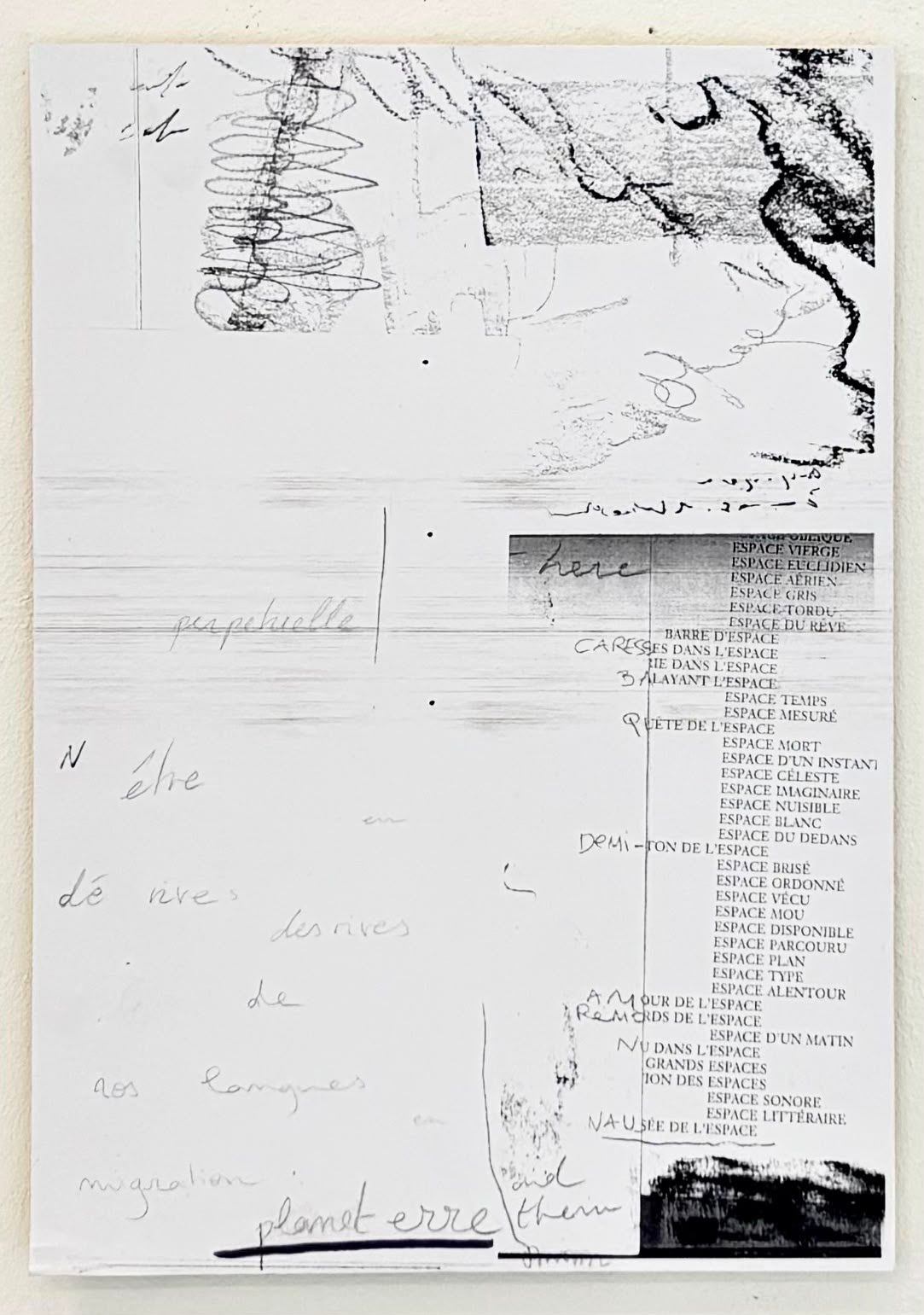
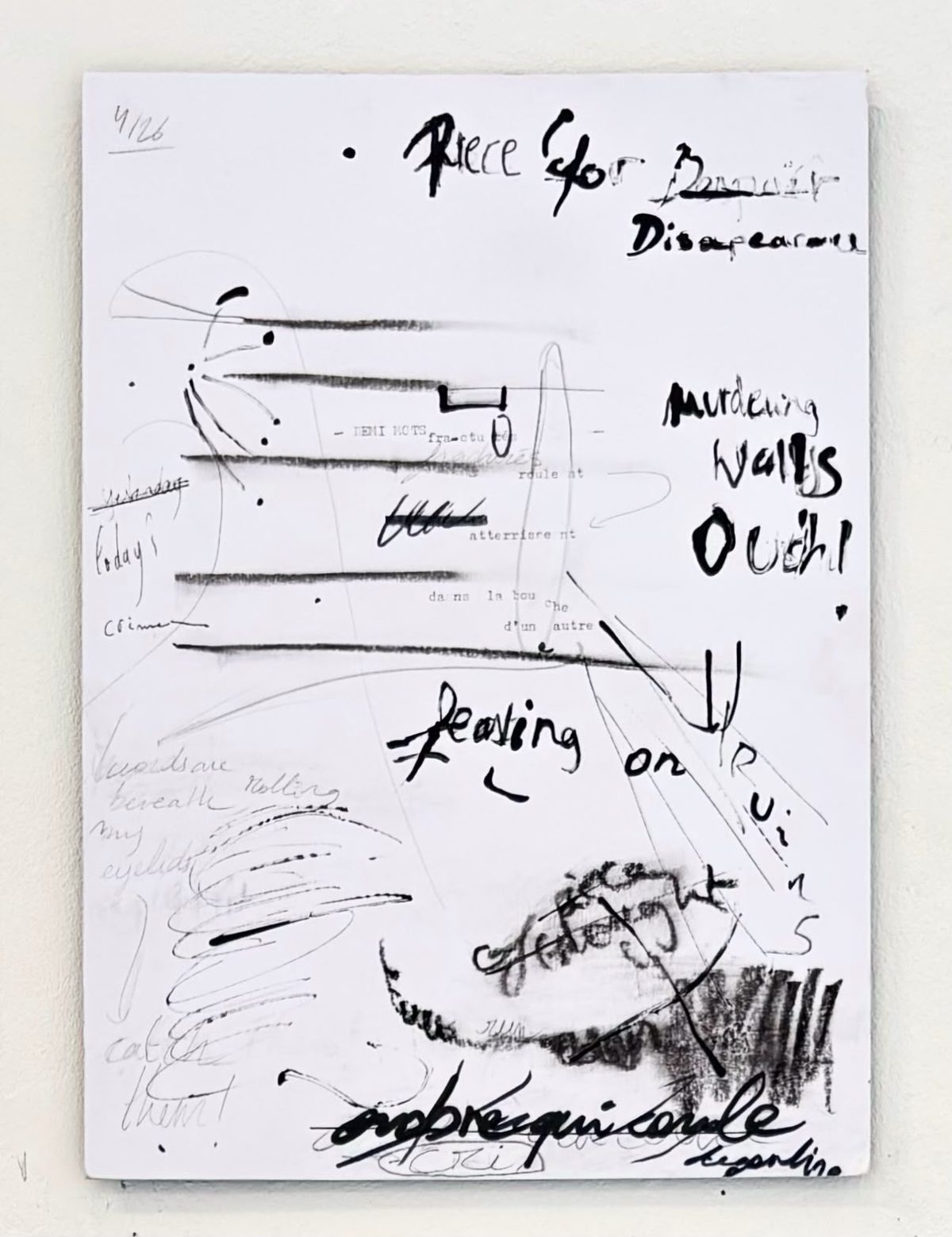
Tara Sammouri Ajami, Pieces for wander or despair (I, II, III), 2026
WANDERING IS POLITICAL
We discuss that wandering is ultimately political. I recount a story, of being out in East London with a friend from Sweden. In that moment, they mixed up ‘loitering’ and ‘littering,’ and told me to be careful ‘not to get caught loitering,’ when standing idle with my cigarette butt, considering flicking it onto the floor. I find this ironic, and would struggle to be shocked if the government were to install ‘NO LOITERING’ signs in the streets. Patterns repeat themselves when you stop to look. ‘Chantier interdit au public’ – reads the metal signs strung up outside building construction works in Paris. I always read these in my head as ‘it is prohibited for the public to sing,’ given ‘CHANTIER’ is merely ‘CHANTER’ minus a skinny vowel. This is something which may well be true. (‘Chantier’ actually translates to ‘construction site,’ I was slightly disappointed to find out.)
Wandering is political. Wandering, in a world obsessed with constant linear motion up the ladder in the cruel game of snakes and ladders, is political. Tara describes the words which inhabit her page in her pieces, which develop organically, as dispersion from a spot. This randomness, this inertia, is a radicalism.
MIXING (A BIRD WITH NO NAME)
In the evening, she is mixing at a bar, Antenne 47, on the corner by Buttes-Chaumont Parc. She invites me along to listen, and I picture one of her pieces – which looks a bit like two speakers coming out of an old record or two apple cores or magnified stalks of apples, with the words
all
drunk
from
the
sweet
nectar
of Eve
to the bottom right of the drawing.
The next day, I study it amongst the images Tara sends of her exhibition. I am reminded of a video I took outside the store which the bookseller remarked could be a still life, of swarms of wasps feasting on the tumbled together nectarines on the spilling out of the wooden crates onto the wooden table outside the corner store right next to the bookstore. We were gathered on the bench neighbouring the wasps to drink beers from the mini fridge and listen to her mixing drifting from the shop through the doors. The image was already in oil paint. I remark that when the people pick them up and pack them into brown paper bags to take home with their groceries, they’ve lost their sugar.
From this spot, we could see the piece hanging in the front window of the bookstore, strung up at the top two corners, and titled ‘A BIRD WITH NO NAME’:
hurry!
before
they (you)
cut
your wings
I notice Tara’s pieces do this a lot. She is radical for splitting up the language. Tara talks about how much of her creative process as she writes poetry can be analogous to writing and annotating a music score; she works in lines and then annotates over the notes. Accrochée à la dernière note (translating in English to ‘a feminine subject is hanging onto/ attached to last note of music’) – ‘accrochée’ is split up as she writes it: in remaking the language, part of it stays on, much like twisting or braiding threads. Many surrealist artists talk of their creative process as pulling at threads, but the notion of braiding and twisting feels, perhaps ironically, as though Tara has put her own spin on this in her creative process.
Tara’s use of grammar and typography and random on first glance but deliberate when studied from a closer distance – and through this, she closes the gap between art and observer. A little like a Rothko, designed for the observer to stand close to the piece; almost inhabiting the painting, the bookstore exhibiting Tara’s pieces fills with a slow succession of people who step in close to the walls and tilt their heads to one side or to another. I think this is something Tara does which is particularly effective; she balances her desire for this feeling of random dispersion from a spot, with a calculated accuracy. This is what delivers the meaning of her pieces with impact.
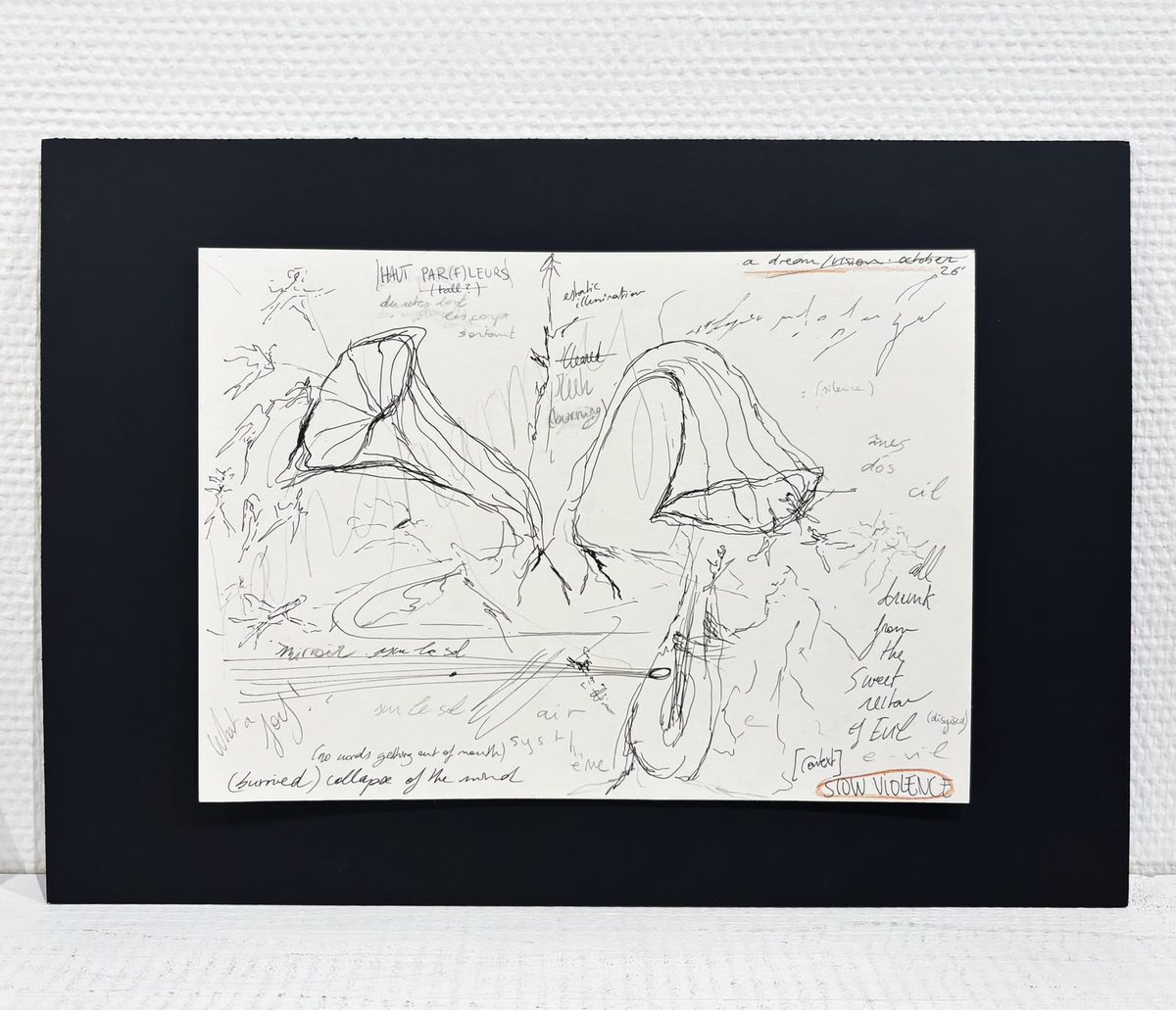
Tara Sammouri Ajami, A vision: sur le sol (bémol) / joyful burning bodies, 2025
FIELD NOTES OF THE HEART LIVING A MOMENT
Splitting up the language; splitting up the land. When we talk about this, Tara tells me a lot about digestion. We consume the land or the language of the land and reconstitute it; we must reclaim this before it is again taken, or the meaning we align with is distorted. There is a beautiful but also a harsh fragility to the way Tara is able to so precisely and boldly fracture words in her work. She replaces earthquake with heartquake in one of her pieces and talks of the process of creation as engraving a map of her heart; field notes of how many times her heart has lived a moment, with place and space representing different dimensions to memory. She etches at parts her heart has skipped in memory retrieval but maintains that her work is more abstract than the precise medium of words: her poetry is a way of expressing something she wants to bring into the space of work, to play with, and by necessity this is not something so well-defined. Herein lies the freedom of interpretation, and I think when viewing a particularly liberated artist’s work such as Tara’s, this playfulness becomes infectious.
Returning to Tara asking me to draw a line in her notepad for her to re-trace on her bike, the notation in Tara’s work is not fixed. Her intention in drawing these lines and dots is to represent something, without achieving this vividly. There is a chaos to this idea of resisting the urge to anchor a piece in such a way. At Tuesday night drawing dialogue, the word is ‘calm’ and I cannot move my mind from these conversations with Tara. I draw a moth with eyes swirling in on themselves and write some fractured lines of poetry around the wings, with purple lightning bolts chopping up the drawing into fragments. There is an inertia to chaos, where it distils into calm. This is how I view Tara’s work.
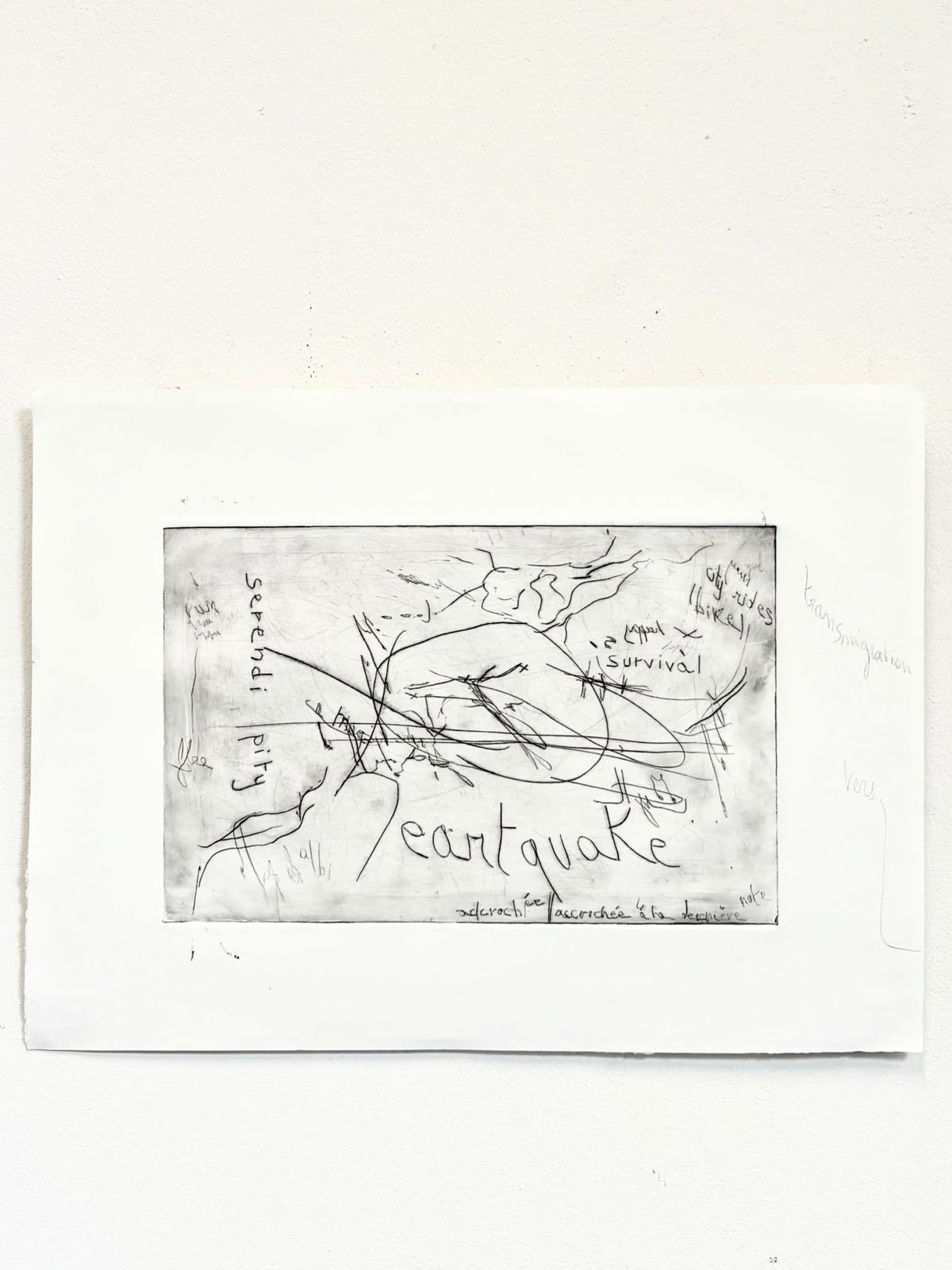
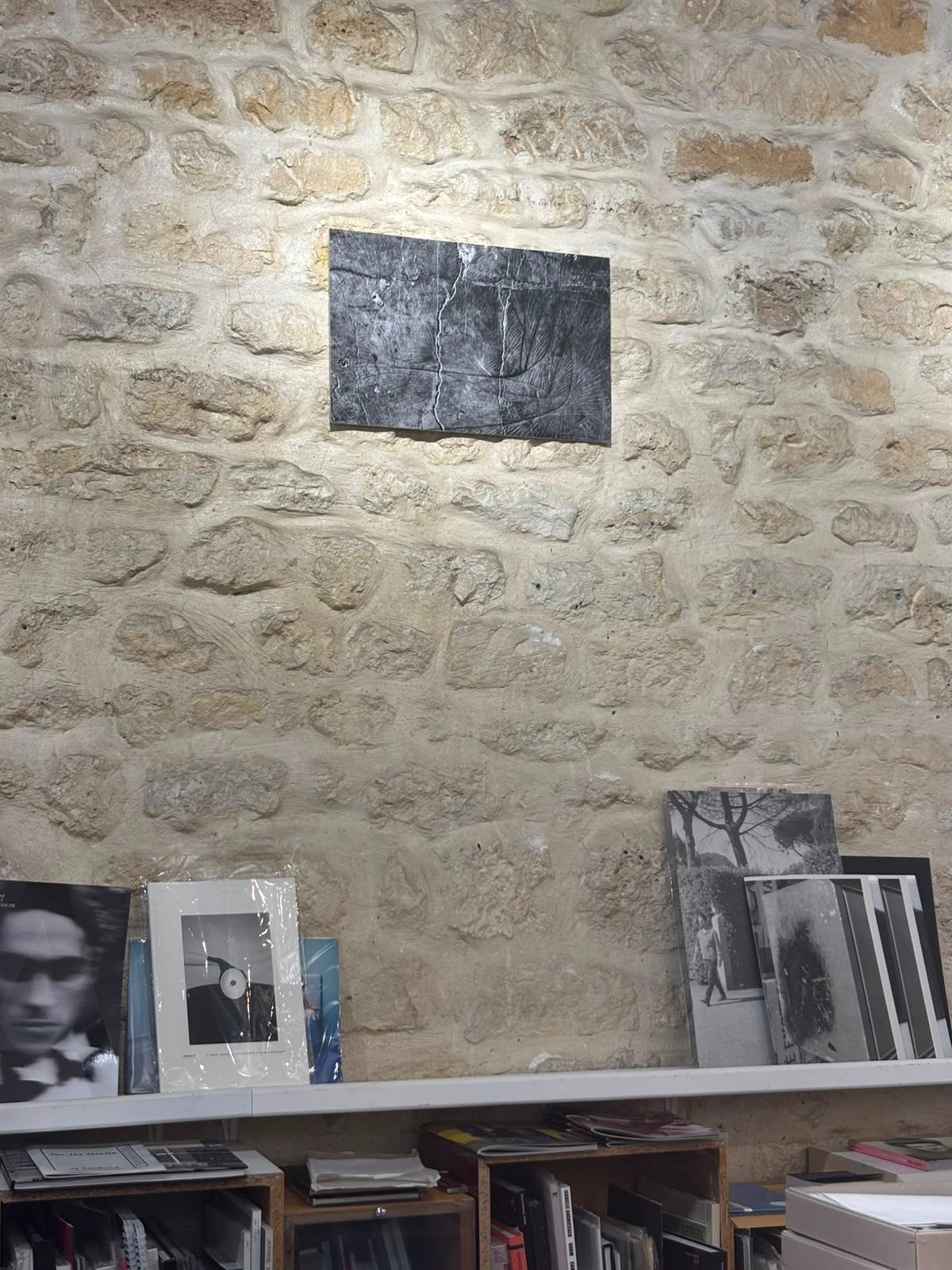
Middle: engraving HEARTQUAKE, accroché à la dernière note (map/score)," 2026
PLAY
There is also a level of childish, jester-like spirit to Tara’s process. Tara talks of almost a jealousy at the spontaneity of children which we lose as we grow old; something which feels powerful in its disinhibition. Tara explains her dilemma when creating a piece – she wants her reader to read and digest her words enough to have an impact, without the words being entirely lisible. This word game leads me to an image of a mother bird feeding their chicks with pre-chewed worms. Tara adds to this image by telling me that the chicks gain their strength through these beak-fuls of chewed worms, which they use to break apart the metal bars of the cage they are in, in the nest. A lot of our conversations feel like this, absurdist. Talking with Tara is liberating in that she frees the words between us, and we can make a language of our own. Much like a child solving a puzzle, Tara’s pieces are received and understood differently by each person, beginning with which word you see first. In this, Tara plays with point of view and perspective in a refreshing way. With time, even Tara sees different things in her own work.
WANDERING WORKSHOP
The final neat link between art and wandering manifests through Tara’s Wandering Workshop attached to Qalb is typing… which she intends to be heart-led, and gesticulates with her hands in the air to describe this wandering flow through the bookstore. I, along with other participants, have no choice but to be taken on a journey. She invites people to act in the way she works, dismantling the language and tapping into a writing flow-state which I think can be the most intimidating part of words as a medium. Tara instructs participants to let words come up and place them freely in the space: the paper. This feels like improv acting or music; the first note can set the tone but does not need to anchor a piece – it can act as a springboard, too.
I ask Tara where she wants participants to find the words to bring up, and she says she encourages such collection or hunting process to come from all sources around us, but that a lot of her words come from what she has read. She returns again to Métamorphoses by Emanuele Coccia, whose central concept is that all living beings share a single, continuous life in a state of constant change. I point to some words in bold at the bottom of one of her pages which Tara has paired on the wall of her exhibit: an arrow, followed by ‘RETURNING TO THE CHRYSALIS.’ Tara also discusses a spiritual novel about birds by a Persian-Sufi poet, The Conference of the Birds, and Silent Spring – an environmental science book written by Rachel Carson. Tara encourages wandering workshop participants to take not foremost the words in the books, but the philosophical ideas behind them, and to then add words to describe these, almost in an inside-out approach, much like the twisting of language she previously spoke of.
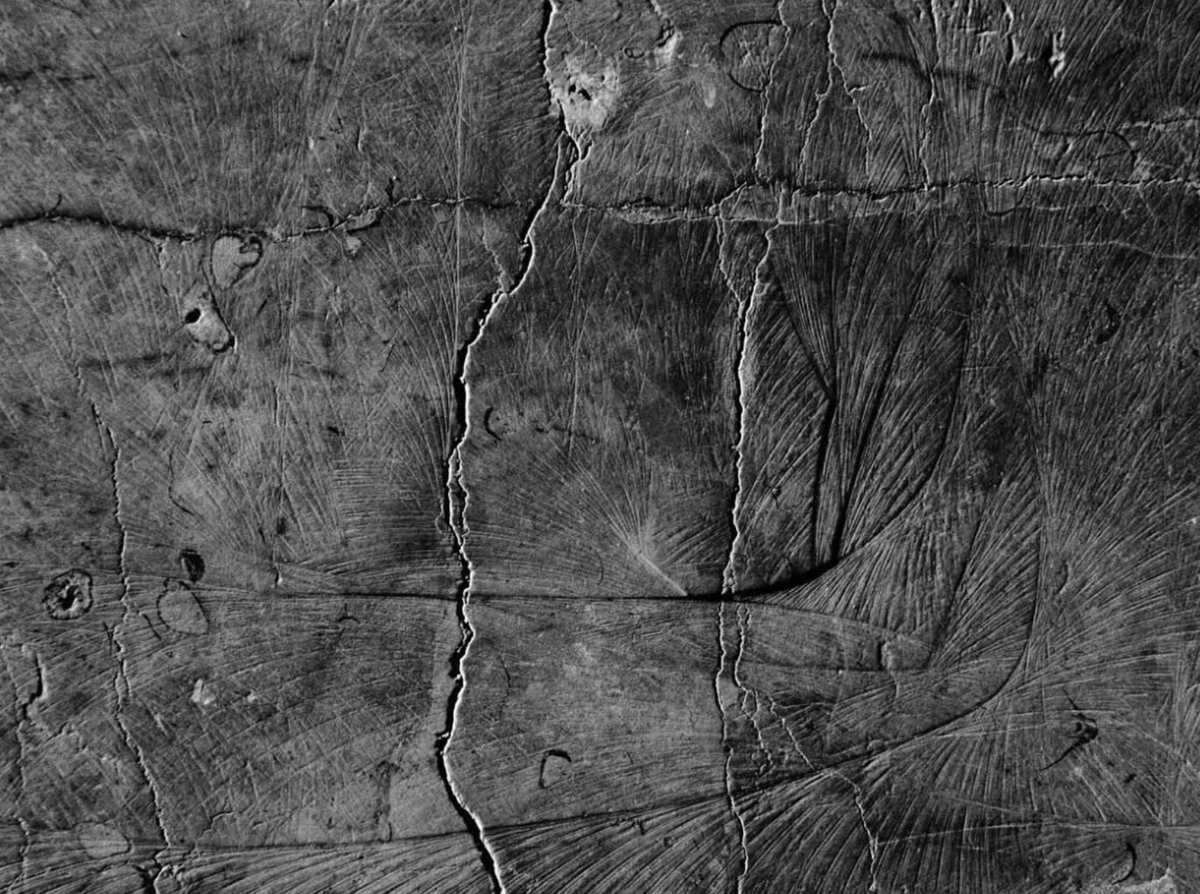
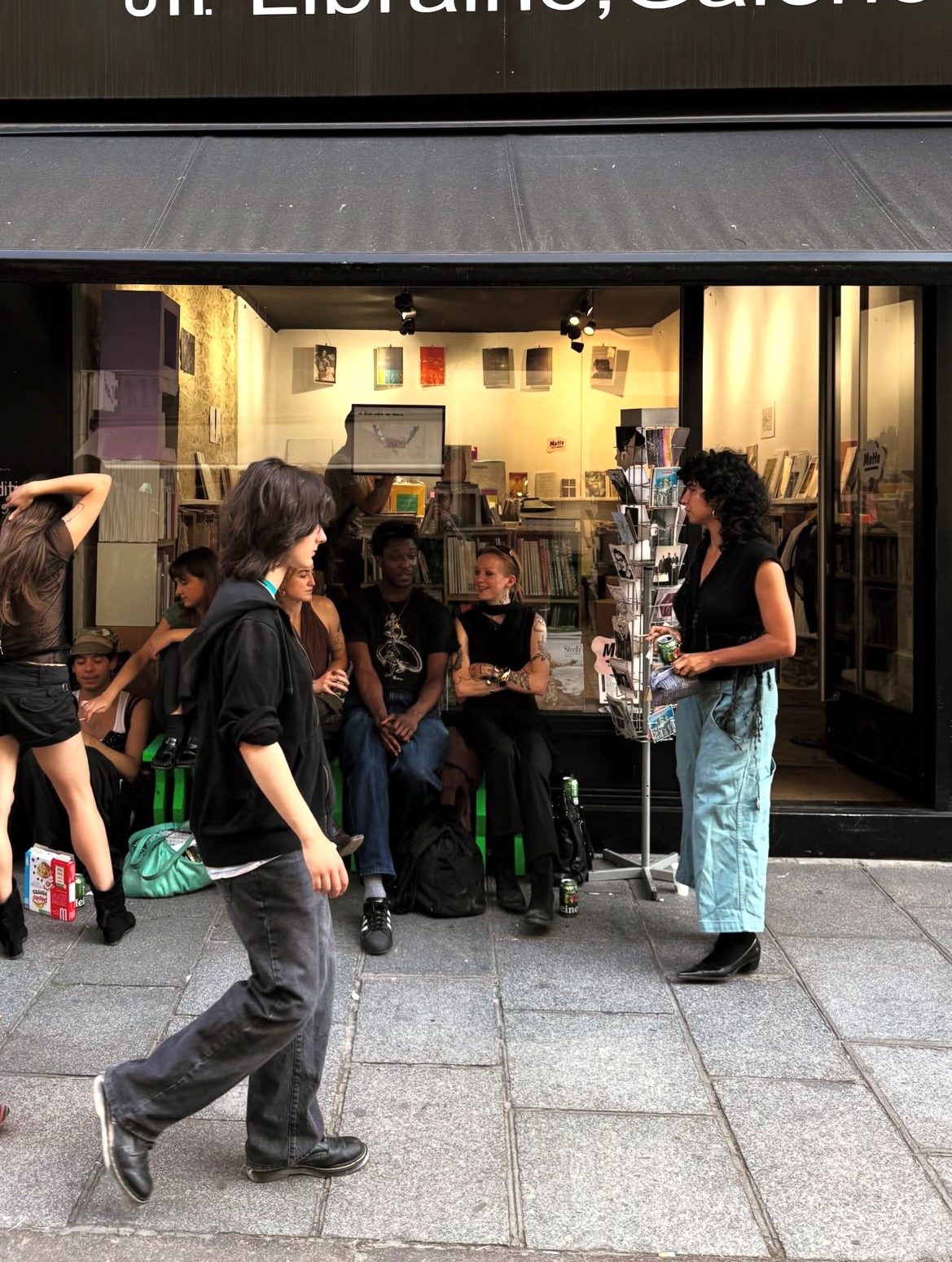
Left: Meeting Wings, 2024
WANDERING STAR
Tara leaves me with an image which ties everything neatly in a complete circle. The word ‘planet’ comes from the Greek translating to ‘wandering star.’ Referencing the philosophy of Métamorphoses, Tara explains that it is only intuitive and natural to, thus, wander; we are fragments of a wandering star. Tara and I also discuss le movement situationniste – an avant-garde and radical art movement in which the ‘situation’ is a moment of absolute freedom. Tara’s central mantra which persists through our exploration of her art, is that life is inherently artistic, and the two are not so severed as we may be led to believe. This idea is made perfectly manifest in her artistic practice to wander, using the city of Paris as a playground.