MORE LIKE EROSION THAN RESOLUTION: IN CONVERSATION WITH ARTEFAKFT STUDIOS
CONVERSATION BY MOCO CHEN
CO-FOUNDER, ART DIRECTOR
27 SEPTEMBER 2026 — ATLANTA, GEORGIA
In a studio in Atlanta, Georgia, Susannah Hightower is covering things up. She lays vintage garment pattern paper down wet, again and again, until it begins to branch like tree roots. Over it go plaster, concrete, and a thick black compound threaded with cut latex, left to cure outdoors where leaves and dust can settle into it. The material that once made her uneasy, with its obvious fetish associations, has become her quiet signature. For an artist raised in an evangelical world that taught the female body to hide itself, the choice is a pointed joke: what happens if I cover myself in latex instead?Formerly a fiber artist devoted to precision, now a painter of surfaces that refuse to settle, Hightower draws on brutalist concrete and the dark, improvised rooms of Berlin's clubs, places where people disappear in order to become someone else. The resulting works are dense, severe, and strangely seductive. They are black monoliths made for everyday homes, holding a tension that never fully resolves. As she prepares to show with ORCA at the Atlanta Art Fair and dreams of bringing Artefakt Studios to Paris, we asked her what the covering protects, and what it reveals.
You work in the space between construction and collapse: precise training underneath, intuition on top. If someone had to identify "Artefakt Studios" the way they'd identify a hand in a painting, what's the tell they'd point to? And underneath that: who is Susannah Hightower, what is Artefakt Studios, and what's the story that got you here?
I think the visual language is still taking shape, but there are already certain things I return to almost instinctively: black, weight, density, texture, concealment, and a tension between something constructed and something that feels as though it is coming apart. Latex has become an especially recognizable part of that language, although I initially resisted it. I was conscious of the material's association with fetish culture and didn't want the work to be reduced to that context. Over time, I've become much more interested in what latex can mean beyond the body: protection, covering, skin, restraint, architecture, and transformation. It has gradually become almost an unspoken signature.
The work is also deeply informed by my longstanding obsession with brutalist architecture. I'm drawn to the contradiction in it: structures that can feel incredibly harsh and severe, but are also deeply beautiful. There is something similar in the Berlin environments that have influenced me, particularly the dark, improvised spaces of the city's rave and club culture. They are places where people can disappear from ordinary expectations and become something else for a few hours. That idea of the places we hide in order to become ourselves has stayed with me.
A lot of the work comes from a more personal negotiation with ideas I grew up around. I was raised in an evangelical environment where the female body was often framed through ideas of modesty, temptation, and concealment. There is something almost deliberately absurd to me about taking that inherited idea of the body needing to be covered and asking: what happens if I cover myself in latex instead? What does the covering protect, and what does it reveal?
I also work extensively with fabric and vintage garment pattern paper. I'm interested in the care and labor that go into constructing something that may ultimately be hidden from view, much like the parts of a person that can never really be understood from the outside. That relationship between the visible surface and everything underneath it has become increasingly important to me.
I came back to making art partly out of necessity. For years, creating wasn't really an option; I was working, providing, and dealing with the practical demands of life. Returning to art over the last few years has given me a way to examine and undo some of the narratives I absorbed earlier in life. I don't think I arrived at the work with a fully formed thesis. I arrived at it because I needed somewhere for all of these things to go.
Artefakt Studios grew out of that return to making. It is the broader space where the visual work, sound, experimentation, and the things that don't fit neatly into one discipline can exist together. My own visual practice is still evolving within it, and I think that openness is part of what makes Artefakt what it is.
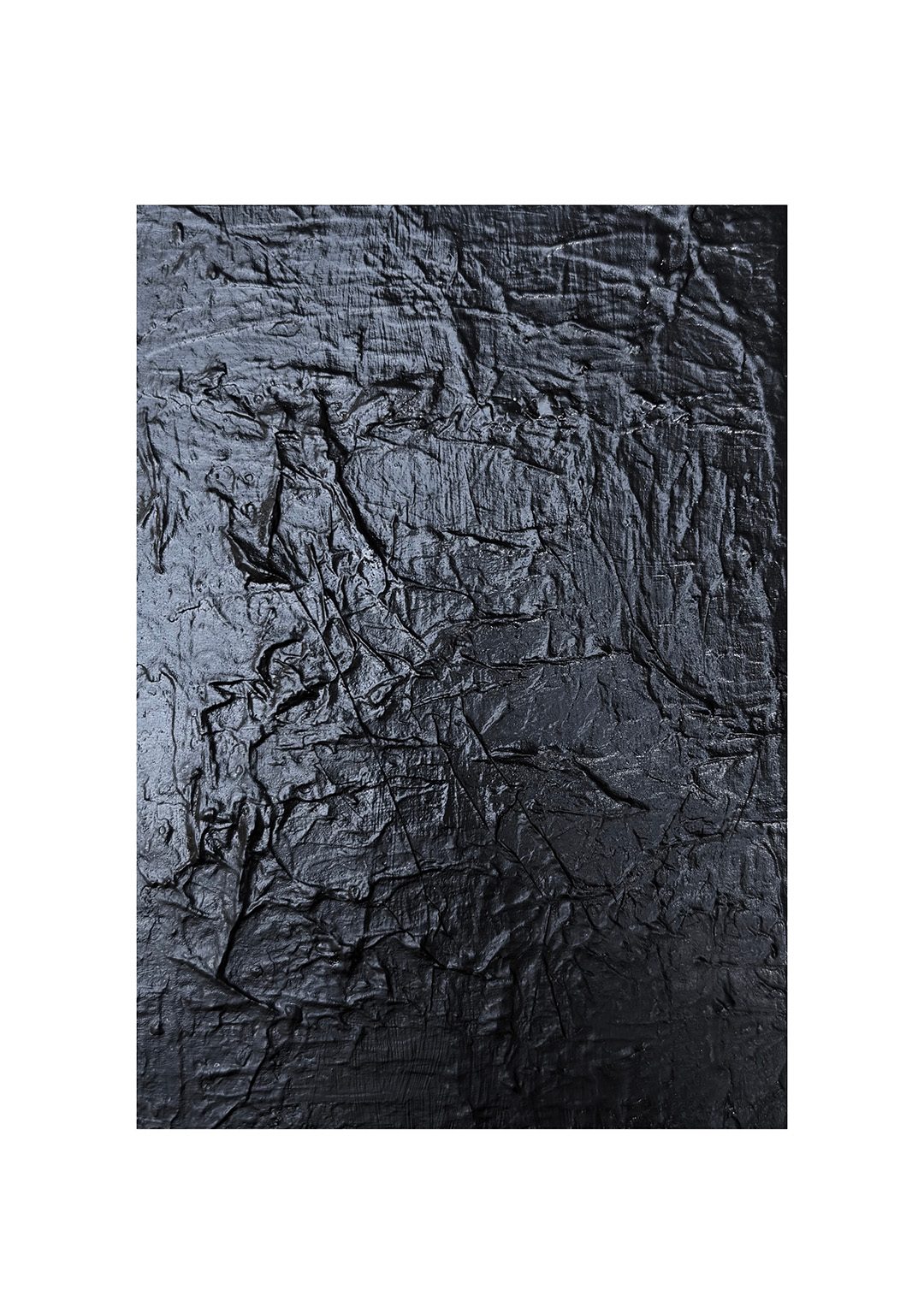
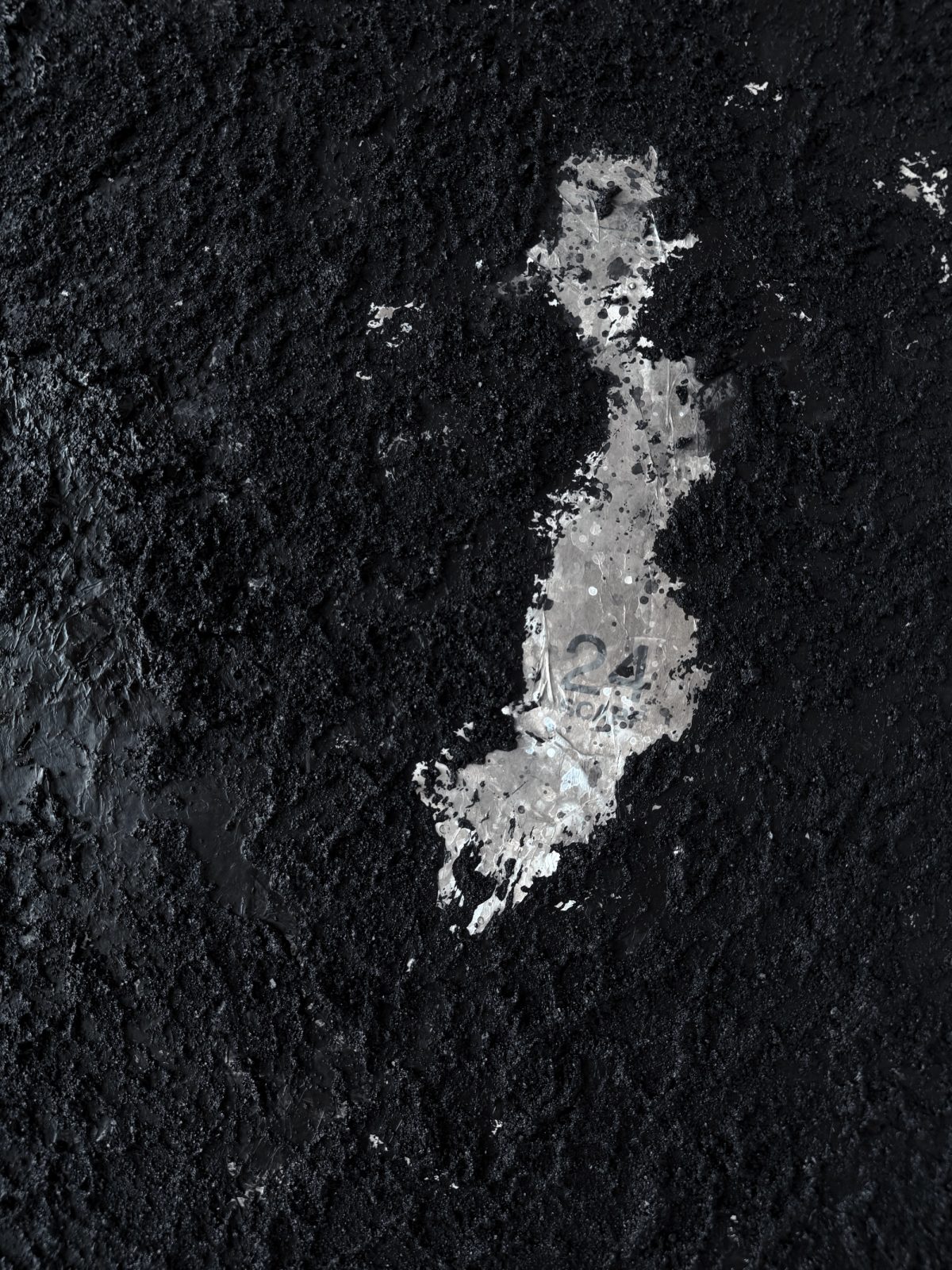
Left: Artefakt Studios, Lacquer.
Right: Artefakt Studios, Sediment, brutalist concrete work (detail).
You describe your surfaces as holding "evidence of what came before": plaster over pattern paper, latex over fabric. When a collector hangs one of these pieces in a home, are they hanging a finished object, or an unfinished argument about what a wall is supposed to hide?
I hope each piece offers some kind of space for introspection. When I'm making them, I can become very absorbed in the process. I'll spend so much time looking at a surface that it begins to change depending on the light, the time of day, or even how long I've been looking at it. A texture that seemed completely obvious in the morning can feel like something else by evening. That experience is part of the work for me.
I think there is something similar in the way we experience other people. We rarely see the work that has gone into someone becoming who they are. We see the finished surface, but not everything underneath it: the things that have been covered, altered, repaired, or left unresolved. The layers in my work are partly a way of making that invisible history physical.
I also want to question what we decide qualifies as a painting in the first place. Why is a slab of concrete art? Why is a nearly all-black surface meaningful? What are we expecting it to tell us? I don't necessarily want to answer those questions for the viewer. I want the work to make them stop and look.
So perhaps the piece is finished in one sense: it is physically complete. But I think the work actually begins when someone stands in front of it. Their attention, their associations, and whatever they bring to that encounter become part of what the piece is.
You've said the work considers what happens to materials after function is removed. A concrete wall in a gallery and one in someone's kitchen are both post-function, but differently: one was never functional; the other still has to hold up a house. Does that domestic setting change what the erosion means to you?
I think it does, because I don't really see the home as separate from the work. Architecture has always been important to me, partly because I think there is something inherently artistic about the structures we build around ourselves. I'm interested in what happens when you take some of that visual language out of its original context and bring it somewhere unexpected. What happens when something severe, architectural, or industrial is brought into a home and given the opportunity to be lived with?
I've recently been working with real estate developers, and that has made me think about this in a more practical way. In those settings, I'm often considering the home itself when I make or place a work. I want the piece to feel like it belongs there rather than simply being installed there. The work can respond to the architecture, the light, the materials, and the atmosphere of the space.
That matters to me because I think of home as a kind of sanctuary. There is an intimacy to living with an object that you return to every day. A piece can change depending on the light, your mood, or what has happened in the room since the last time you looked at it.
In that sense, the ritual involved in making the work becomes its own kind of iconography. The layers, the covering, the accumulation, and the erosion aren't just surface effects. They are records of the process that brought the piece into existence. Once it enters someone's home, that history meets a new one: the life of the person living with it.
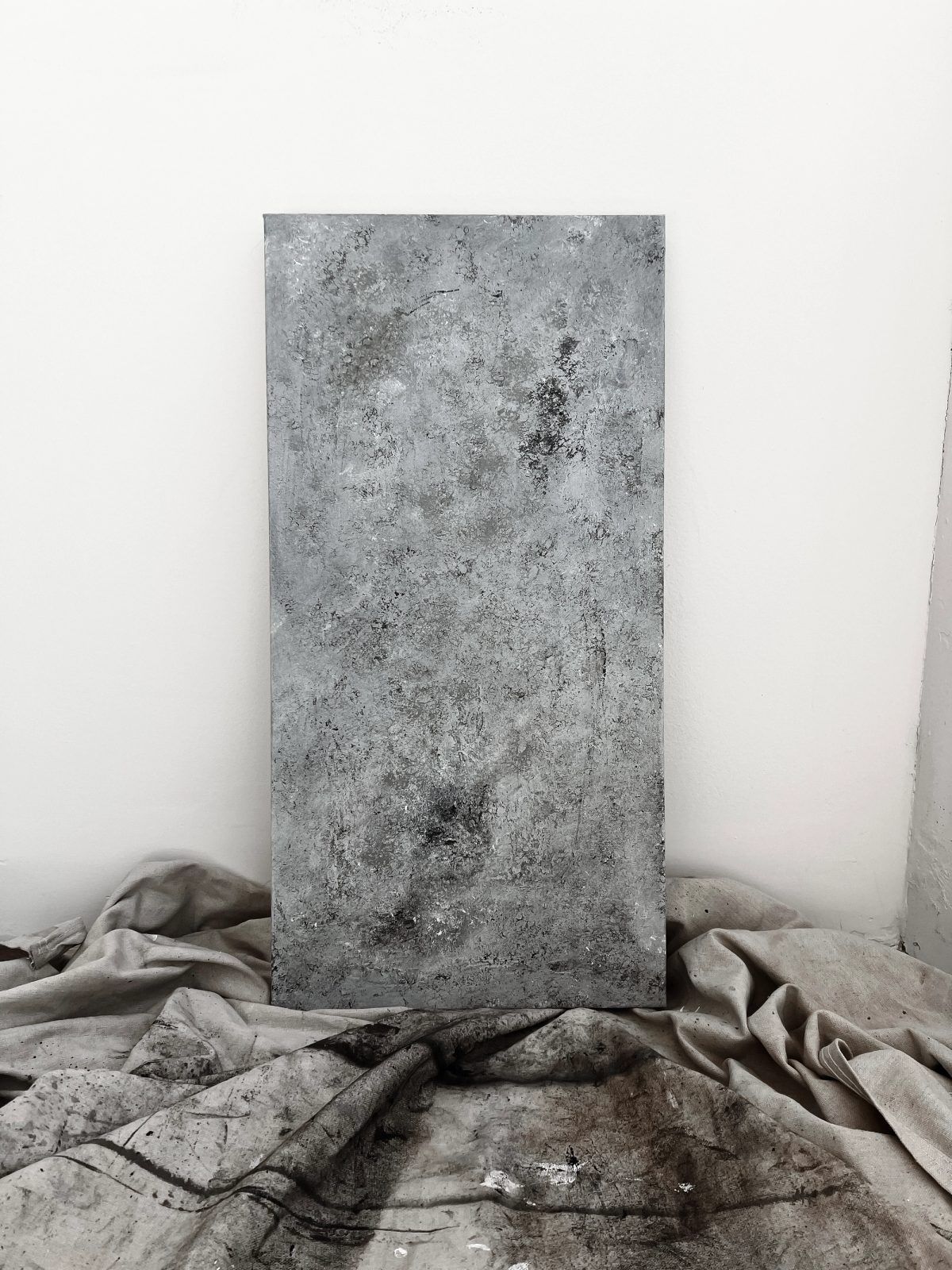
Artefakt Studios, Terra Obscura, concrete work.
"There is something almost deliberately absurd to me about taking that inherited idea of the body needing to be covered and asking: what happens if I cover myself in latex instead?"
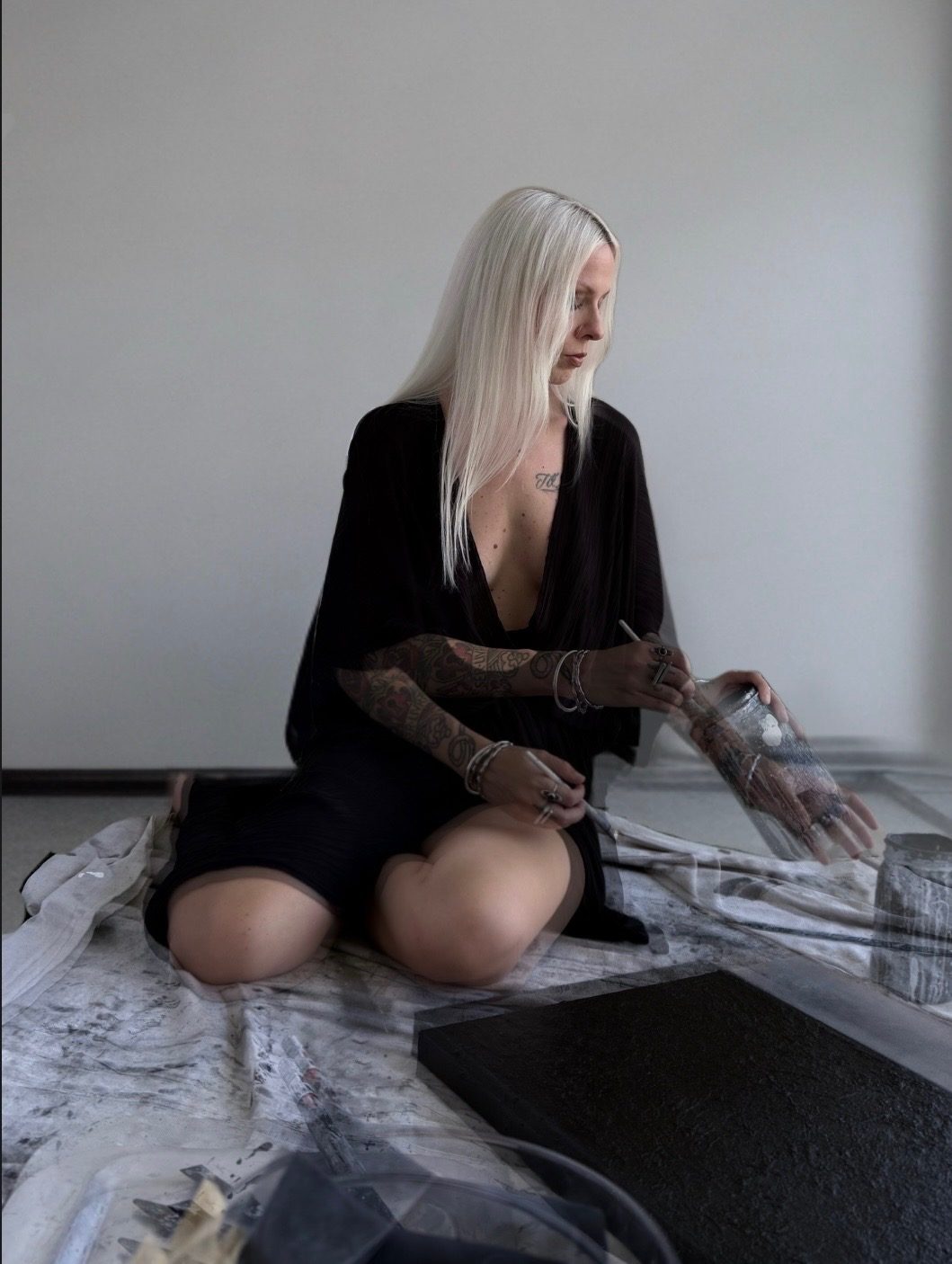
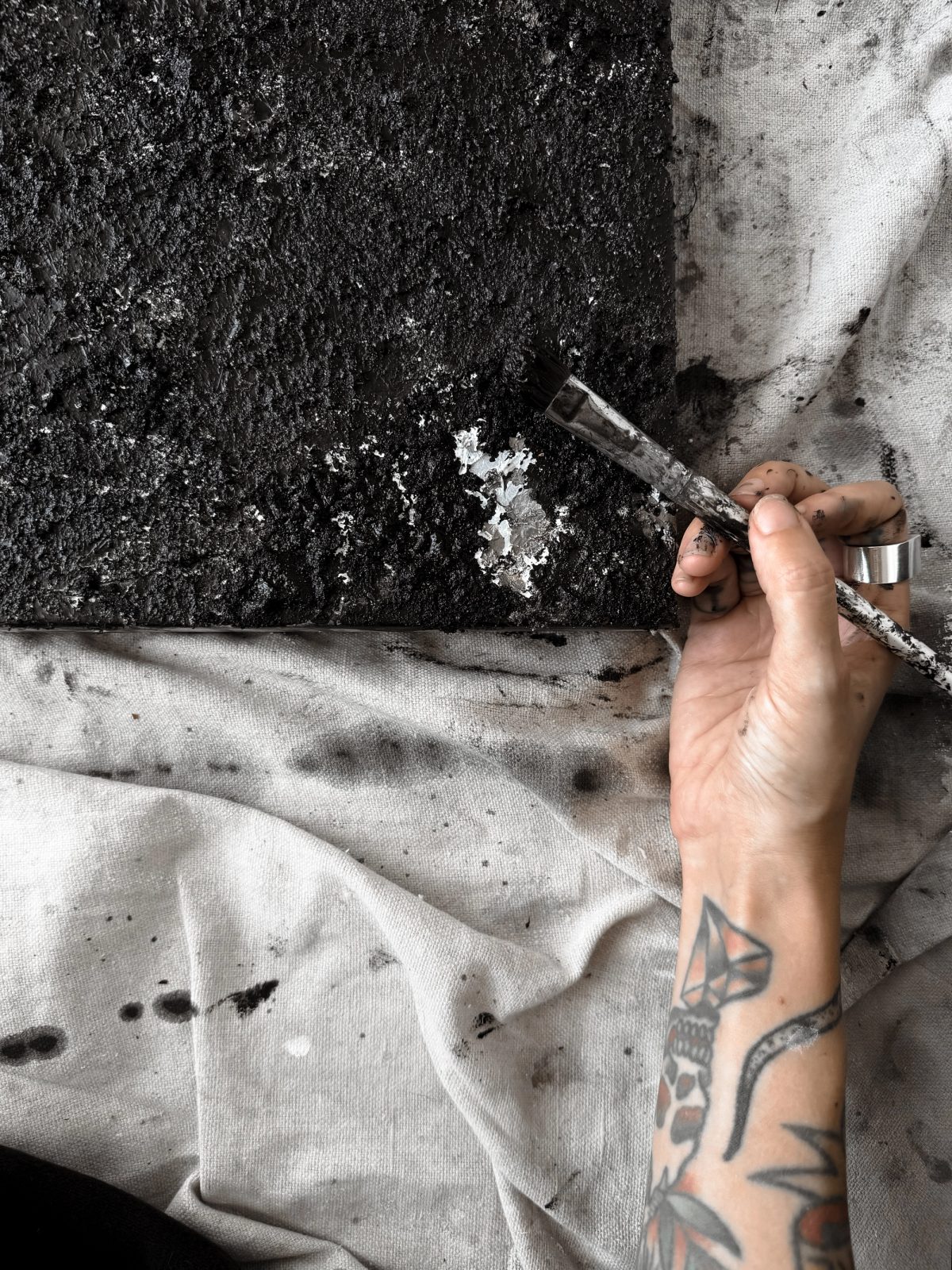
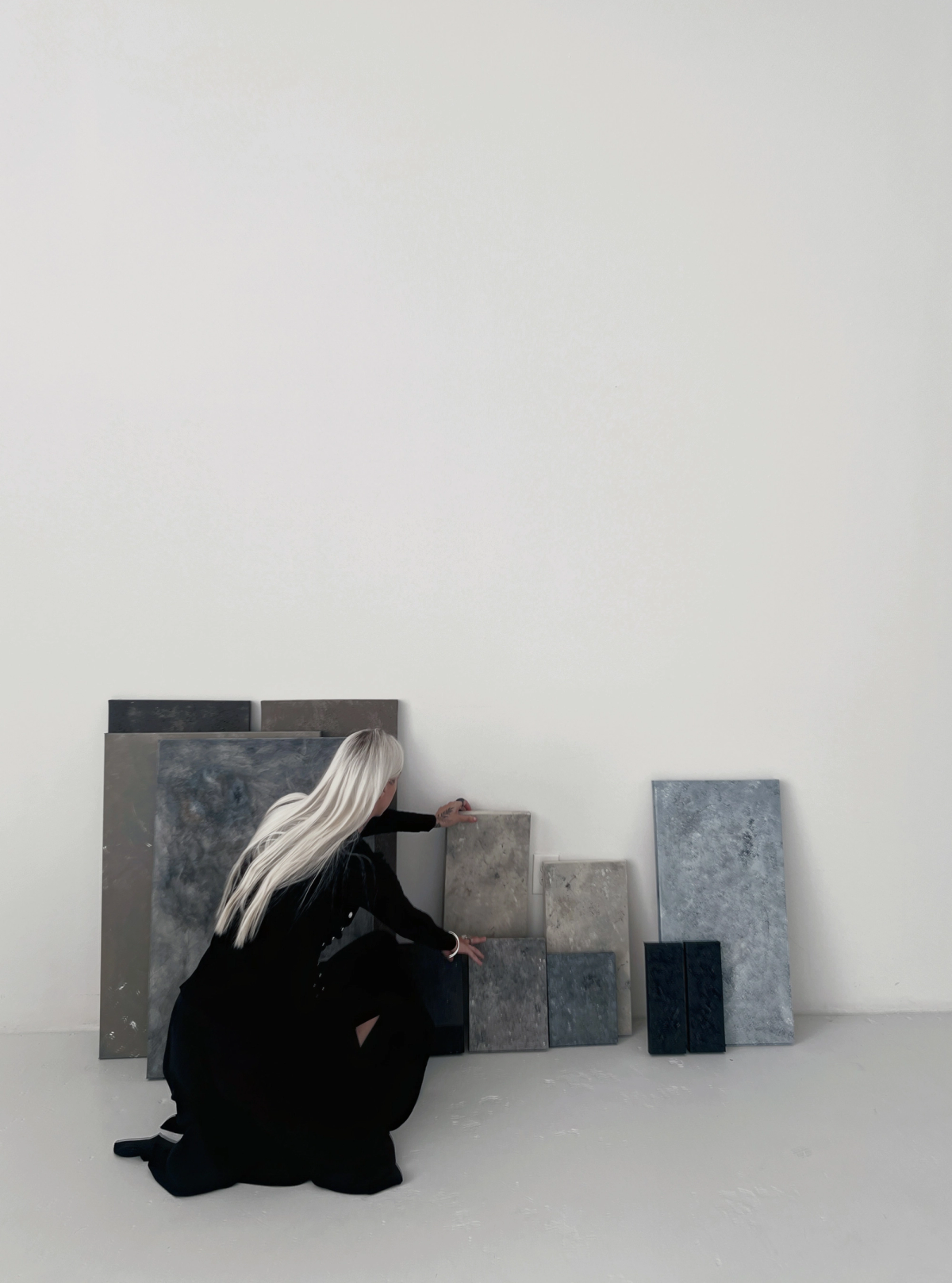
Left: Susannah Hightower in the studio.
Right: Artefakt Studios, Sediment, brutalist concrete work.
Brutalist architecture shows its own construction; interior design usually covers it up. Your work sits between those two. When you're building a surface, which side are you actually on that day?
I'm always looking for the sweet spot between the two. Aesthetics are obviously important to me, and I'm naturally drawn to minimalist spaces because they reflect the way I live and the way I see things. But I don't necessarily want the work to exist only in an idealized brutalist environment. It can hold its own against a plain gallery wall, but I also like the idea of it becoming part of a more lived-in space, surrounded by someone's belongings and their own taste.
Most people aren't living in enormous brutalist houses. They're living in apartments, smaller rooms, spaces that already have a history and a personality. I'm interested in how a work can bring some of that sense of scale and architectural vastness into a smaller environment without completely consuming it.
That's probably where the balance comes in for me. The work can feel heavy because of the materials, the blackness, and the density of the surface, but it can also feel surprisingly light within a room. I don't want it to dictate the entire space. I want it to introduce a certain weight or atmosphere and then allow the rest of the room to exist around it.
So I suppose I'm not really choosing between construction and concealment. I'm interested in what happens when they meet: something that feels substantial and architectural, but still has enough restraint to become part of a lived environment.
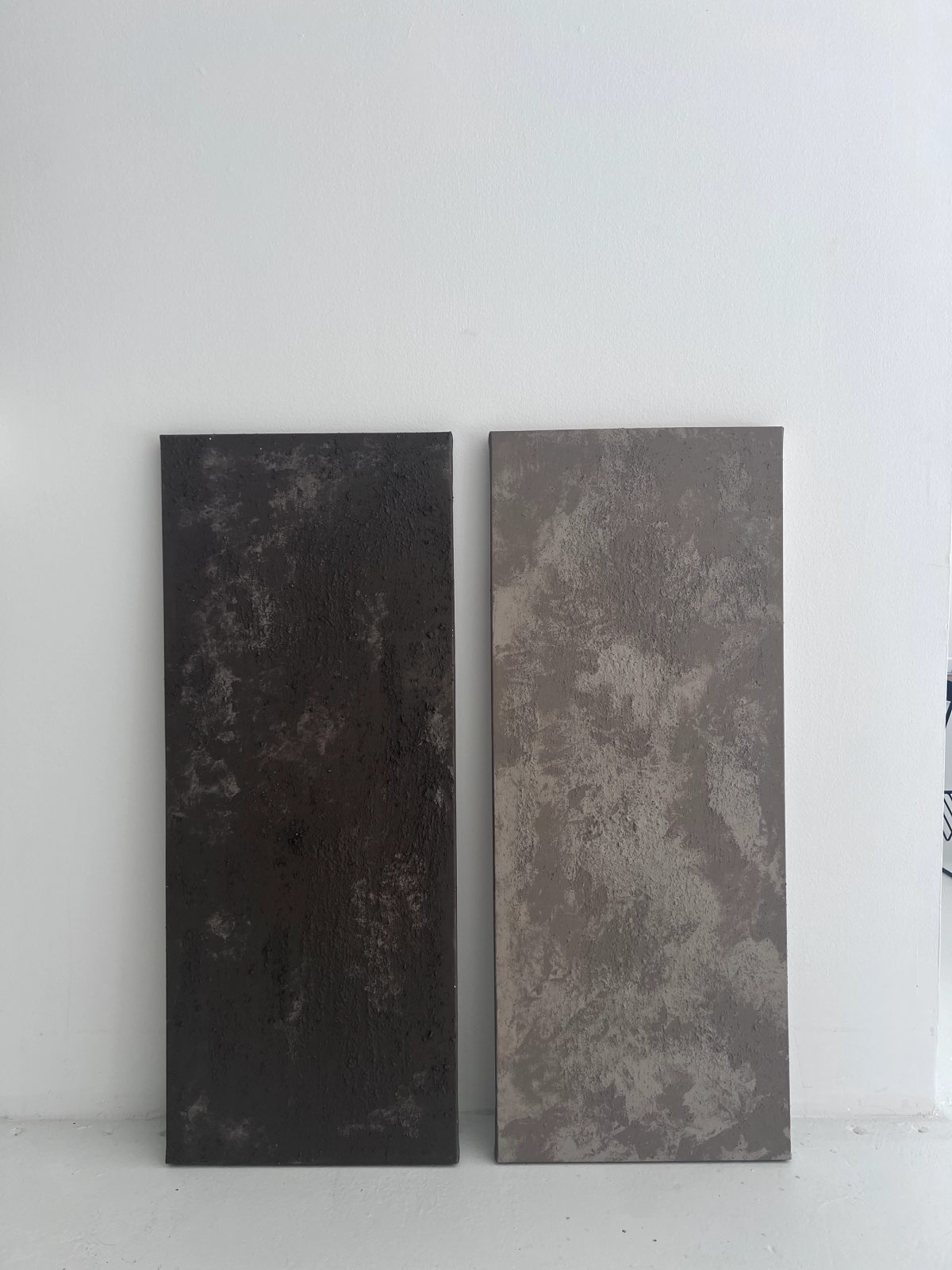
Artefakt Studios, Armor Fati, concrete work.
Interiors are usually built to resolve tension: matching tones, clean transitions. Your palette is restrained, but the surfaces themselves are anything but resolved. Are you making calm objects for spaces that are too controlled, or are you sneaking a little collapse into rooms that don't know they need it?
I wouldn't necessarily describe the work as calm. There is a tension in it that I think is important, even when the surface appears restrained. The lightness I mentioned earlier is less about tranquility and more about shedding. The work is constantly moving between stripping something back and covering it again, stripping it back and covering it again. It feels more like erosion than resolution.
Time is a big part of that. It weathers us, and it weathers everything. It is one of the few things we ultimately cannot escape. I think that inevitability creates a certain tension in the work because there is never really a final state. Even when a piece is finished, it still feels as though something could be exposed or eroded further.
That process can become quite difficult for me while I'm working. Sometimes I become so absorbed in a piece that I start seeing things in the surface that aren't necessarily there. The work can almost feel as though it has turned on me, and I think that unresolved quality is important. I don't want the work to simply become decorative. Ideally, it becomes its own kind of monolith: something quiet but persistent, carrying a reminder that what remains after we are gone still matters.
Maybe that's the balance I'm looking for: not calmness, exactly, but a contained tension, something that can coexist with a person's life while still asking them to confront the fact that everything changes, erodes, and eventually passes.
Your surfaces are built from layers (pattern paper, plaster, latex), each one partially covering the last without fully erasing it. Walk me through how a piece actually begins: does the fabric or pattern paper go down first, or is it introduced later, once the plaster and latex are already in motion?
My process is intentionally slow and fairly intuitive. I start each canvas with fabric pattern paper, which I use to build the initial texture. I work wet, let the layer dry naturally, add a little paint, and repeat that process ten or more times. By the time the underlying surface is built, there are already many layers that have accumulated without necessarily being visible. I particularly love the moments when the pattern paper starts to resemble tree roots or something organic.
Once that foundation is completely dry, I usually add another one or two layers of paint before introducing the other materials. I work with concrete mix, plaster, and latex, which I cut into different shapes and strips and combine with molding paste and a few other ingredients to create a thick black compound. The latex in particular has become an important part of the surface, because it behaves very differently depending on how it is cut, layered, and incorporated.
I don't plan a piece in advance in any rigid sense. I might have a general idea of where I want it to go, but I really trust my instincts once I begin working. Sometimes I'll introduce a more abstract pattern or gesture into the surface simply because it feels right in that moment. I let each material dictate something about what happens next.
I also let everything dry naturally, usually outside. That means the process has an element of chance built into it. Occasionally leaves, sticks, dust, or other things find their way into the surface. I don't necessarily see those things as mistakes. They're evidence of the process and of the environment the work was made in.
I've tried working from a much more rigid formula before, and ultimately it didn't feel right for me. I don't want every piece to follow the same sequence or arrive at the same destination. I think there is something important about allowing each motion to play out organically and seeing what the materials give back to me.
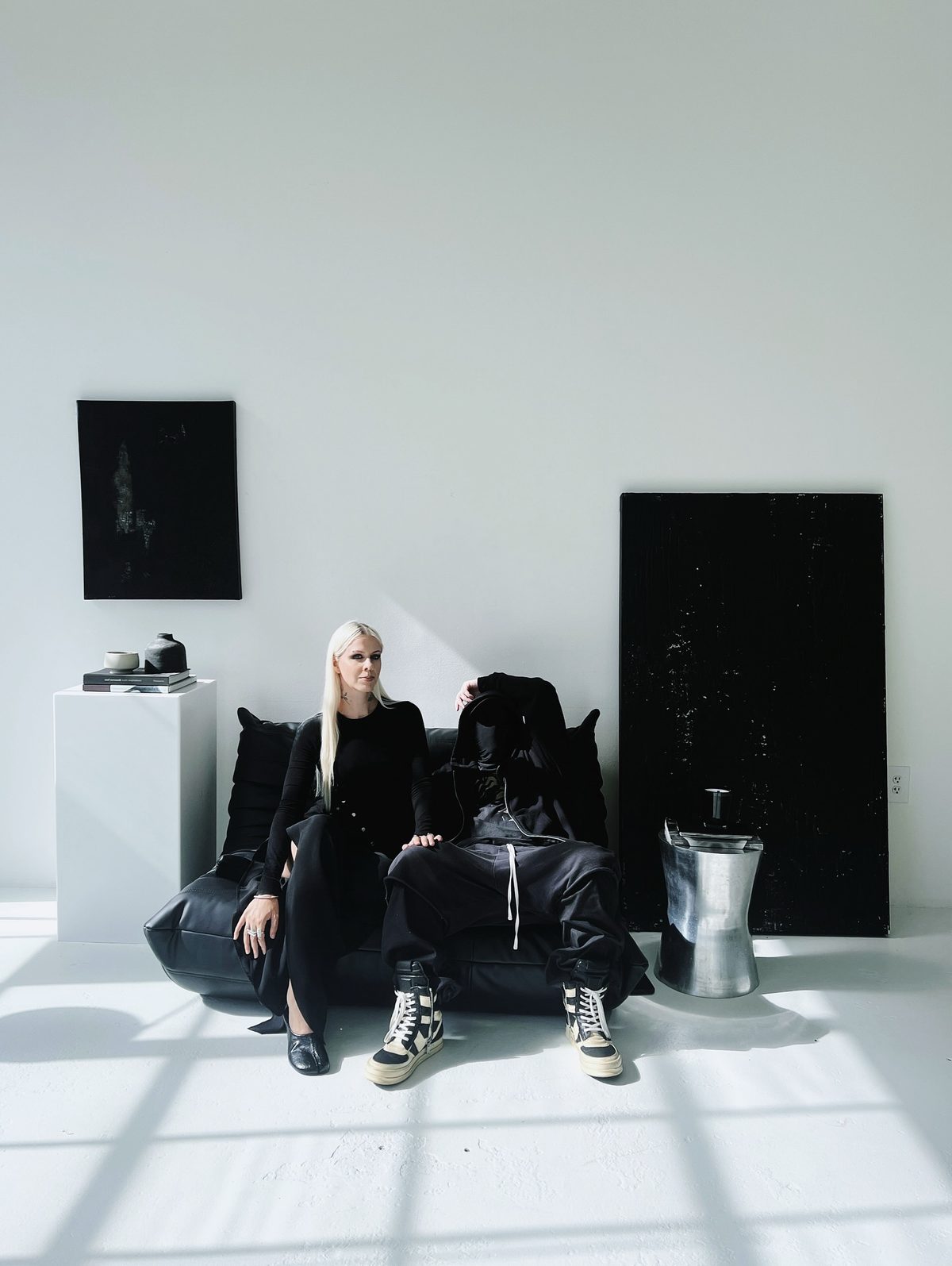
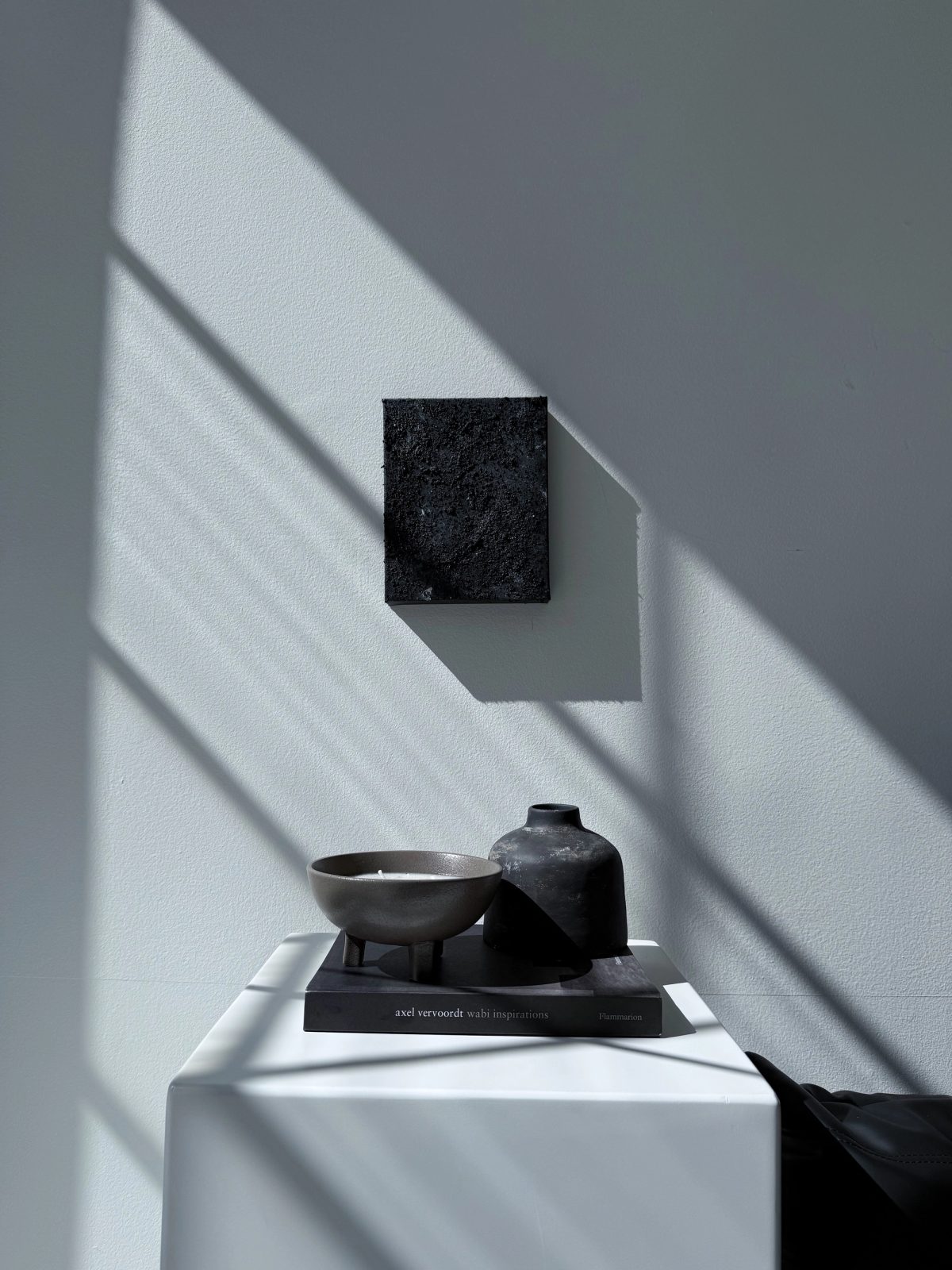
Left: Artefakt Studios.
Right: Artefakt Studios, brutalist concrete work.
"That idea of the places we hide in order to become ourselves has stayed with me."
You trained in fiber arts, a discipline built on precision and control, and now describe your practice as intuitive, nearly the opposite. That's a real reversal. What actually changed in you, and was there a specific piece where you felt that shift take hold?
I initially understood creating as a form of control. Fiber arts rewarded precision, repetition, and technical discipline. There was a very clear relationship between the amount of time and labor I put into something and the finished result. At some point, I became much more interested in what happened when I stopped trying to control the outcome.
I also think I burned myself out by monetizing the practice too quickly. I had a storefront and was constantly making things in between shifts at my full-time job. What had initially been something I loved became another obligation, and eventually I developed a real resentment toward it. I needed to step away from it entirely before I could figure out what I actually wanted and needed from art.
When I eventually came back to creating, I didn't want to return to that kind of production. I wanted the process to feel exploratory again. That's probably where the intuitive nature of my current work comes from. I'm not trying to reproduce a particular object or execute a predetermined design. I'm responding to what is happening on the surface and allowing the materials to take me somewhere.
Interestingly, I haven't completely left that earlier practice behind. I still use fabric and vintage garment pattern paper extensively, but I think I use them very differently now. In some ways, they're an homage to that previous life. They're materials I already have a history with, but now they're being incorporated into something much less controlled.
I think that's part of what interests me about the work now. I'm still using materials associated with construction, but I'm no longer interested in following the instructions.
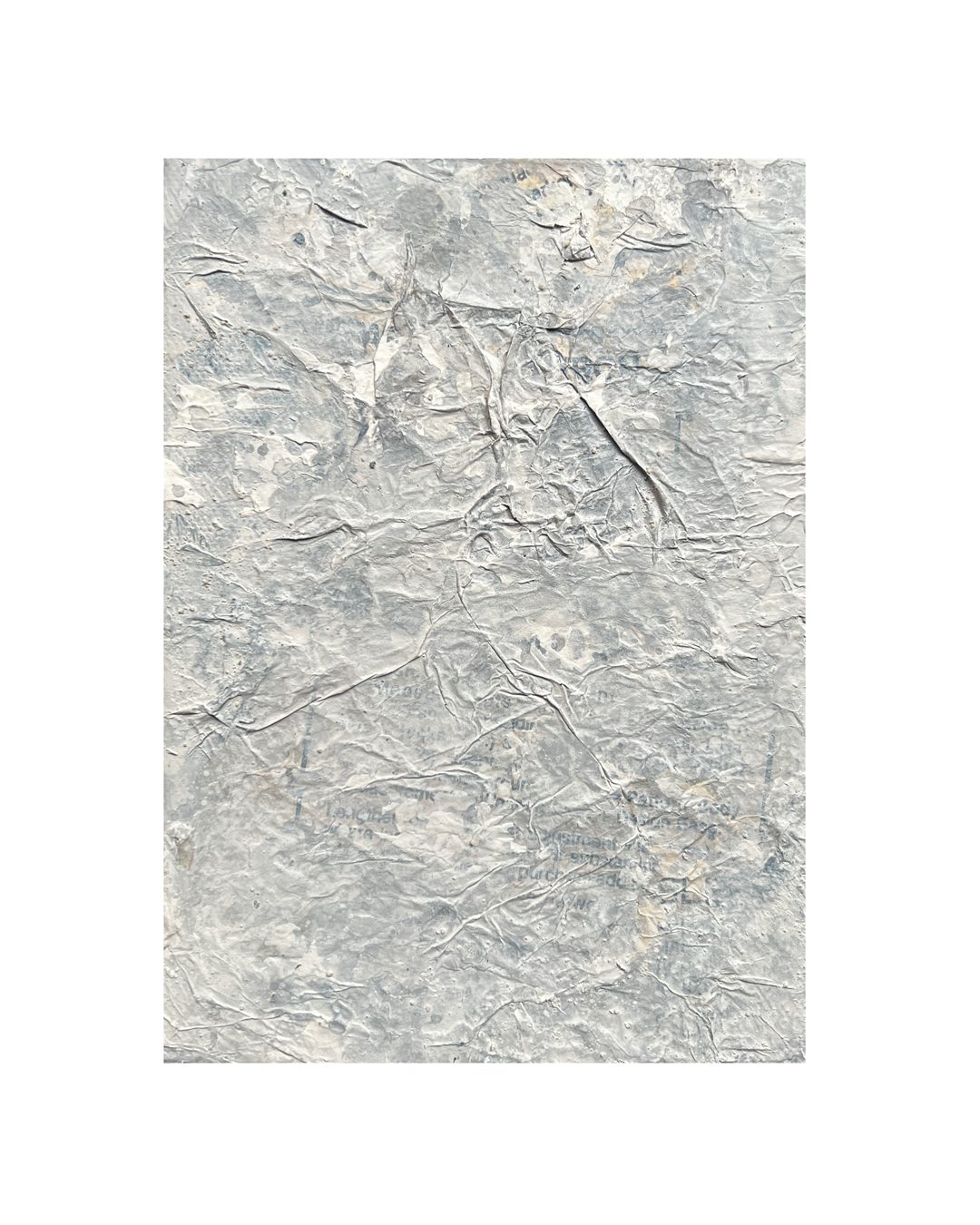
Artefakt Studios, Untitled, mixed media.
Your language for your work is architectural (erosion, structure, concrete), which suggests you're thinking beyond the canvas. As you're making a piece, are you already picturing the room it might occupy, or does that only enter your mind once the work is done?
I don't usually think about where a piece will ultimately end up when I begin it. Nine times out of ten, I'm not imagining a particular room, collector, or interior at all. I think doing that would probably drive me a little crazy. I already have a tendency toward perfectionism, and part of what I'm trying to practice through this work is letting go of that need to control the outcome.
The exception is when I'm working on a commission, particularly something like the recent work I've done within real estate. In those cases, I see the house first. The architecture, scale, light, and existing materials of the space become part of the conversation, and I think about how the work can live within it.
But with my own work, I actually prefer not knowing. I want to let the piece fall where it may, so to speak. There is something freeing about making a work without already deciding what kind of person will own it or what kind of room it belongs in. It gives the work room to become what it wants to become before I start thinking about where it might go.
Artefakt is unusual in that it houses two disciplines under one roof: your surfaces and 01111111100000000000's sound. What does that collaboration actually look like in practice? Does the sound come first, the painting first, or do the two develop together?
Lately, we've both been developing our individual practices while continuing to collaborate closely through Artefakt. He has been releasing his own music and creating soundscapes for exhibitions, soundtracks, and fashion shows, while I've been focused on building my own body of visual work. I think that separation has been important for both of us creatively, because we've each had the space to develop our practices without forcing them to constantly exist together.
At the same time, we still have a very strong desire to eventually bring the two together in a fully immersive experience. The idea has always been bigger than simply putting my paintings in a room and having his music playing in the background. We want the sound, the visual work, the space, the lighting, and the movement through the environment to feel like one experience.
We haven't found the right fit for that yet where we live in Atlanta. A lot of the interest we've encountered for that kind of work has actually been in Europe, but for something at the scale we're imagining, it needs to feel right. We don't want to force it simply because an opportunity comes along. It needs to be the right space, the right context, and the right moment for the work.
I'd love to eventually do something around Paris Fashion Week, ideally in 2027. That feels like a particularly interesting environment for what we're imagining because of the relationship between fashion, sound, architecture, and visual art. For now, we're both building toward it independently, and I think that will ultimately make the experience stronger when we do bring everything together.
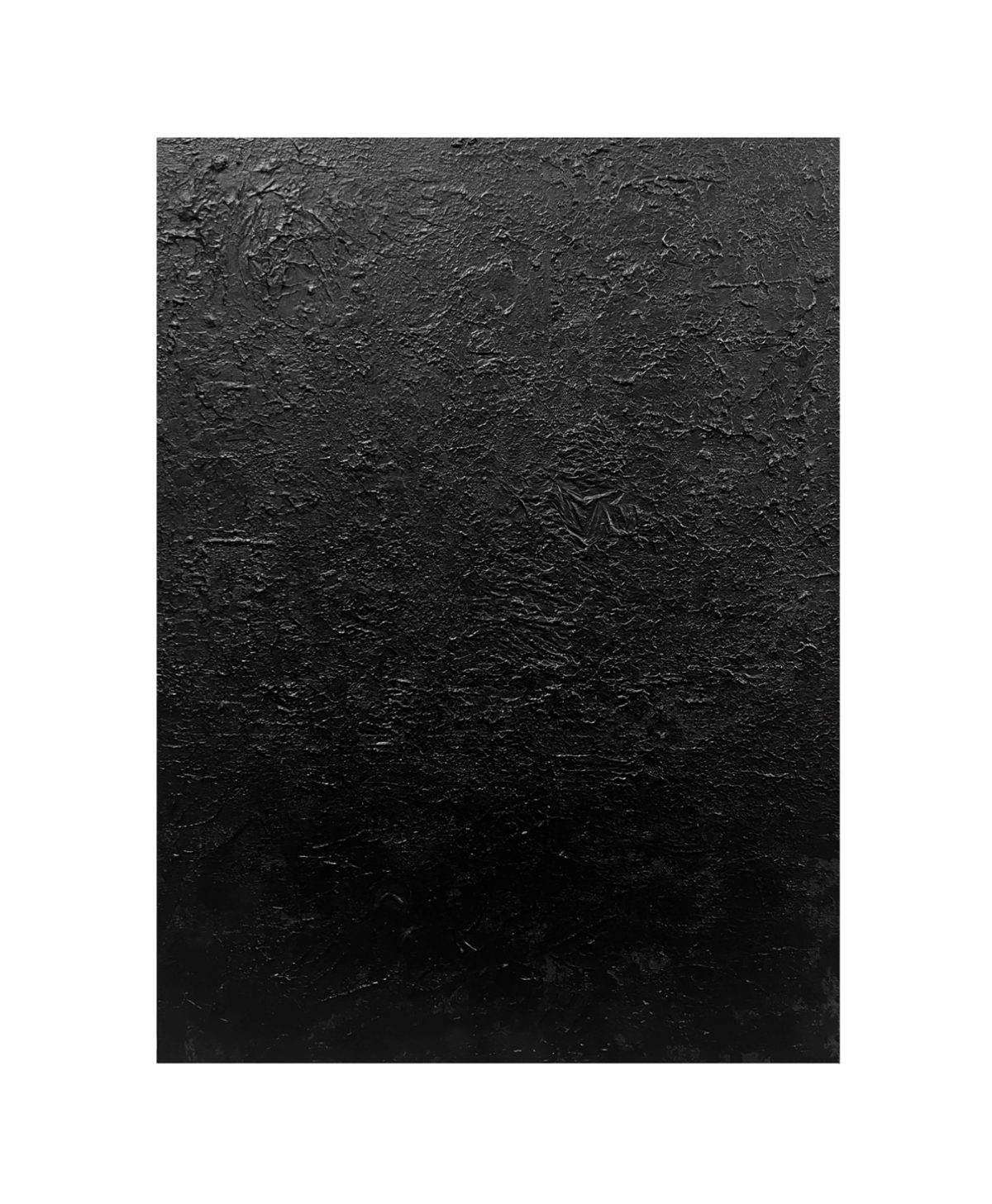
Left: Artefakt Studios, latex painting, mixed media.
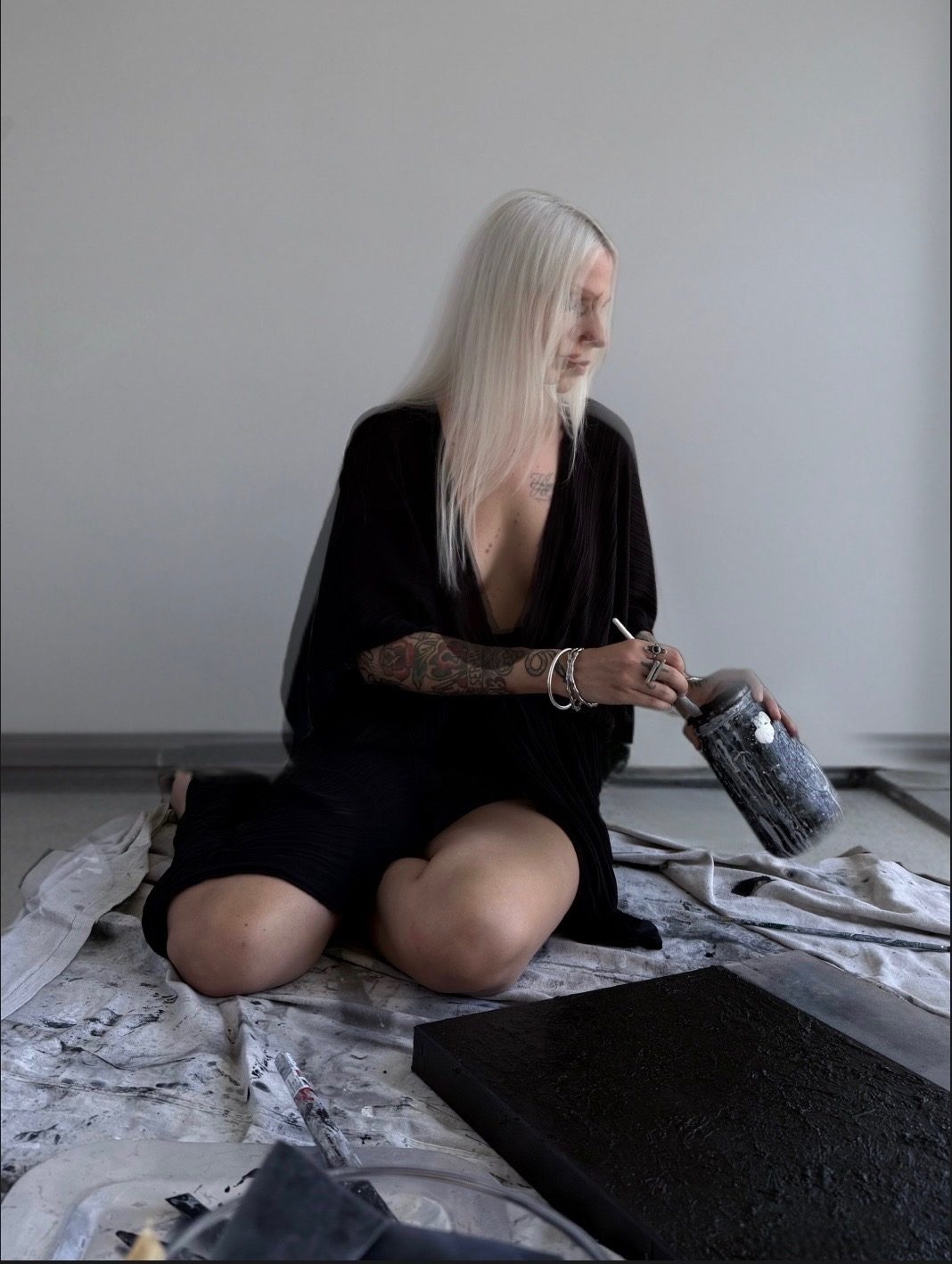
Right: Artefakt Studios in the studio.
"I'm still using materials associated with construction, but I'm no longer interested in following the instructions."
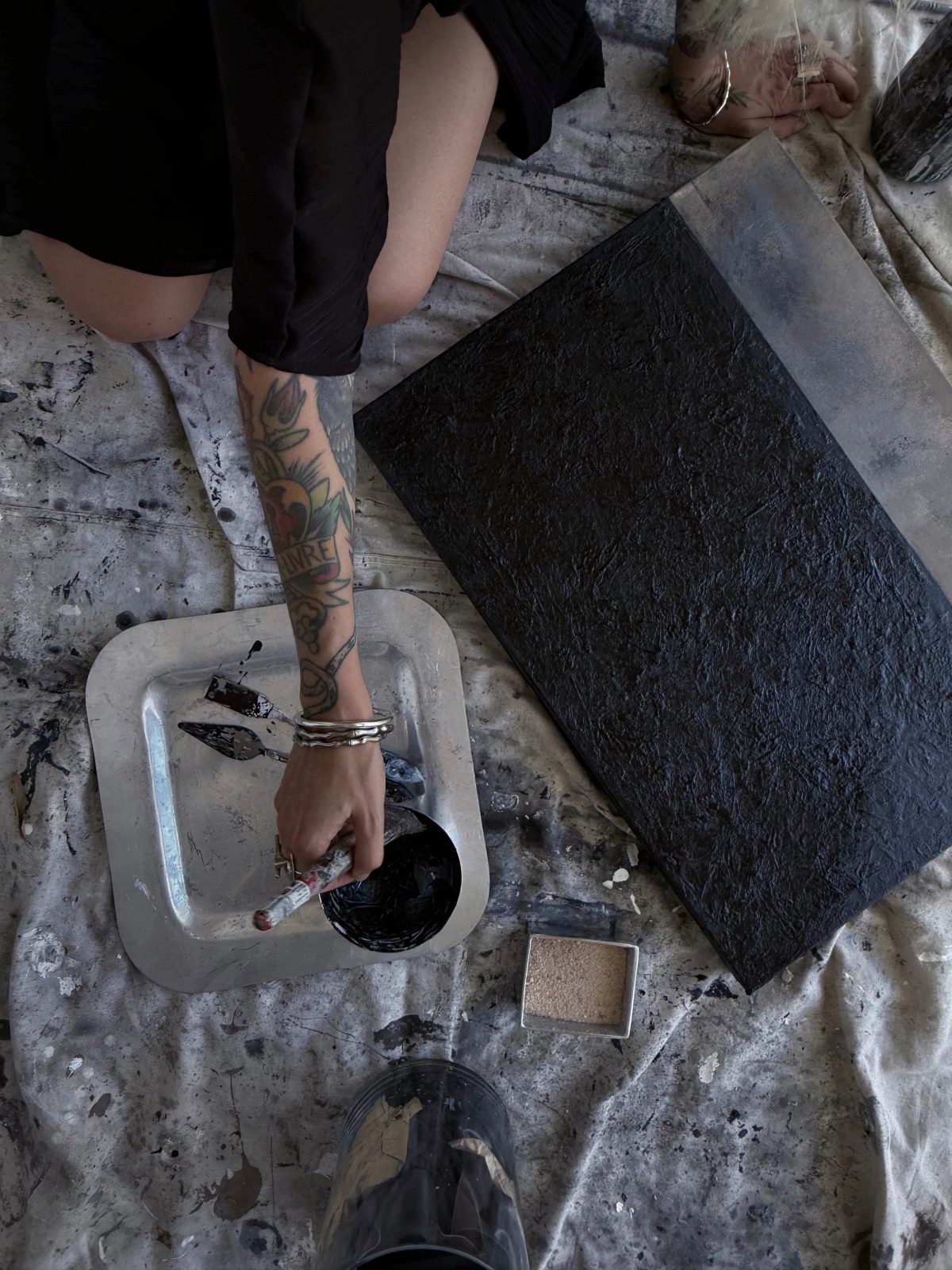
Artefakt Studios, Absolution (detail), behind the scenes in the studio.
You closed out a busy stretch this year: the Sikora Arts group show in Cortland this spring, the Roots to Runway Afterparty at ORCA in April, plus the Saatchi Art feature last fall. What's next for you and Artefakt? Any shows, collaborations, or new material you're pulling into the work?
I have more showings with ORCA planned, with the next one taking place October 4th during the Atlanta Art Fair. But beyond those immediate exhibitions, my main focus is on continuing to create new work and pushing into larger scale.
I'm still very much in a period of building the practice. I want to keep strengthening my discipline, experimenting with the materials, and seeing how the work evolves as I give it more time and space. I don't have a completely defined destination for it yet, and I think I'm actually okay with that. At this point, I'm more interested in staying committed to the work and seeing where it takes me.
Cover Image: Susannah Hightower of Artefakt Studios, in the studio.