COFFINS FOR PETS, NUMBERS FOR STONES: IN CONVERSATION WITH CHARLES DEGEYTER
CONVERSATION BY SELIN KIR
CO-FOUNDER, CURATOR
21 SEPTEMBER 2026 — GHENT, BELGIUM
Charles Degeyter builds houses for things that do not last. Trained as an industrial designer in Ghent and formerly a screen printer for Nine Inch Nails, the Melvins and Pentagram, the Belgian artist now works in taxidermy, resin, 3D printing and engraved stone, and his subjects are the ones that carry their shelter with them: hermit crabs, bees, beloved pets. His childhood home in the south of France survives only as a ruin overrun by crustaceans. He has given a hermit crab a shell modelled on the family dog. His petroglyphs come with counterfeit museum inventory numbers, as if a seven-year-old's drawings had been dug from the earth. For his recent exhibition Life in Cold Blood, he masked beehives in black metal corpse paint, then hoped they might shelter us as well. In this conversation, he speaks about memory as a slow fossilisation, ambiguity as a principle, and why a work whose meaning is settled at birth is hardly worth making.
You spent your childhood summers at your father's house in southern France, the same house that reappears in Mas Del Bos as a sinking, abstracted ruin, overrun by crustaceans and built at the scale and logic of a toy playset. What is it about that place, out of everywhere you could draw from, that keeps pulling you back to rebuild it? And why crustaceans specifically as the thing that overtakes it?
The house you grow up in plays a crucial role in your life and is a place you often revisit emotionally. For a while, my father lived in the middle of nowhere in the South of France, in a slightly dilapidated but charming house with a little tower. It reminded me of Gargamel’s house from The Smurfs, without hot water, a shower or heating, and, apart from some electricity, unchanged since the 1800s.
It’s not that I want to accurately rebuild or relive the house as it was in the past. It’s more that I want to find out what is left of it in my memory, so I don’t work from pictures. In reality, the house has probably been renovated or changed, but in my mind it lives on as a ruin, continually crumbling.
The hermit crabs are connected to this idea of memory, decay and transformation. I find them fascinating because they inhabit the remnants of past life: shells and, in recent times, human waste. They therefore become a kind of symbol for transience, but also for the way in which nature eventually reclaims everything.
As time passes, the houses of our childhood and the memories attached to them become something almost sacred. The particular shape of the house with its wide tower gives it an almost iconographic quality. This is one of many reasons it keeps returning in my work. The house turns into a shrine of memories, but the memories themselves are unstable. Over time they fade until eventually only their skeleton, or maybe their essence, remains. They kind of crystallize with time. I think that is what I am trying to find in the house: not an accurate reconstruction of the place, but the essence of what it has become for me.
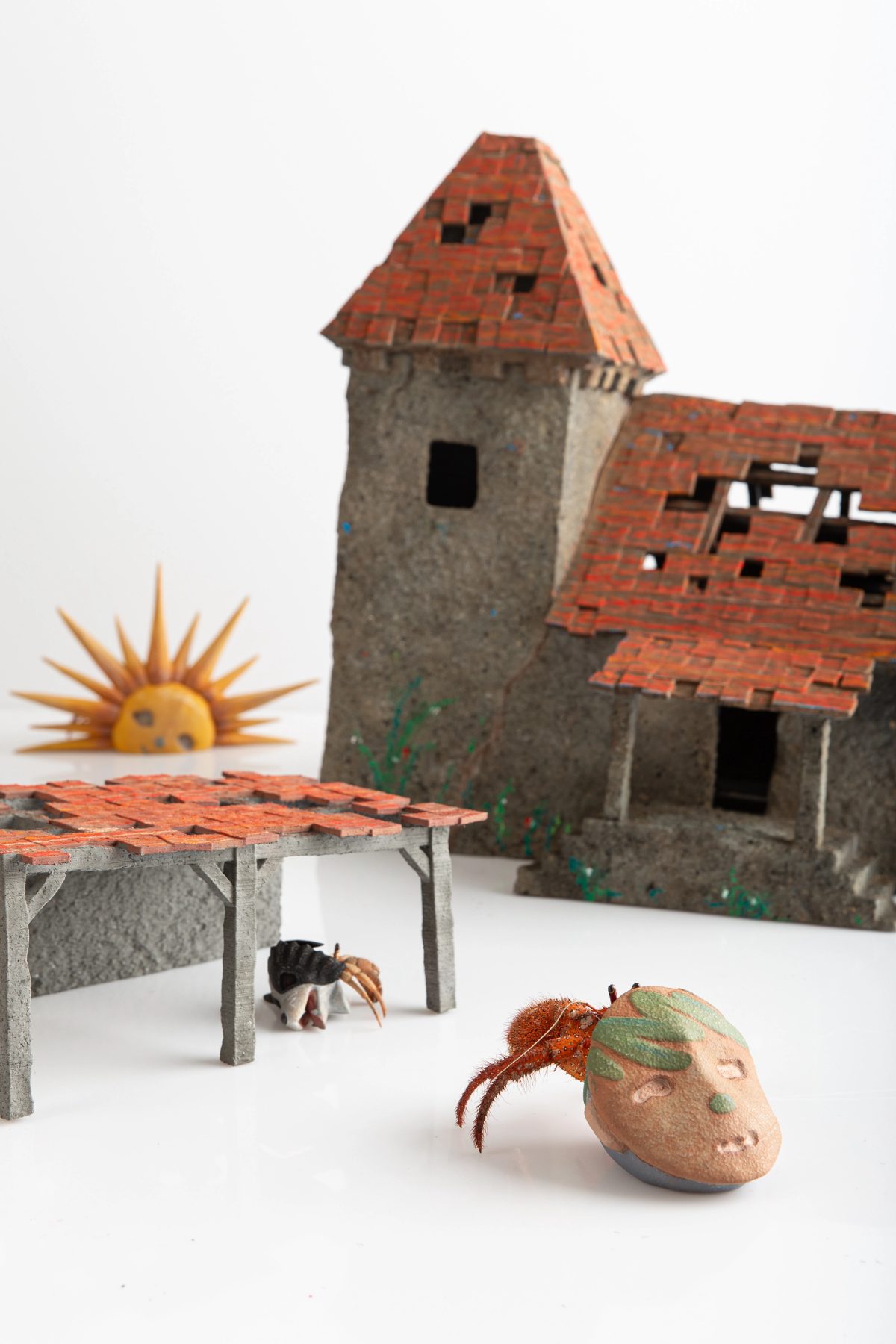
Charles Degeyter, Mas Del Bos, 2025, installation view, NADA, New York (USA)
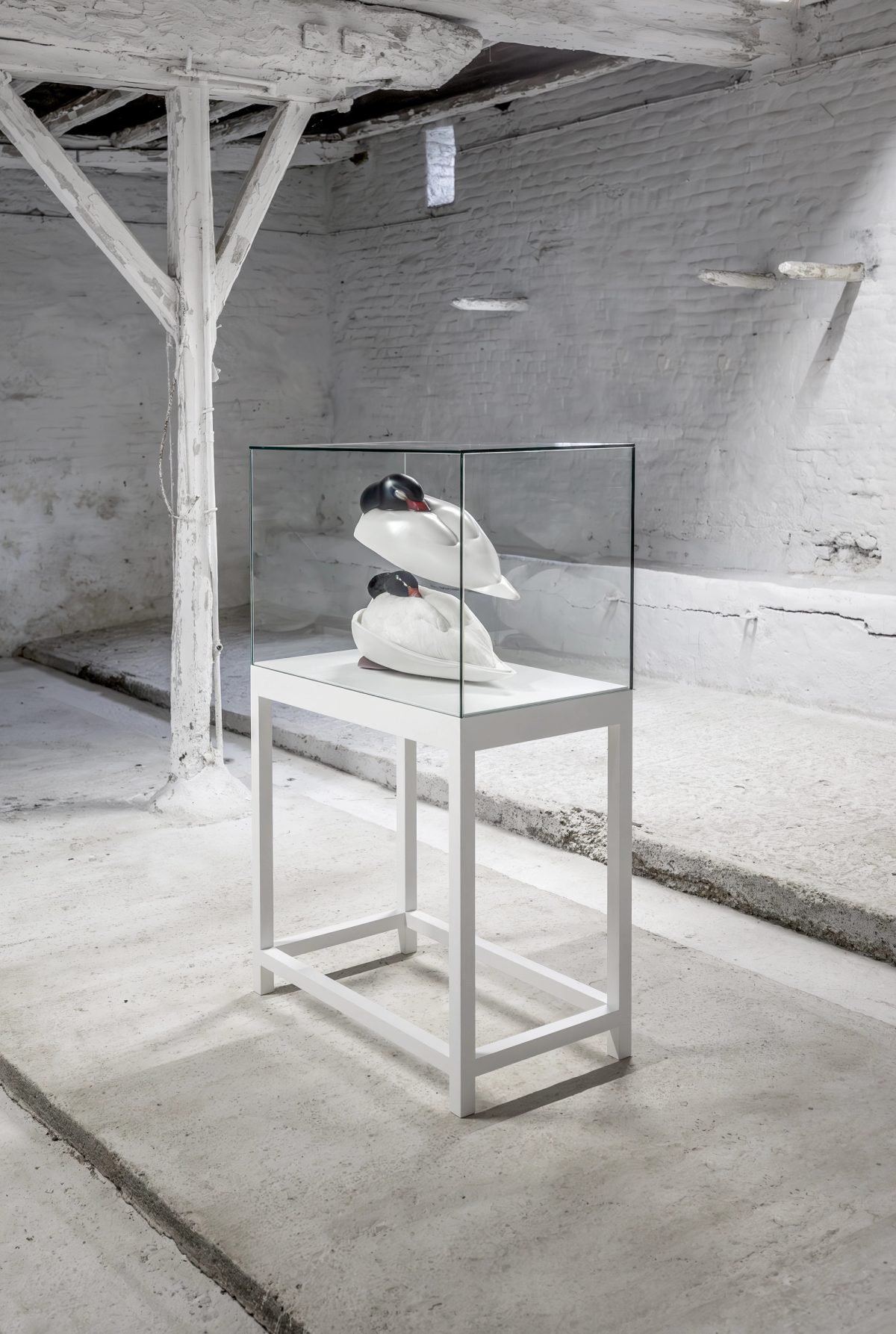
Your sarcophagi house preserved pets inside coffins shaped like cartoonized versions of the animals themselves. How do you decide how much to caricature an animal you actually knew, versus how much to preserve its real likeness? Is that a negotiation with grief, or purely a formal one?
The sarcophagi started in 2019 from a critique of domestication. I initially made cartoonised coffins for deceased domesticated animals, as a comment on the somewhat questionable existence of pets. I was interested in taking their ultimate transformation into an idealised and often cartoonish object. American squeaky toys from the ’60s and ’70s were an important sculptural reference at this stage.
Over time, the series evolved into a more ritualistic approach to remembrance, where I started making actual sarcophagi for people’s recently deceased pets. The representation became more subtly idealised and took on a more sacred character. The poses became slightly more naturalistic, and these days I often aim for this sense of eternal sleep, with Baroque nature morte paintings as reference.
I usually don’t know these animals personally, so I ask the owners for photographs of the animal when it was still alive, as well as images of the positions in which it typically slept. This allows me to create a fitting and personal representation of the animal.
Stylisation and the exaggeration of certain features of an animal help to express emotions that go beyond its natural likeness. For me, this approach is similar to the Fayum portraits and the more sculptural stucco death masks, where certain features of the deceased are enlarged or emphasised, such as the eyes, hairstyle or jewellery. In a similar way, I use exaggeration and stylisation to bring out something beyond the physical likeness of the animal.
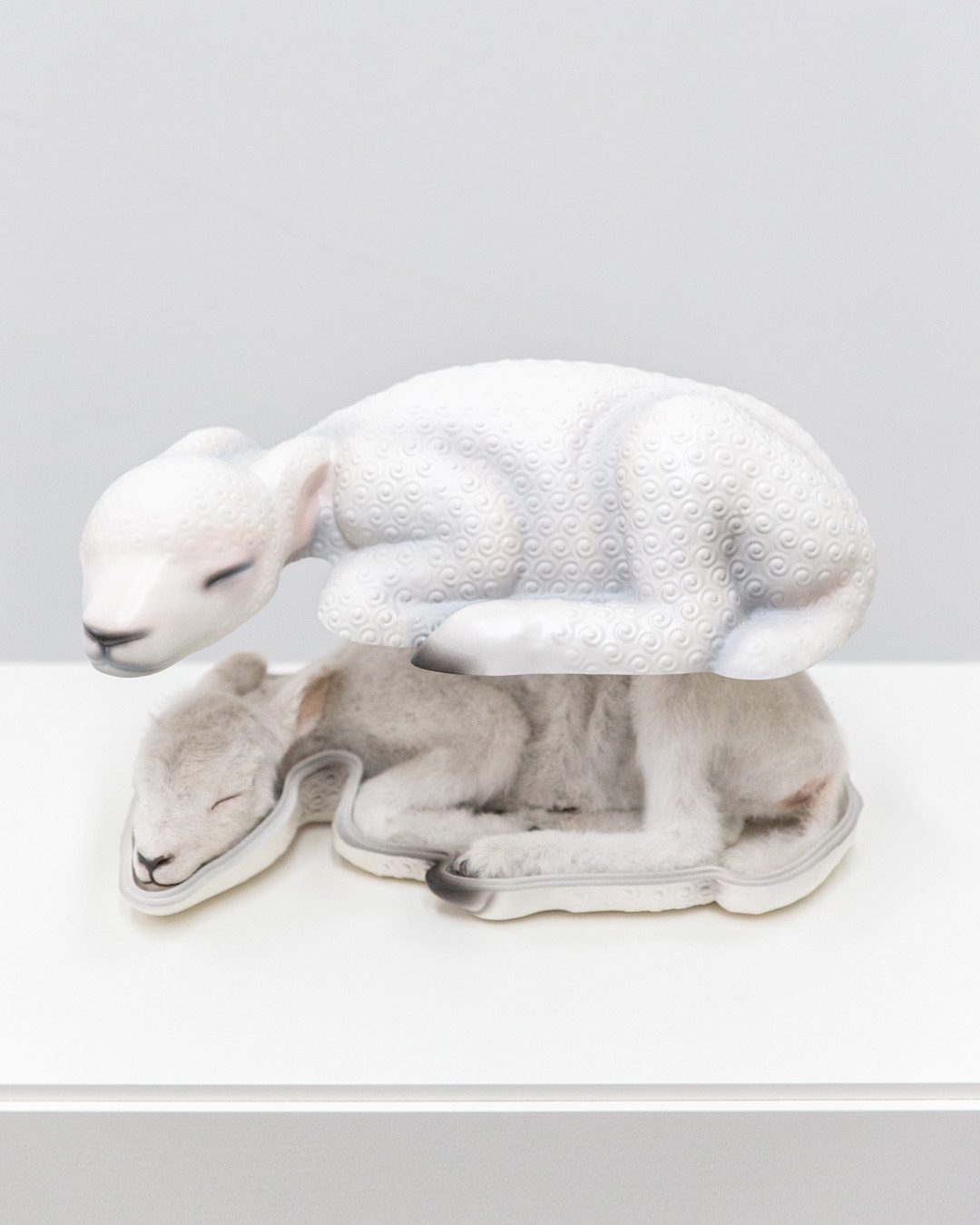
Left: Charles Degeyter, Aimee, 2025, Ovis aries, resin and airbrushed acrylics, 40,5 x 22 x 14 cm (closed)
Right: Charles Degeyter, Céleste, 2024, installation view, This is my Church, Tourinne La Grosse (BE)
The high reliefs in Life in Cold Bloodcompress past, present, and future into a single flattened moment, like a fossil or a flower pressed into a herbarium. When you’re composing one of these scenes, how do you choose which moment gets frozen? Is it always autobiographical, or do the invented futures come from somewhere else?
The characters in the current exhibition refer to my partner, the stray cat in our neighbourhood, and the native black bees I’m housing in my beehive, so they are at least rooted in autobiographical experiences. The scenes usually start as intuitive drawings in my sketchbook, drawing from personal experiences, things I’m experiencing at the moment, but also from a positive, emotive future I envision for myself and my environment. Often they’re small sketches I make on the train to work.
Time is almost never linear in these works. While the viewer might see a captured moment from the past, there’s no clear past, present or future for me in the reliefs. They coexist together. The non-linearity of time in other cultures has always interested me. The Aymara in Bolivia, for example, view the past as visible and in front of them, while the unknown future comes from behind.
The stray cat Jackson, who often visits me while I am working at home, is a representation of the present. I also depict myself as a younger version of myself, introducing the past alongside historical references such as the Josef Hoffmann chair on which Jackson sleeps, as well as the visual affinities with fossils and bog bodies.
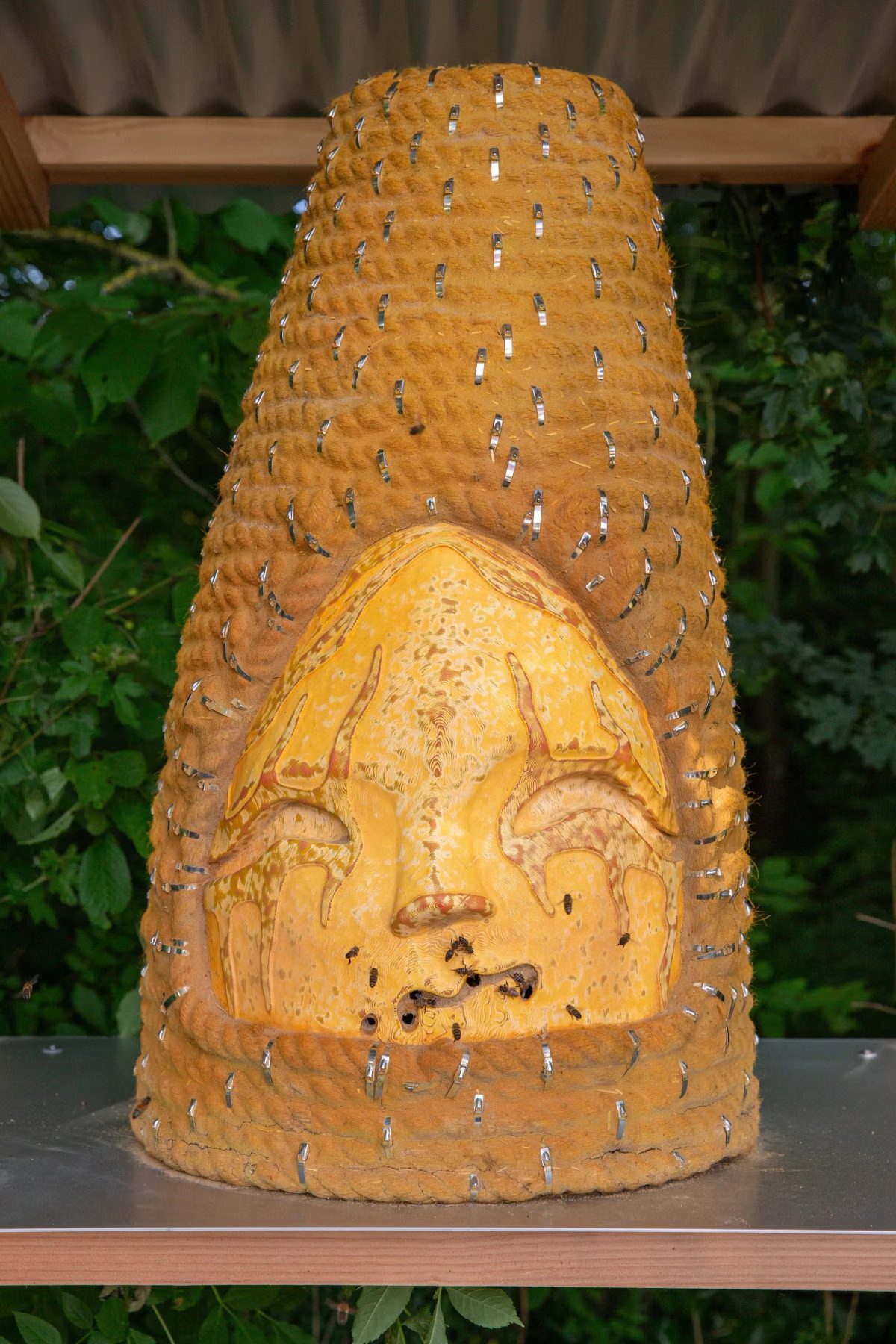
At the centre of the exhibition are the beehives, which point towards a hopeful future: one in which we might imagine a form of coexistence with our indigenous black bees, Apis mellifera mellifera.
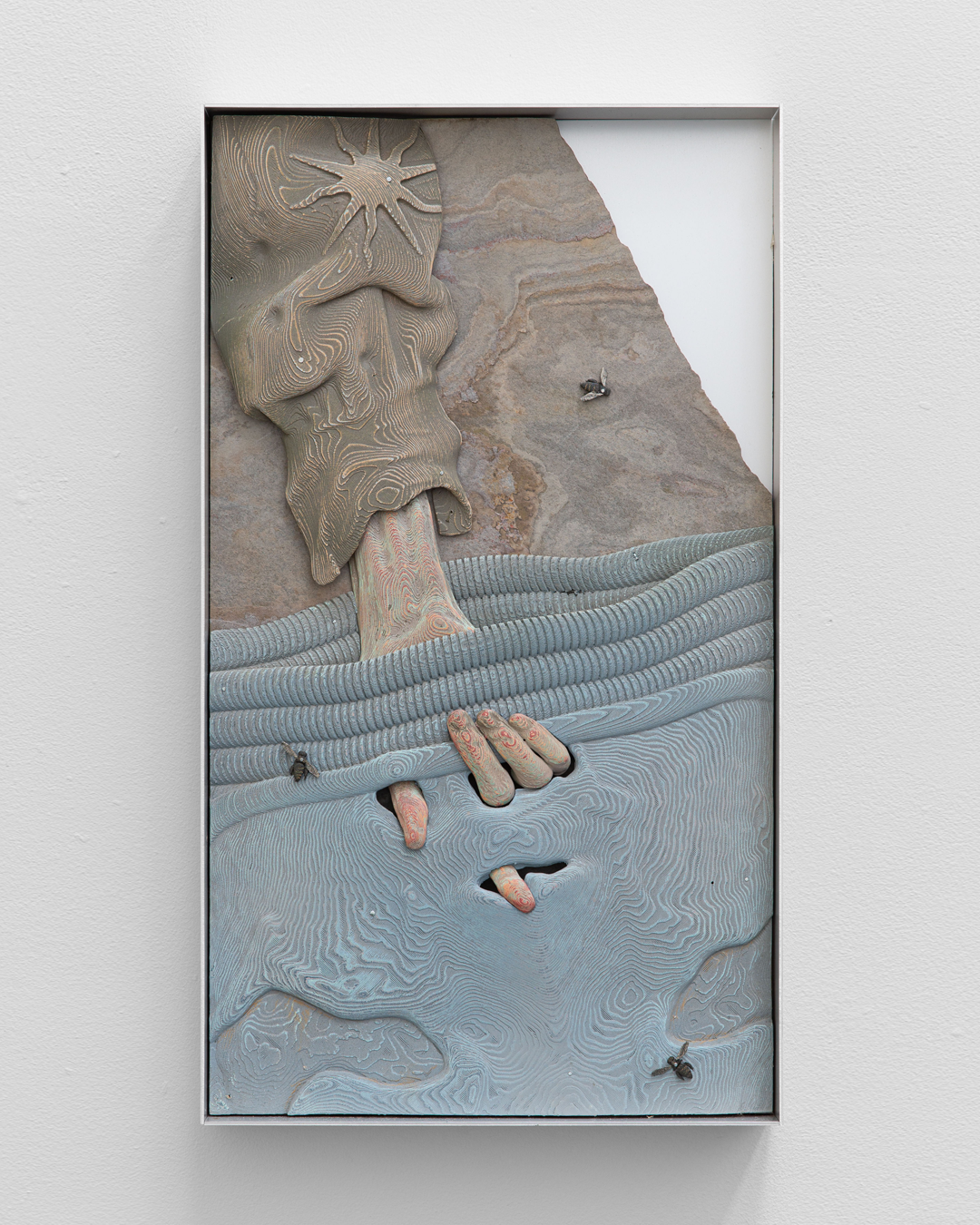
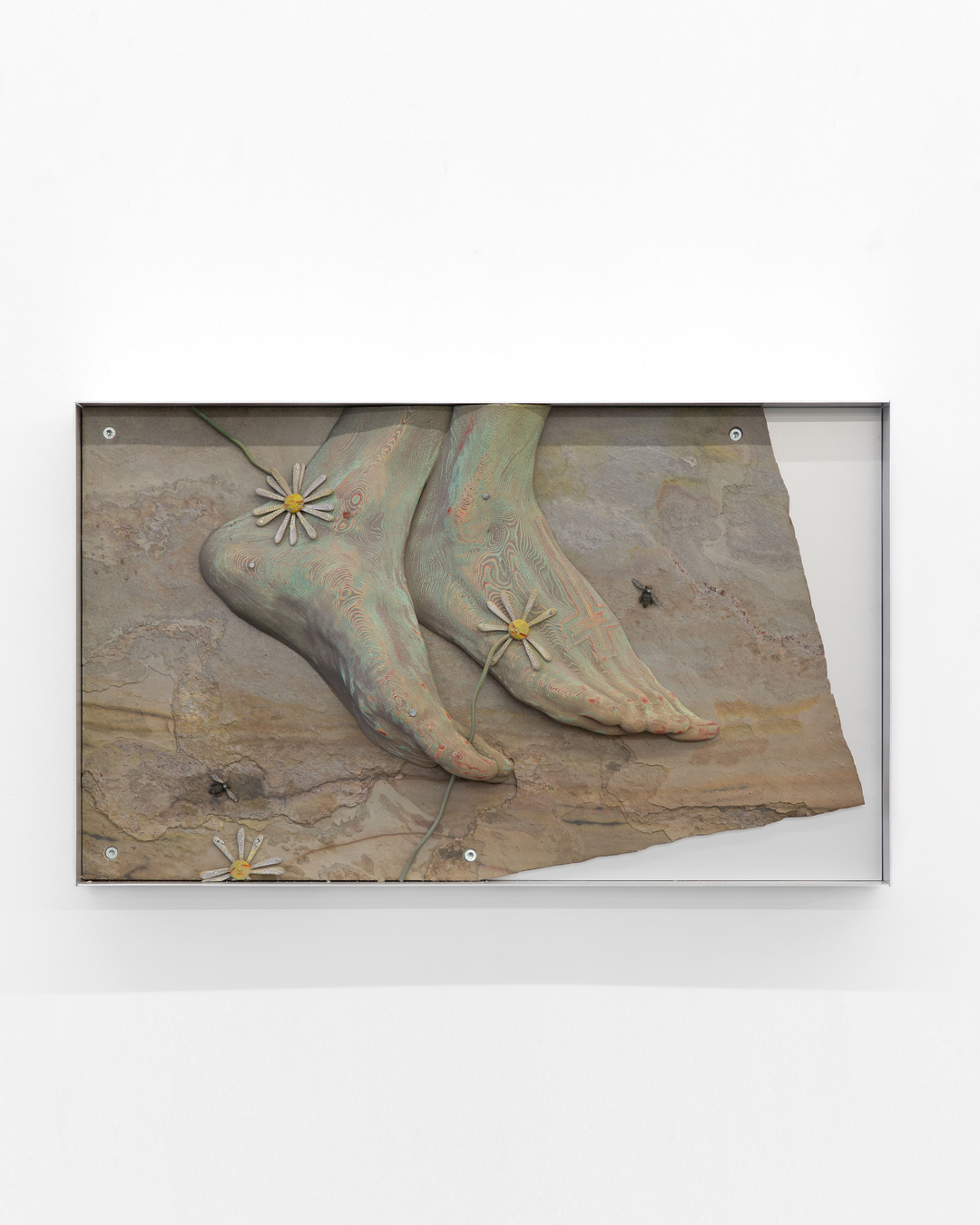
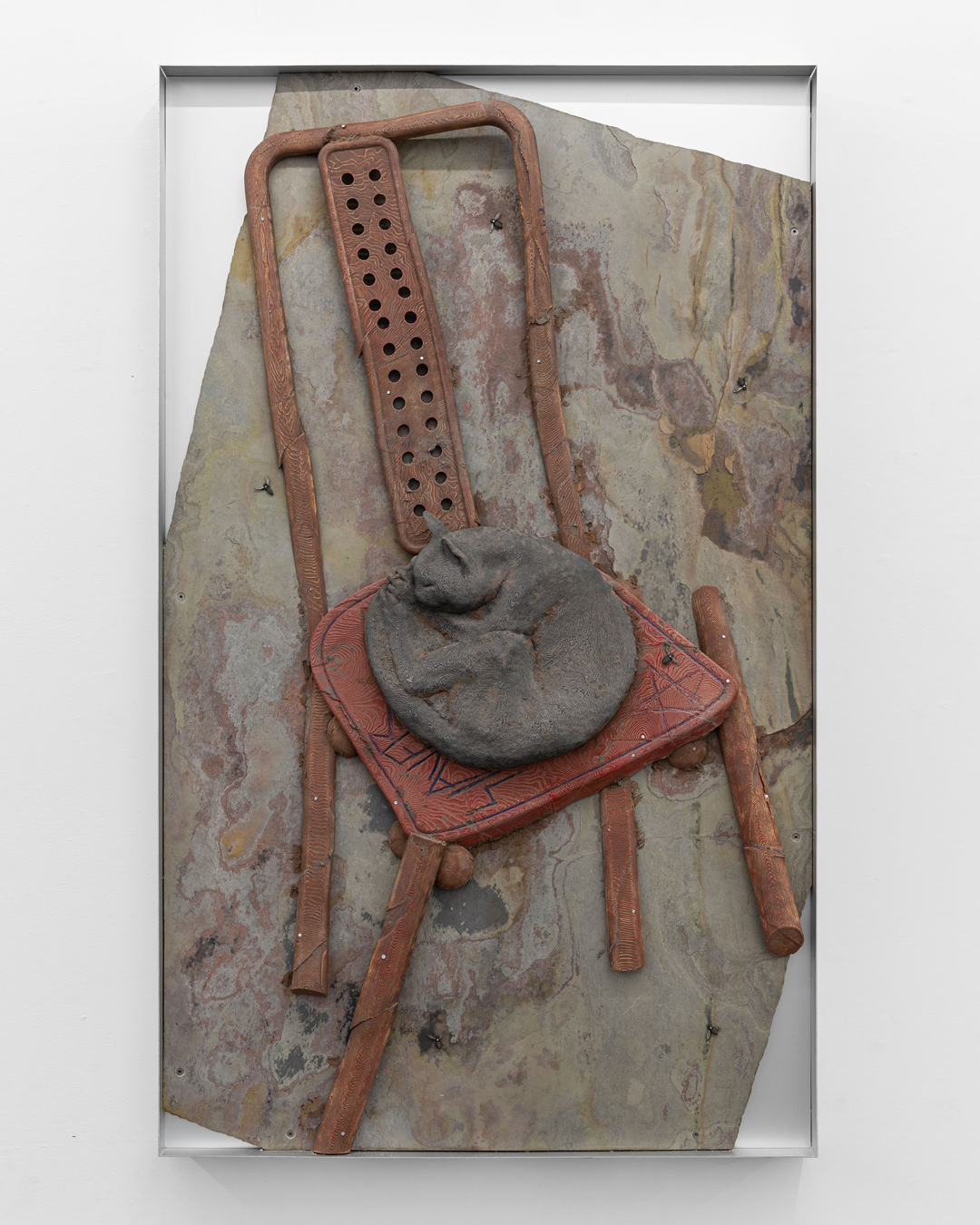
Left: Charles Degeyter, Clinging (Fossil Plaque), 2026, stone, 3D print, aluminum and mixed media, 53 x 30 cm
Middle: Charles Degeyter, Void Cross (Fossil Plaque), 2026, stone, 3D print, aluminum and mixed media, 56 x 33 x 6 cm
Right: Charles Degeyter, Catnap (Fossil Plaque), 2026, stone, 3D print, aluminum and mixed media, 127 x 77 x 13 cm
The Bannkörbe tradition you’re reworking used masks on beehives to ward off malevolent forces; you’ve layered in corpse paint from black metal, an aesthetic built partly on anti-humanism. Are you treating the hive as protection for the bees, protection from us, or something closer to a shared refuge for both?
I deliberately keep it ambiguous, as I want people to interpret the hives in a way that feels right to them. All three of the suggested interpretations are valid.
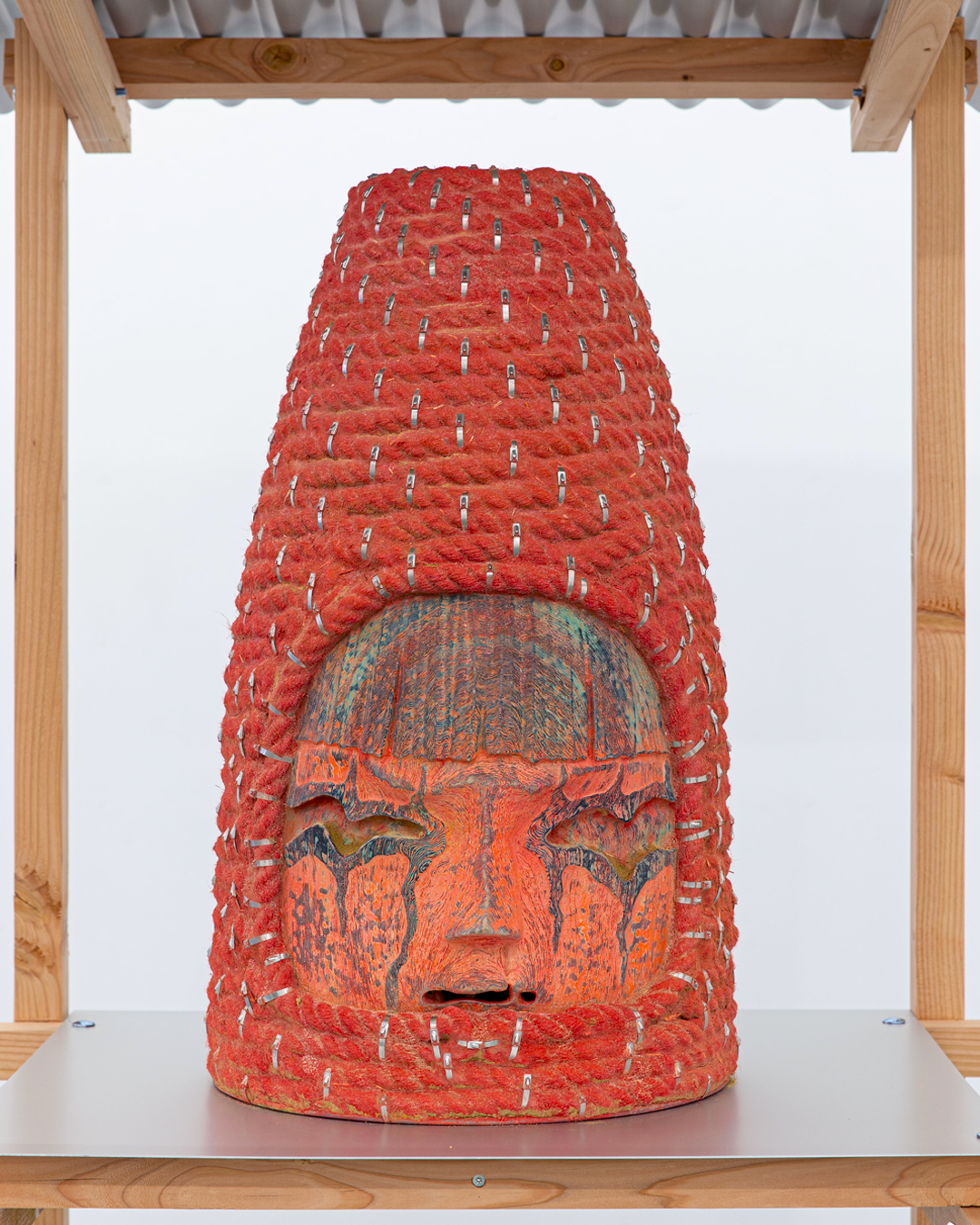
By drawing references from second-wave black metal, probably the historically most problematic subgenre of metal due to its very turbulent starting period in the ’90s, I draw parallels to broader societal problems we’re experiencing today, such as radicalism and intolerance, as things we need to ward off.
At the same time, black metal has largely risen above this problematic past into something more positive, focusing on closer relationships with the natural environment and cultural heritage. This is reflected in zines such as Becoming the Forest. As houses for indigenous bees, the beehives focus on exactly this positive future and offer a refuge not only for the black bees but, in a broader sense, also for humanity itself.
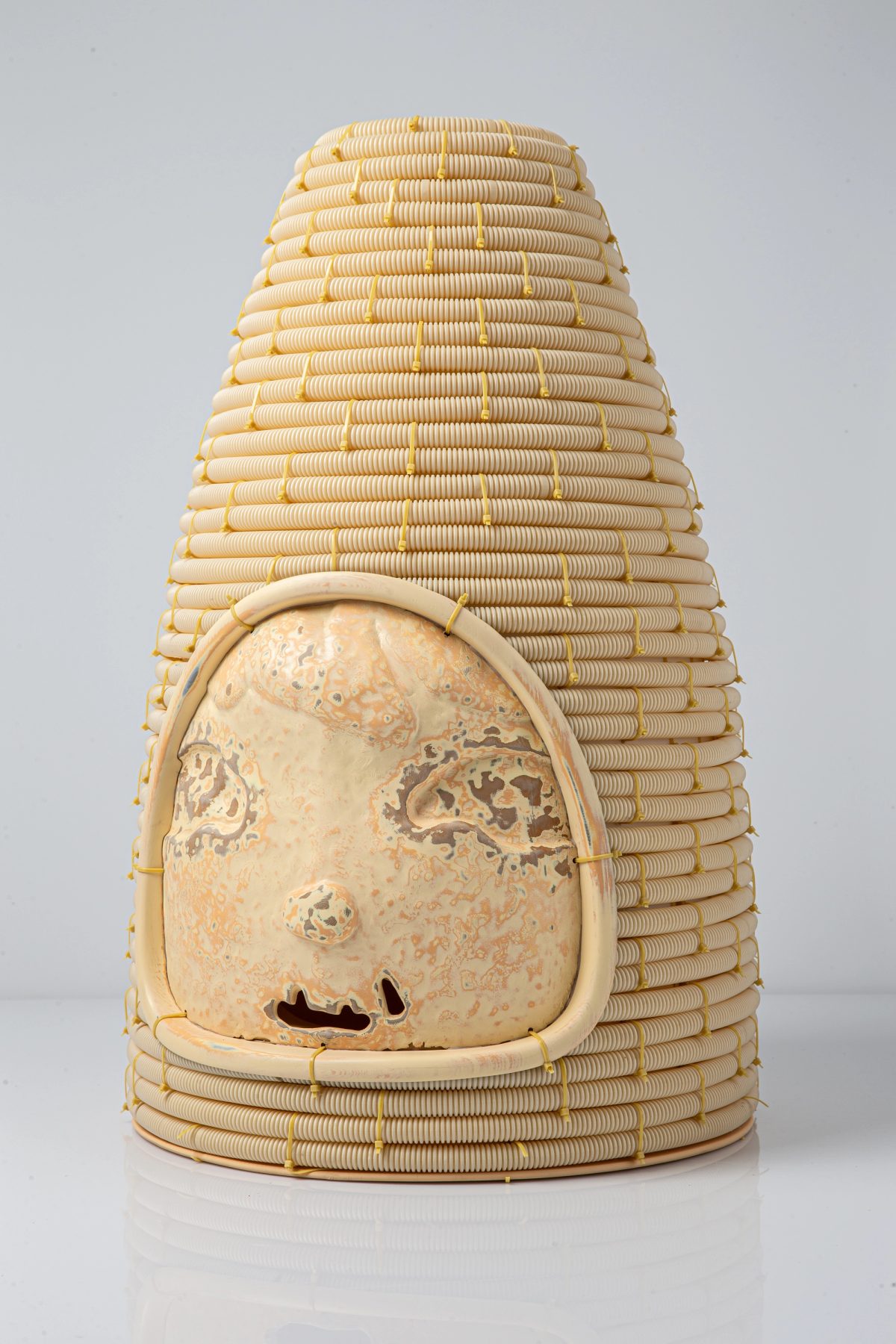
Left: Charles Degeyter, Biekorf prototype - beige, 2026, PVC tubing, tyraps, 3D print and acrylics, 45 x 45 x 75 cm
Right: Charles Degeyter, Biekorf - Red, 2026, hive (organic rope, loam, metal tyraps, 3D print, acrylics and steel rods), 80 x 45 x 45 cm (hive)
"There is nothing more uninteresting to me than creating a work whose meaning is completely resolved at the moment of its creation."
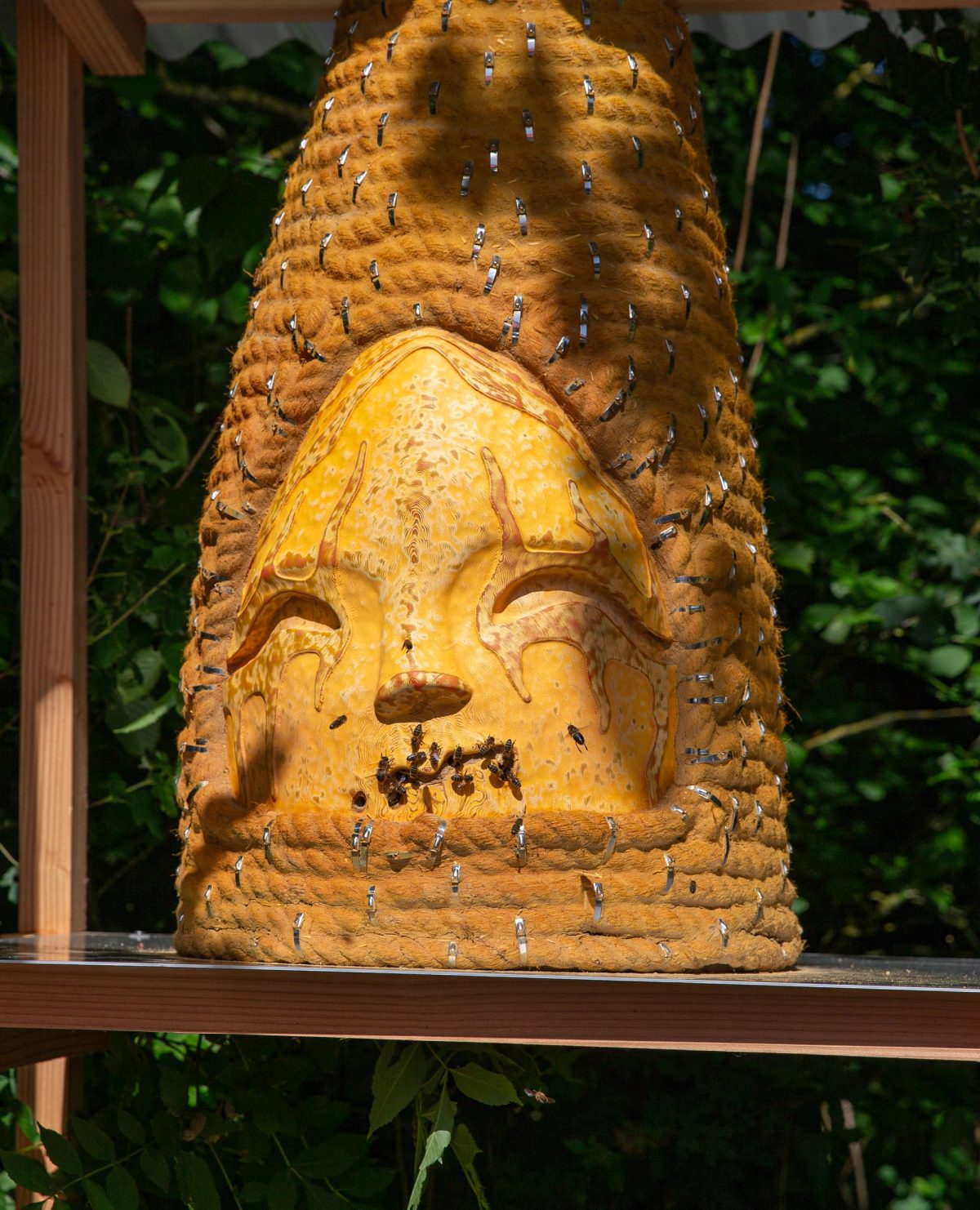
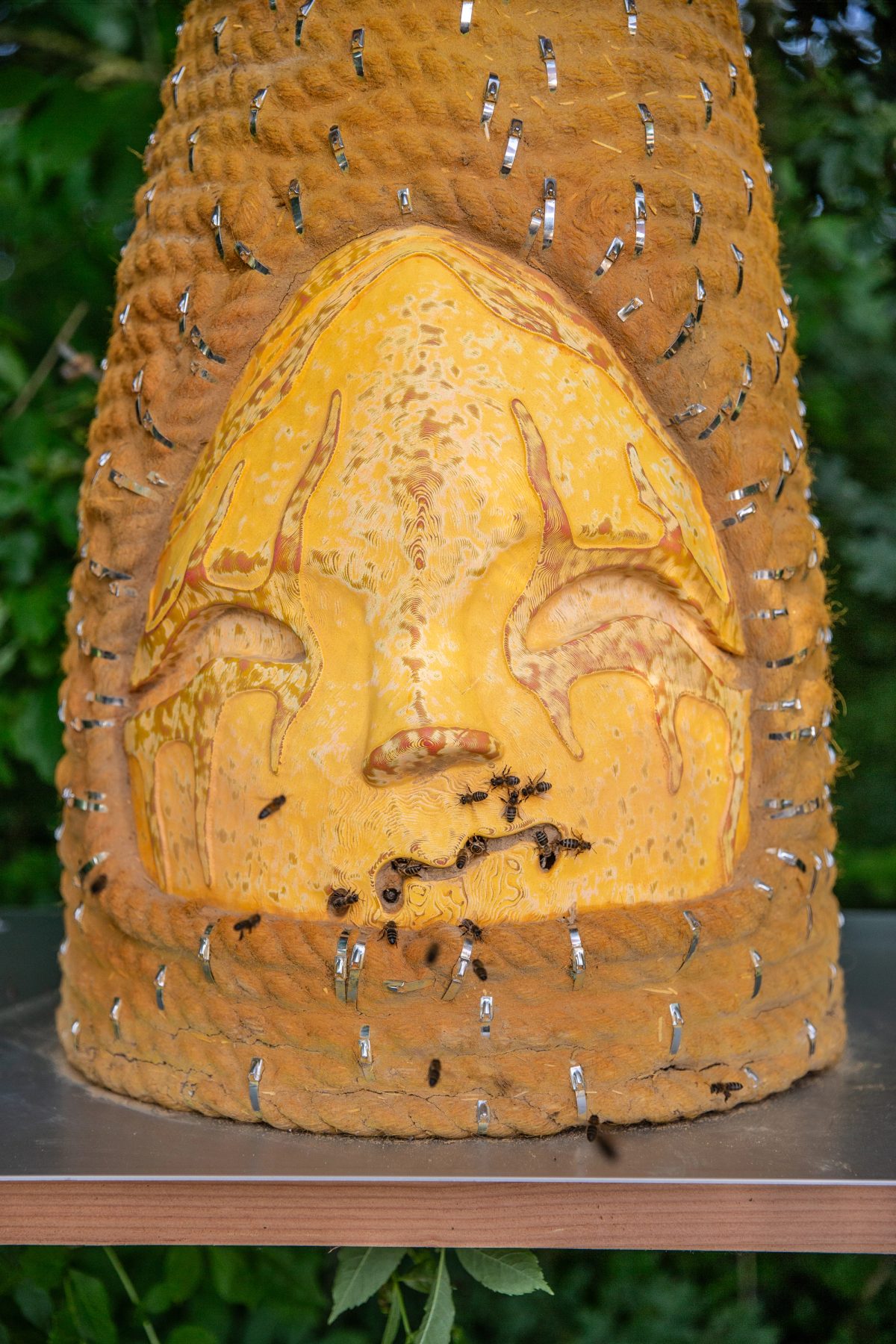
Charles Degeyter, Biekorf yellow, 2026, installation view, Deb’s Tea Garden, Heuvelland (BE)
The petroglyphs take childhood drawings and engrave them into found stones, which then get labelled with fake inventory numbers as if they were archaeological finds. When you’re inventing those catalog numbers, are you building a consistent fictional archive with its own internal logic, or is each one invented in the moment?
The labels and inventory numbers are mostly invented, but they are based on the logic and formats used in museum archives. One of my biggest passions is the traditional arts of Africa, Oceania and the Americas, and I am currently building an archive that traces the labels and inventory numbers historically attached to traditional African works of art. Many of these works are now, unfortunately, scattered in private collections, often stripped of their original contexts and stories. This research may eventually result in a publication that helps reconstruct parts of their history.
I am particularly interested in these labels and inventory numbers because they are traces of a work of art’s life, while also reflecting the human impulse to label, archive, study and control the world around us.
For now, the inventory numbers and markings I add to my own works have a more symbolic than strictly archival meaning. But I can imagine that this might change at some point in the future.
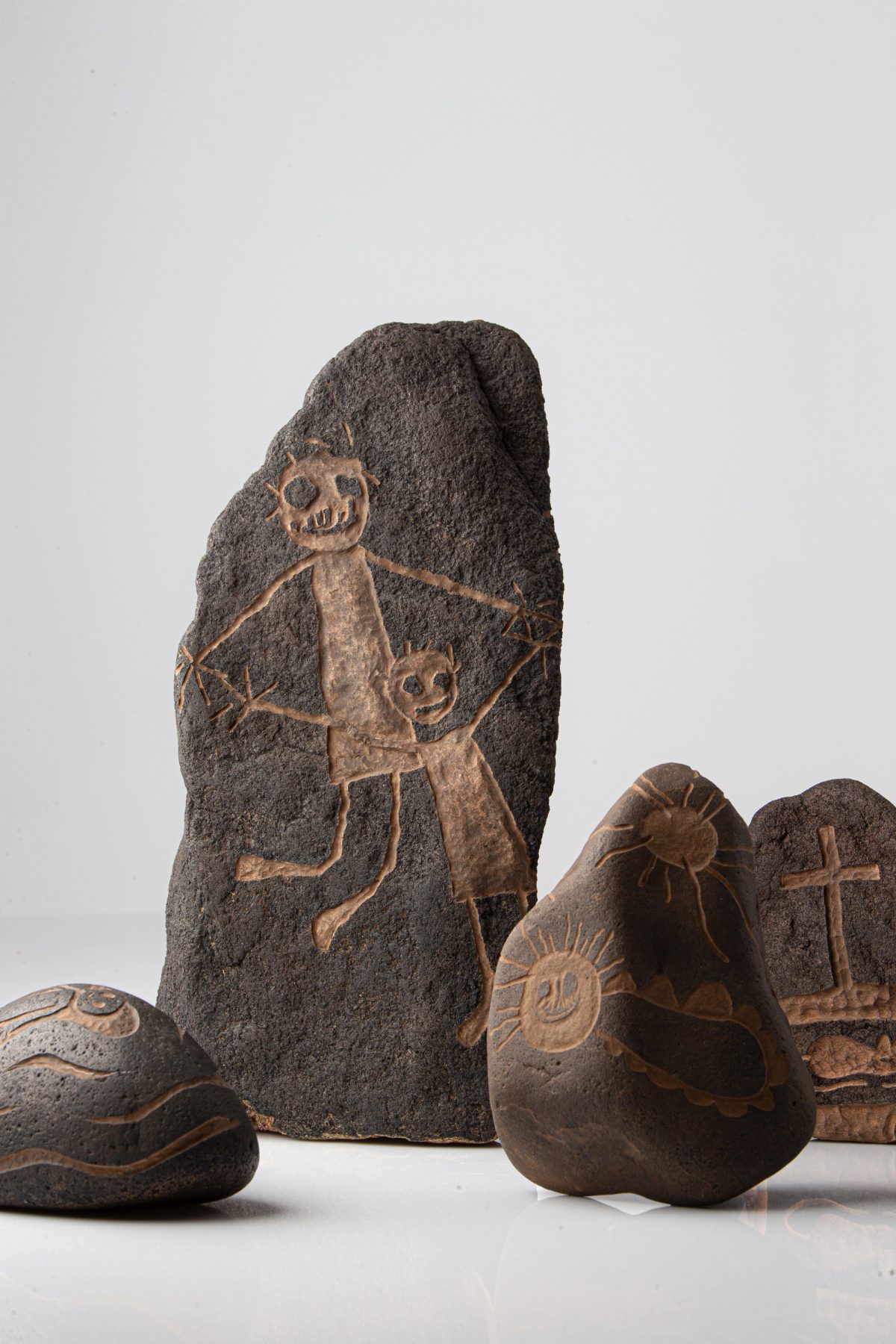
Charles Degeyter, Petroglyphs, 2024, engraved stone, variable dimensions
Field for Preyframes its central question as “who is the prey, and who is the hunter”. In your own sculptures within that show, is there a hunter and a prey you had in mind, or did you deliberately leave your own pieces unresolved on that question too?
I tend to deliberately leave much of the meaning in my works open-ended, even to myself. I don’t like creating works that are completely comprehensible or fixed in their meaning. I find it much more interesting to move back and forth between different interpretations, allowing both the viewer’s understanding and my own to change over time. This also allows certain series to develop in directions I couldn’t have anticipated when I first began them. There is nothing more uninteresting to me than creating a work whose meaning is completely resolved at the moment of its creation. It would leave me wondering why I felt the need to create it in the first place.
The sketches I made for Field for Prey were very spontaneous and ambiguous. At one moment, there seemed to be an affectionate relationship between the two figures, the hunter and its falcon, while at another, one appeared to be devouring the other, suggesting the untamable character of nature. As I developed the drawings, I increasingly felt that the strength of the work lay precisely in this ambiguous relationship, in constantly moving back and forth between understanding and resistance. I think this is something most of us experience, to some extent, in our relationships with the people closest to us.
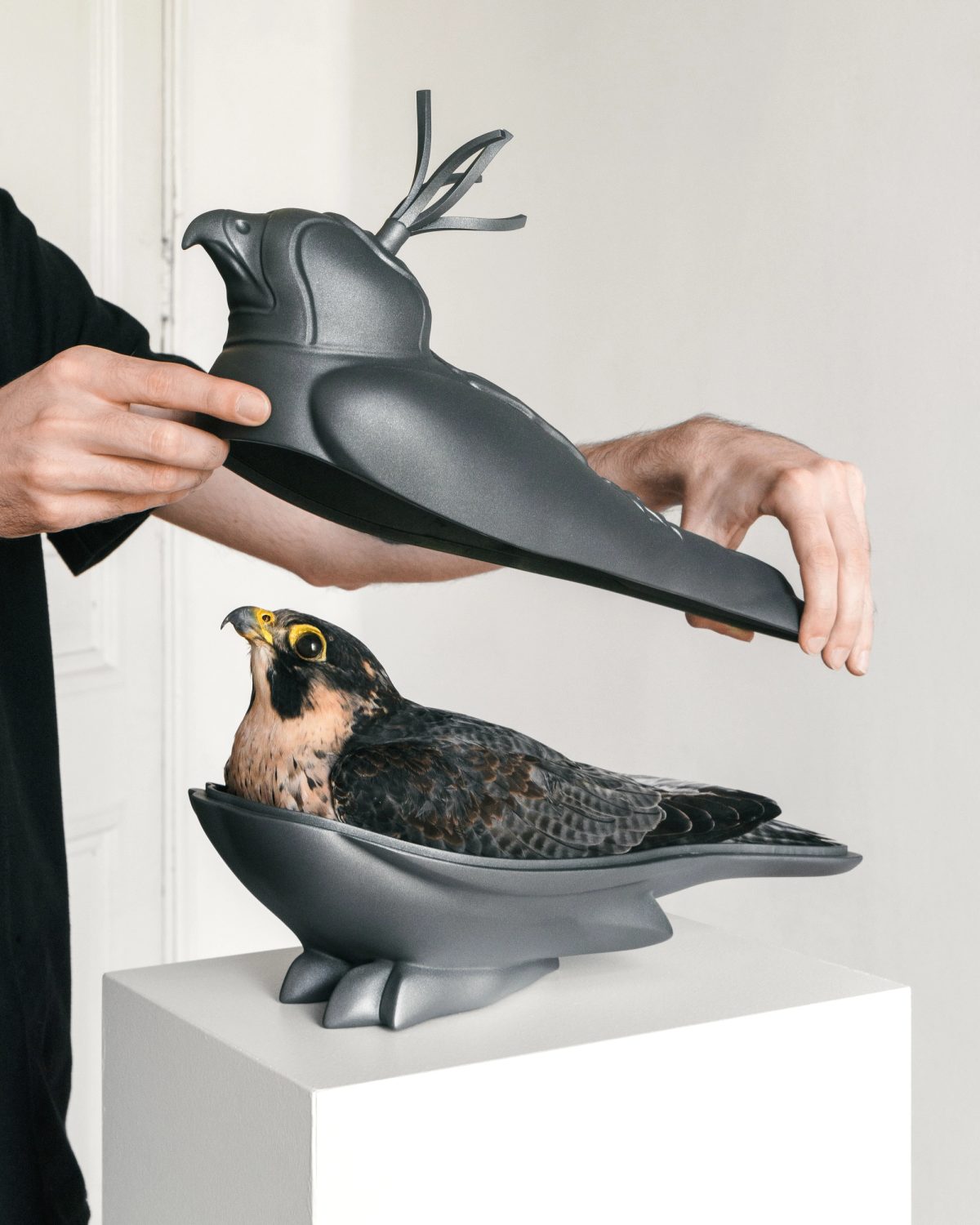
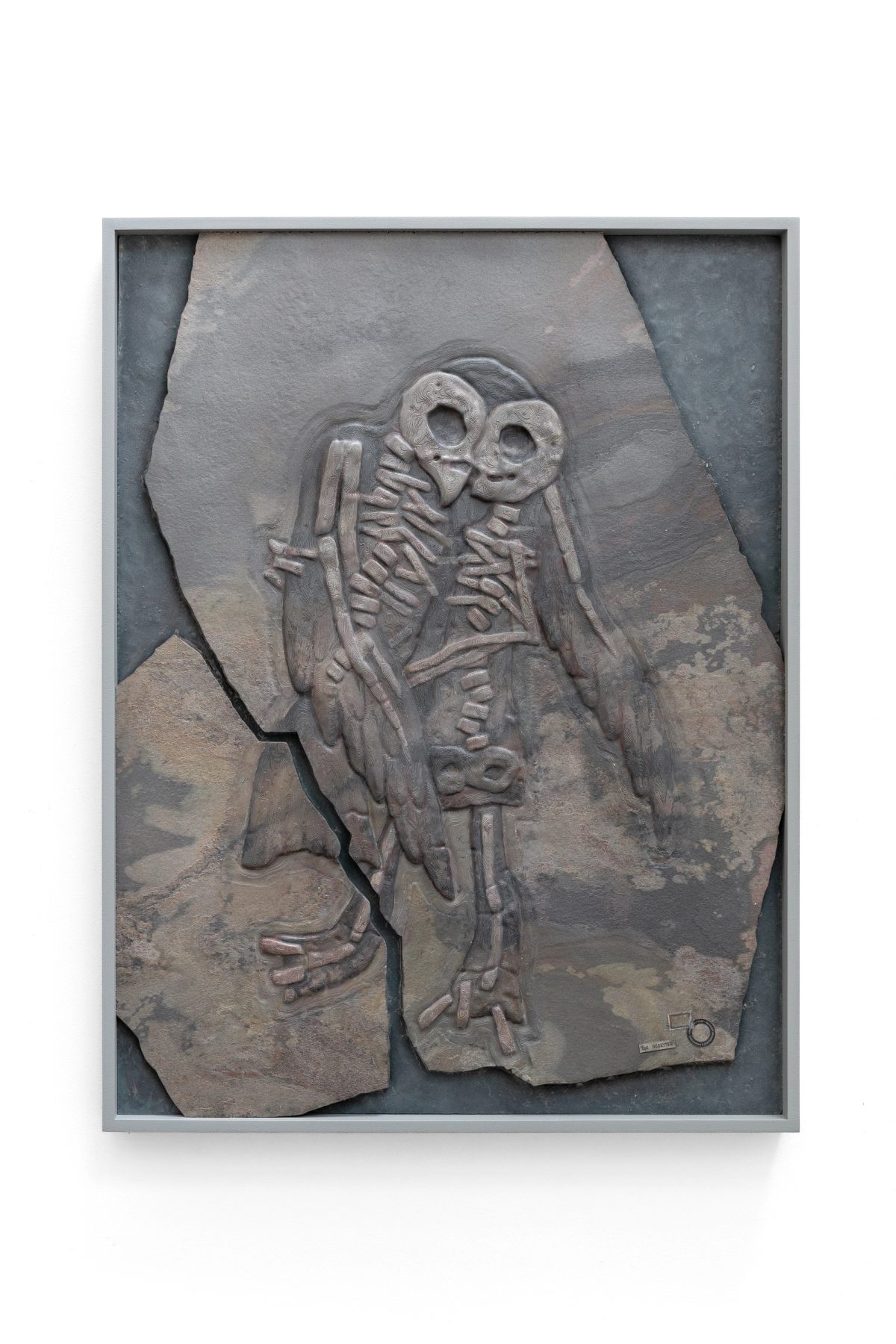
Left: Charles Degeyter, Shevardena, 2024, Falco peregrinus, resin print and acrylic, 26 × 35 × 15 cm
Right: Charles Degeyter, Die to be One, 2024, slate stone, FDM print, gouache, cast, acrylic and wooden frame, 59 × 45 cm
"In the case of the hermit crab with my head as its shell, the work suggests that when I have lost my own existence, other life will find refuge and a safe haven within me."
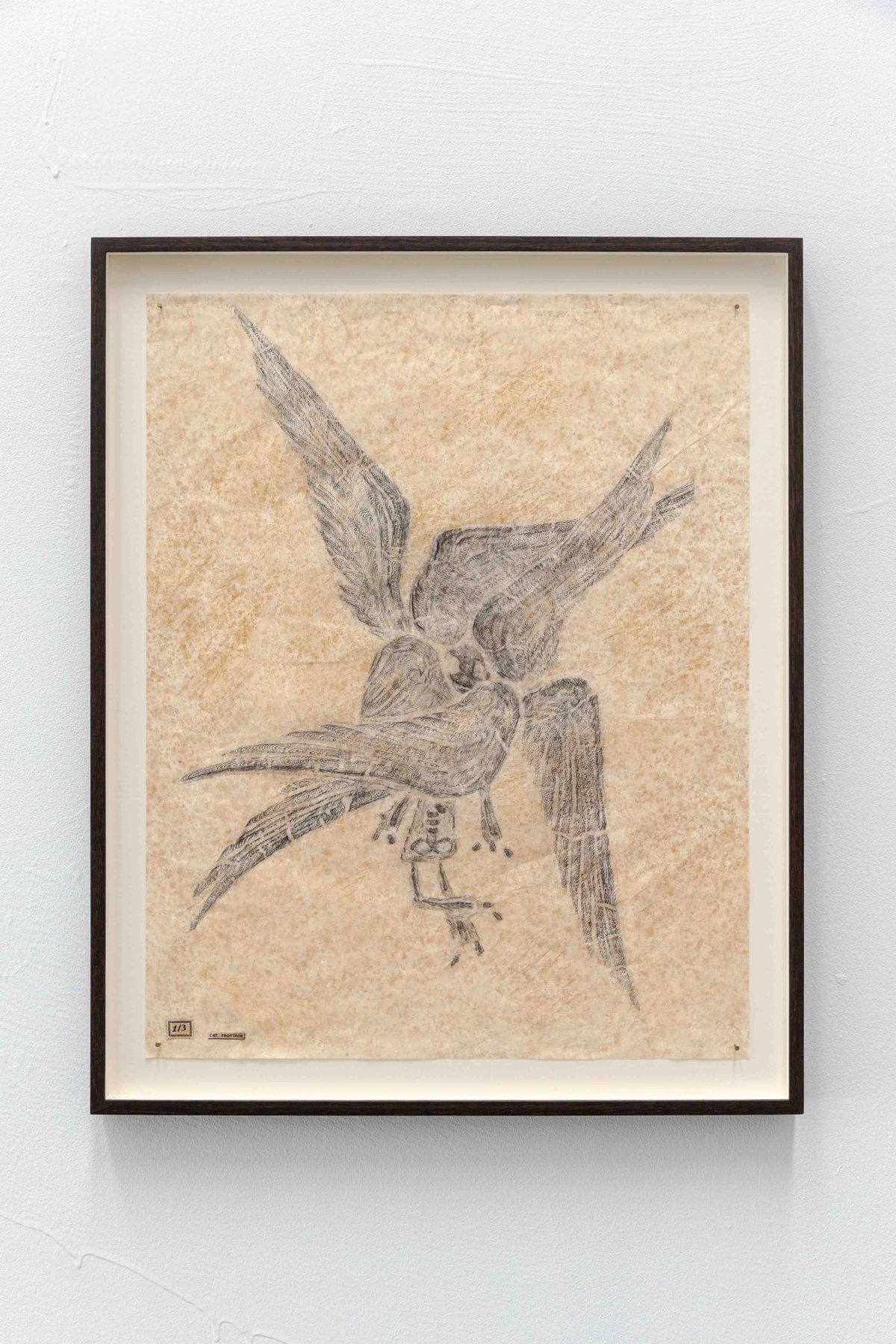
Charles Degeyter, Cherub - frottage, 2024, washi paper and pencil, 59 x 48 cm
You trained in Industrial Design at Ghent and also worked as a screen printer for metal bands like Nine Inch Nails, Melvins, and Pentagram, before this sculptural practice. What did designing for a band's audience, people who already have a shared visual language, teach you about how much you can leave coded versus how much you need to spell out for a gallery audience that doesn't share that vocabulary?
It's been eight years since I last made a screen-printed gig poster, so a lot has changed since then. What I found interesting about making gig posters was the ability to immerse myself in the sonic and visual atmosphere of a band and create work that resonated with its fanbase, while still having almost complete freedom in how I interpreted that world visually. Fans would immediately recognise the references and understand how the work fitted within the broader universe of the band.
When I started creating personal work, I suddenly found myself on my own, without the universe of a band to provide a starting point. It was both frightening and exciting to take a leap into the unknown and begin building a visual and conceptual world of my own. Over the years, that world has gradually expanded and become clearer, both to myself and to my audience.
One of the things I appreciate about contemporary art is that you don't necessarily have to spell everything out. Certain things can remain ambiguous, allowing the audience to project their own experiences onto the work and arrive at their own interpretations and conclusions. For me, this is one of the most exciting differences from the world of gig posters that I came from.
Lately, I've been incorporating references to music into my work in the form of band shirts and logos. I find this particularly exciting because it allows me to introduce these bands and their visual language to an audience that may be unfamiliar with them, while at the same time bringing me back to the starting point of my journey into the arts. At some point, I would like to start making posters again, but with the insights and experience I've gained through working on my personal work.
"I think that is what I am trying to find in the house: not an accurate reconstruction of the place, but the essence of what it has become for me."
You move between engraving, taxidermy, 3D printing, laser cutting, and resin casting, sometimes within a single piece, like the hermit crabs housed in resin prints with gouache and pastel crayon. How do you decide which technique gets to touch a given work? Is it the material dictating the process, or do you already know the process before you've chosen what it's made of?
The works always begin with a conceptual idea, which is usually accompanied by certain material contrasts or textural qualities that I want to explore. These can involve contrasts between natural and sterile materials, such as the combination of taxidermy and a 3D-printed shell, or between warm and cold tones, such as aluminum and wood. At this stage, the work is not yet fully defined, but I have a sense of the qualities I want to pursue.
The specific techniques and materials are usually determined at a later stage, through an iterative process of research, experimentation and testing. Schooled as an industrial designer, I often explore more industrial or architectural materials and techniques. The material itself often dictates the process, rather than the other way around. It can sometimes take me months, or even years, to determine the precise combination of materials and techniques that a work requires. These choices also tend to crystallise gradually over time, as the work or a series develops.
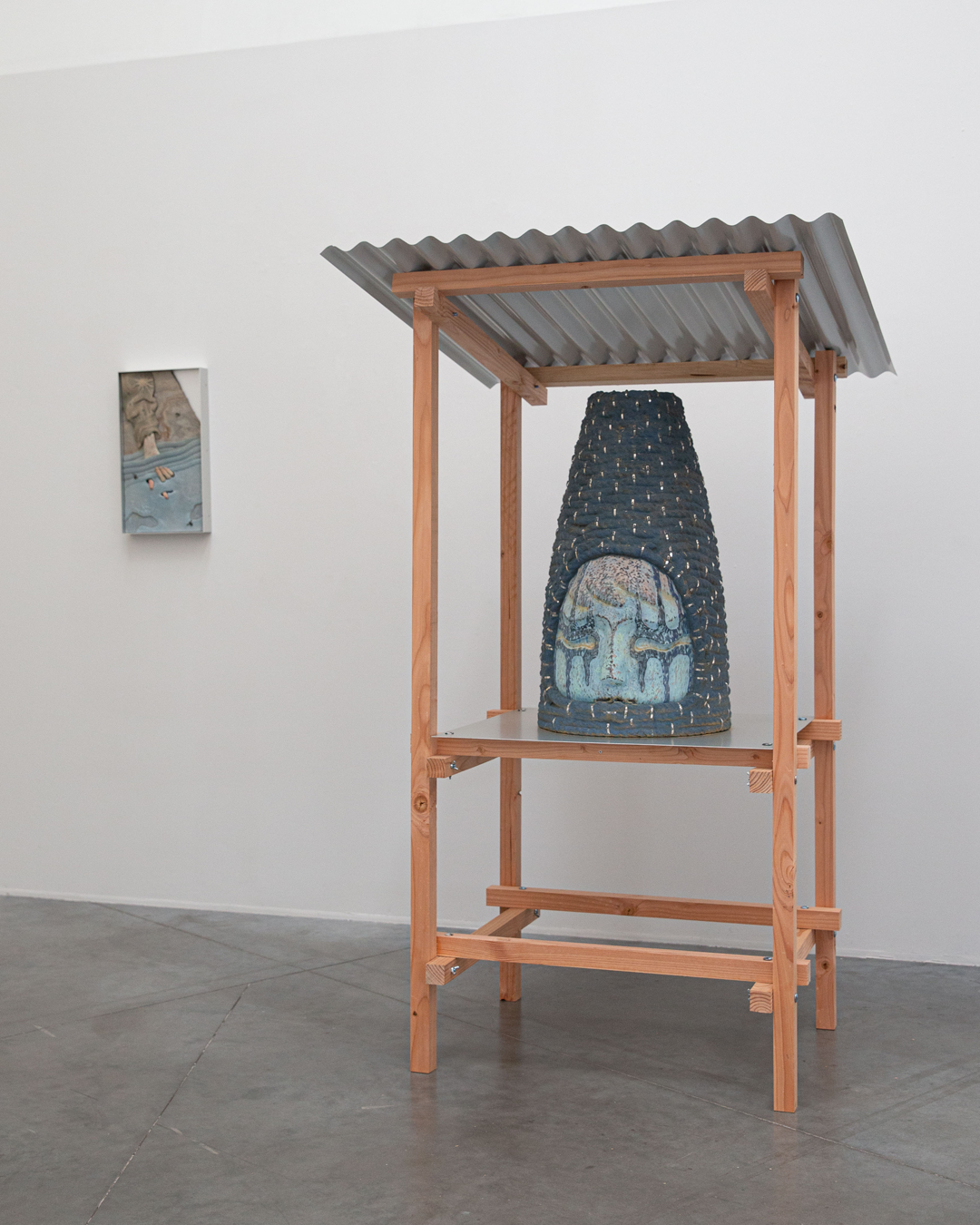
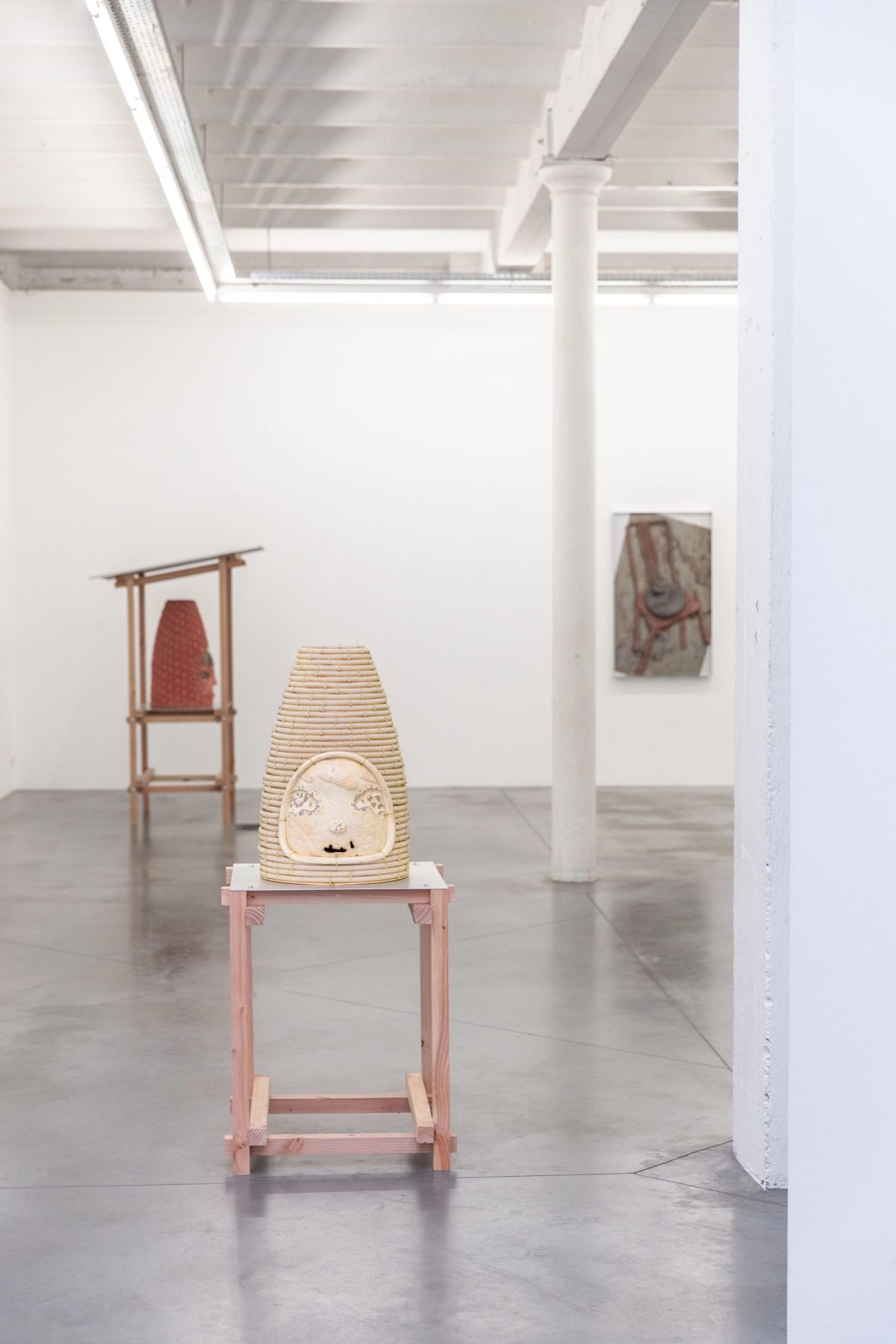
Charles Degeyter, Life in Cold Blood, installation view, Tatjana Pieters, Ghent (BE)
A lot of your subjects, the beekeeper, the hermit crabs, the animals in the sarcophagi, are creatures that carry their homes with them or build elaborate shelters around something vulnerable. One of the hermit crabs is even named after you, Hermit, Charles. Is that the shape you recognize in your own life right now? Something small, carrying its shelter wherever it goes?
Life is fragile in a world of chaos. A house, a shell, a beehive, a nest or a sarcophagus are all spaces that offer protection from the outside world, a world that is fundamentally unforgiving. The ways in which we and other organisms create and inhabit these spaces, and how we position ourselves within the world, are among the most interesting aspects of life on Earth.
In the case of the hermit crab with my head as its shell, the work suggests that when I have lost my own existence, other life will find refuge and a safe haven within me. In this sense, it becomes a kind of positive memento mori, a reminder not only of the fragility of life but also of our connection to the natural cycle of life and death. I recently came across this sentence from Shakespeare’s Hamlet that profoundly captured this sentiment: ‘Thou know’st ’tis common; all that lives must die; Passing through nature to eternity’. It’s also the title of a book on the bog bodies of northern Europe, which served as one of the main references in my most recent exhibition Life in Cold Blood.
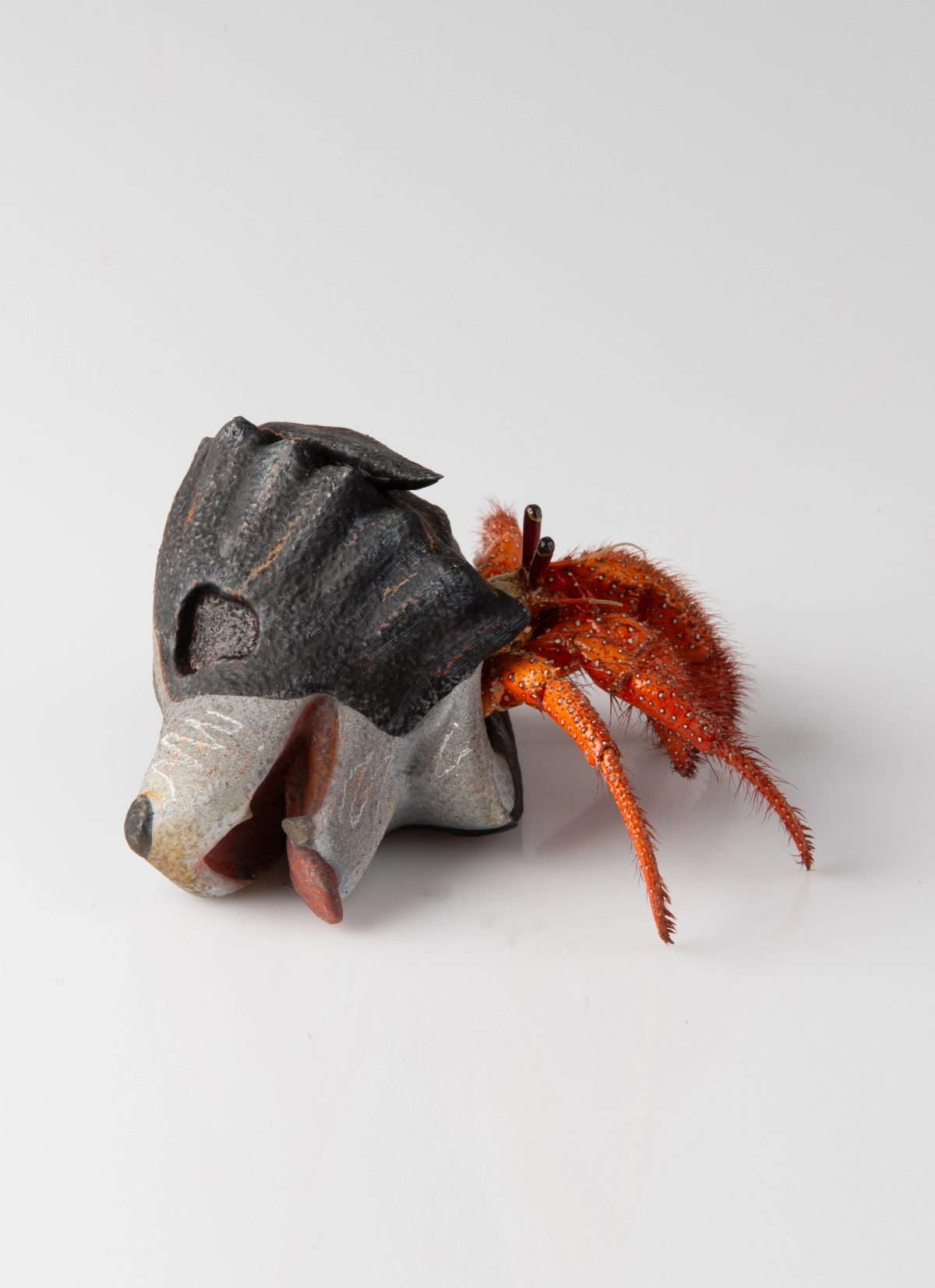
Left: Charles Degeyter, Hermit – The Dog, 2025, hermit crab, resin print, gouache and pastel crayon, 15 x 13 x 7.5 cm
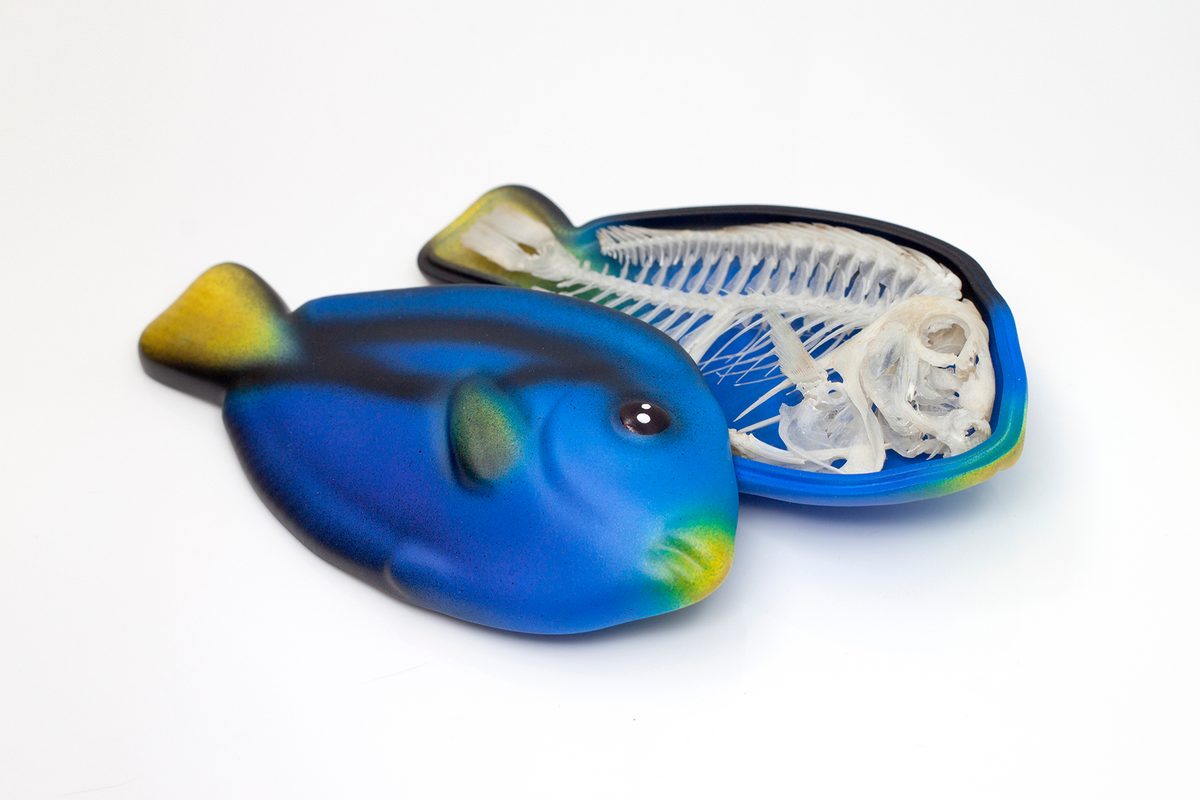
Right: Charles Degeyter, Dory, 2023, Paracanthurus hepatus skeleton, resin print and airbrushed acrylics, 10 x 5 x 3 cm (closed)
What’s next for you? Is there a direction, a material, or a story you haven’t touched yet that you’re already thinking about for after this?
I would like to further explore the idea of sculpture as living things. Historically, traditional sculpture often had a clear function and would live a life of its own, gradually accumulating patina and traces of that life while performing a role within society. The beehives for our indigenous black bees that I recently started making are clearly connected to this idea. More recently, I also began collaborating with musician Nicolas Van Belle on a masked performance that fits within this line of thinking. The performance introduces a sonic layer to the exhibitions, extending their atmosphere into sound.
My intention is to further develop these newly started series and explore what new forms the beehives and performances can take, while simultaneously developing new concepts connected to this broader idea of sculpture as living things.
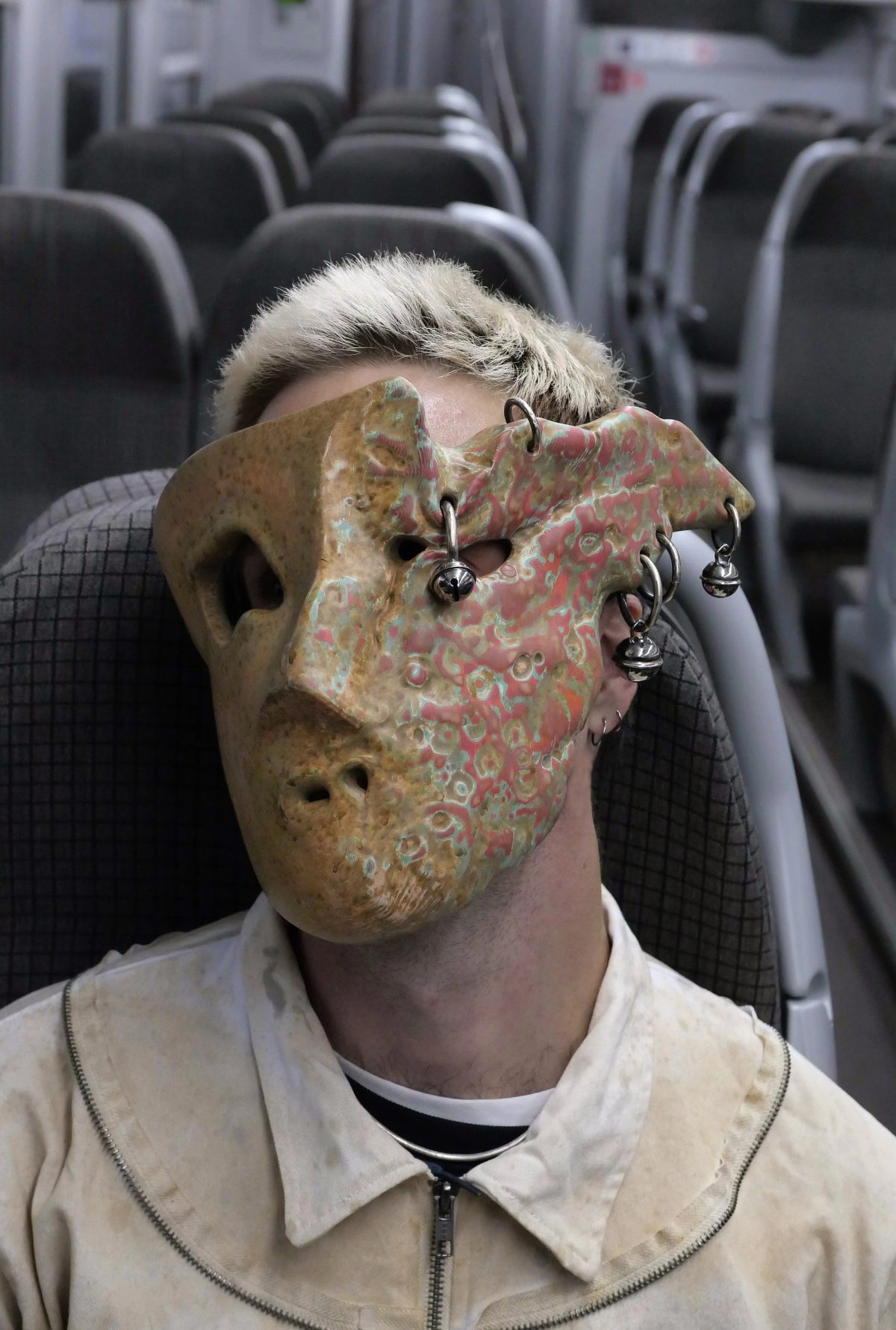
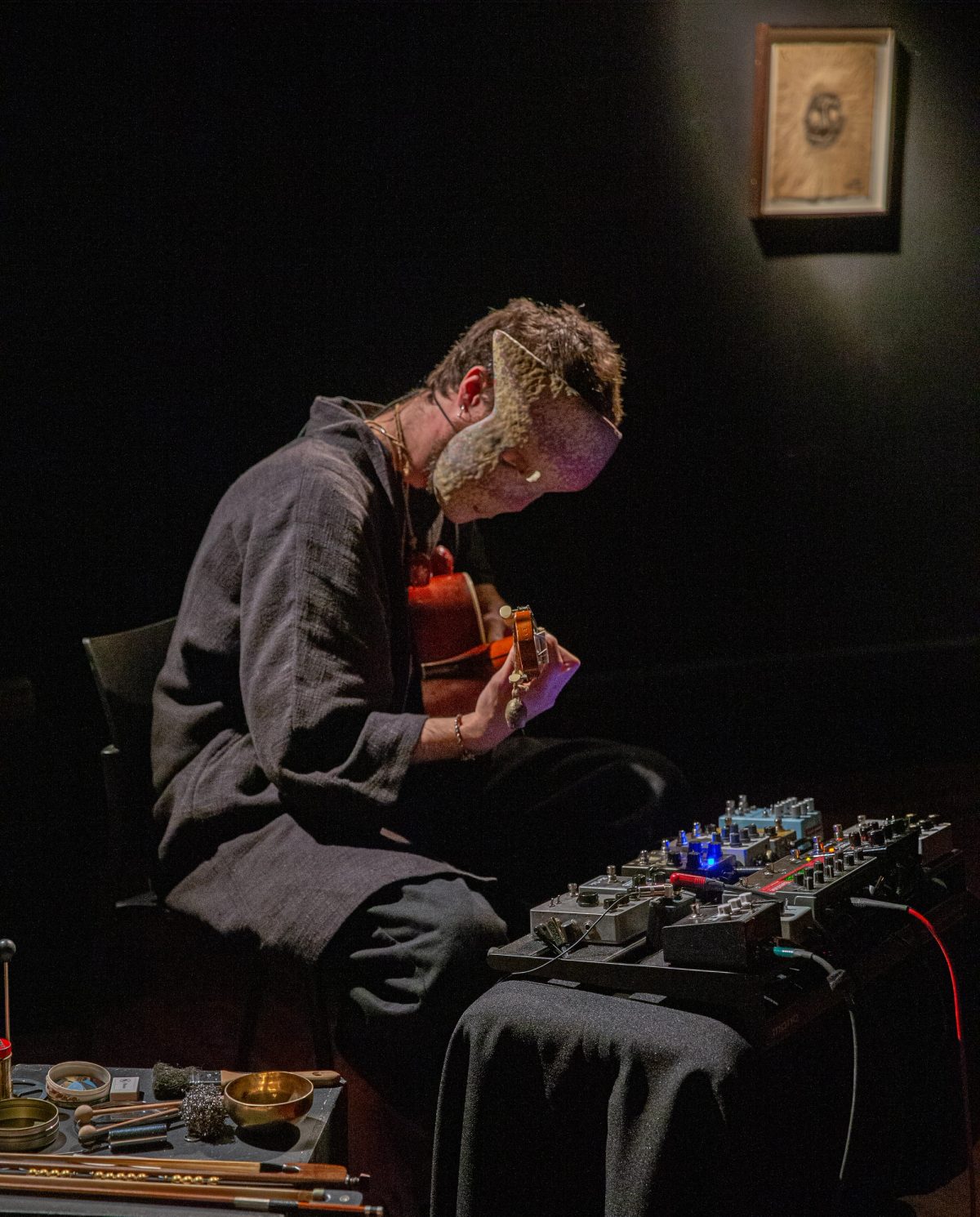
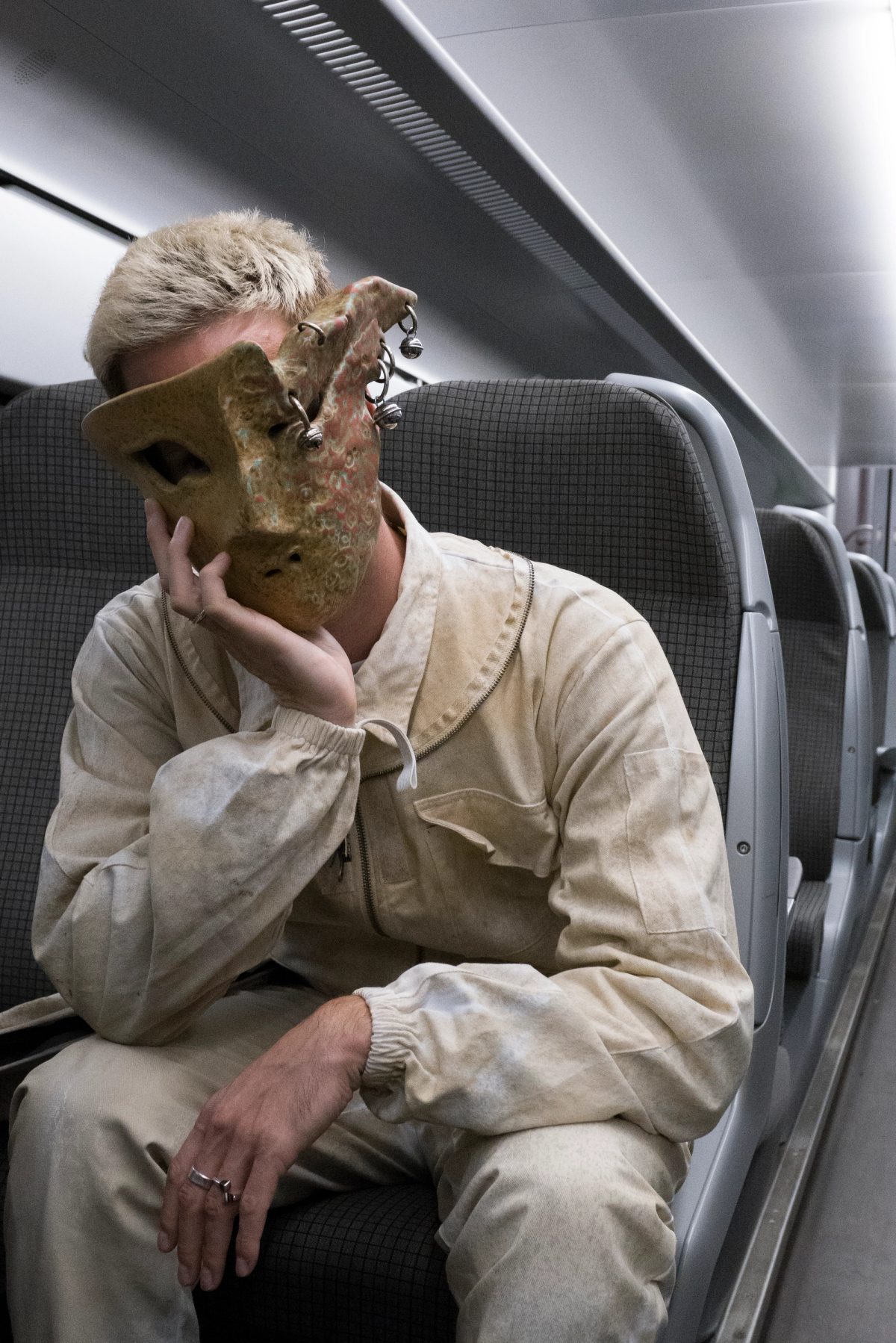
Charles Degeyter, Ritual Regalia, for performances by Nicolas Van Belle
Cover Image: Charles Degeyter, Biekorf yellow, 2026, installation view, Deb’s Tea Garden, Heuvelland (BE)