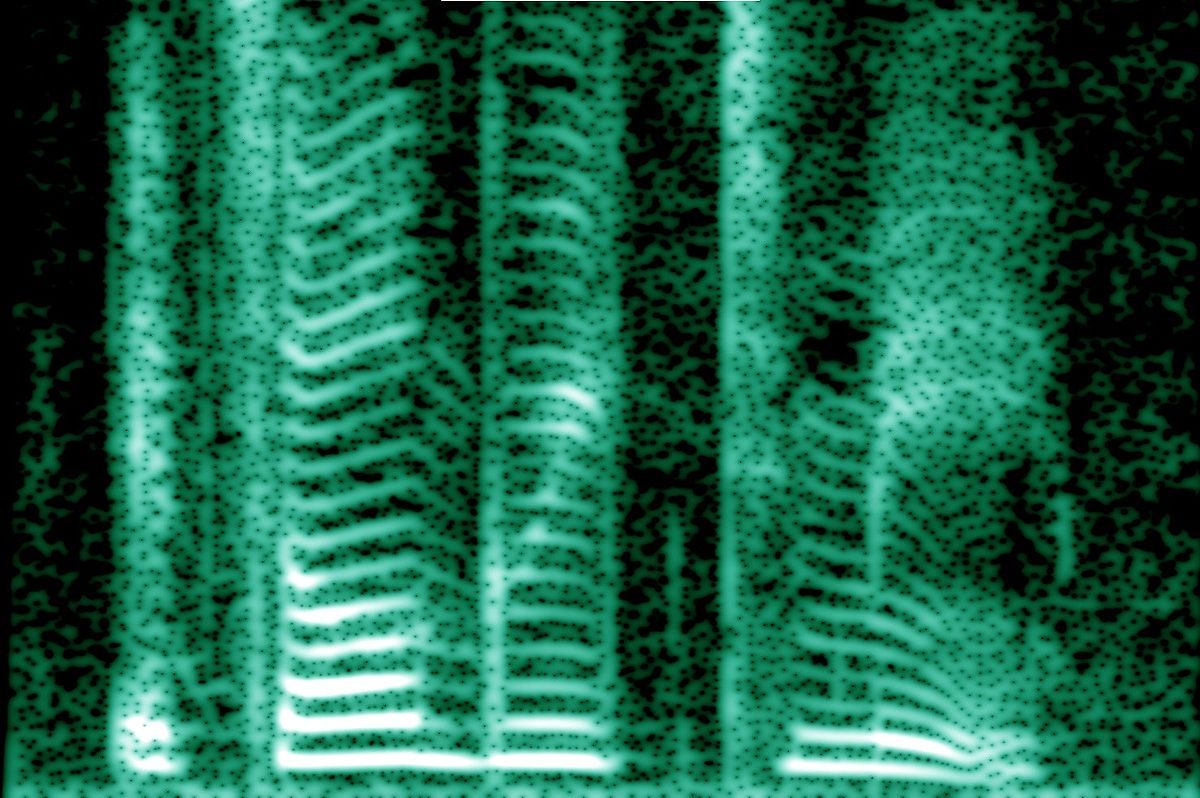
EXPERIMENTATIONS ON KEEPING A SONIC DIARY
WRITTEN & RECORDED BY G. NAZ FEREL
19 NOVEMBER 2025 — UNITED KINGDOM
This essay is an attempt to combine sonic and written elements in the making of a diary/journal with an autobiographical purpose. It can also be defined as a personal guideline, bringing together an audio essay: a recorded piece combining sound and speech without a necessary inclination to be musical and with a certain demand for the listeners attention. ¹ In being personal, it affirms and promotes the abundance and diversity in ways of producing a sonic work as such: no feeling and no method, is considered here as final in the making of an audio essay. Instead, it lays out only one among many possible paths that can be taken in creating an aural diary of daily life and an expression of journeys through emotions. Throughout the piece, you will be hearing the sounds I gathered in Istanbul, Turkey.
My creative endeavour in sound is rooted in radio art, field recording, spoken word poetry and sound-walking. I prioritise being open to what happens in the sonic realm I live in and let myself be amazed by things I hear. I like chasing the cavernous barking of dogs and the sounds of daily prayers in Istanbul. I like capturing my own voice by talking my broken heart out or reading my poetry to the mic. I exaggerate bodily sounds, co-produce sounds of love and connection, sometimes just to collect them and invite friends and lovers to sound themselves out.
I was immersed and feeling blessed when I first started to focus on the raw material of sounds around me. An awareness of them felt like being at the core of something elemental, something so coarse and real, so immersed in the material that it is at the point of rendering the creative invisible. Foraging and manipulating sounds helped me deal with my anxiety of the vulnerability that comes with creating, of rendering my insides visible, of the feeling of being naked in the making of art. It was as if the sounds themselves were speaking, not me. Thus, that turned out to be my way of artistic expression through burying the expression itself deep into the materiality of daily life sounds. And here is the route I take to create:

Basics: Listening
First things first: this quest requires a focus on the sense of hearing. It demands an attentive habit of listening that one can improve through practice. By frequently directing my attention to the sounds of life around me, I realised that I could develop a natural focus, an instinctive attention towards my sense of hearing.
Drever describes attentive concentration on listening as an engrossing experience. One that through which we can become absorbed in the flow of the soundscape we are moving within.² Letting myself be aware of how immersed I am in sounds not only gives me information on what is unfolding around me but also, it tells me about how my body is shaped by them constantly, and how I navigate myself through time and space via the knowledge I collect, through sounds. It also makes me aware of my own feelings and changing mood, which has an impact on how I tend to listen and interpret what I hear.
Listening is to be open to and curious about what sounds can do. In a letter she wrote to Kate Millet, Pauline Oliveros puts it quite clearly:
“I am concerned with the power of sound! and what it can do to the body and the mind.”³
Thus, my first step is to listen to the vastness and abundance of sounds unfolding around me every single day. And it can get messy, crowded and full of memories like this recording of the Taksim neighbourhood, one of the vibrant entertainment and nightlife areas of Istanbul, captured during the summer of 2024.
The Star of the Toolkit: Field Recording
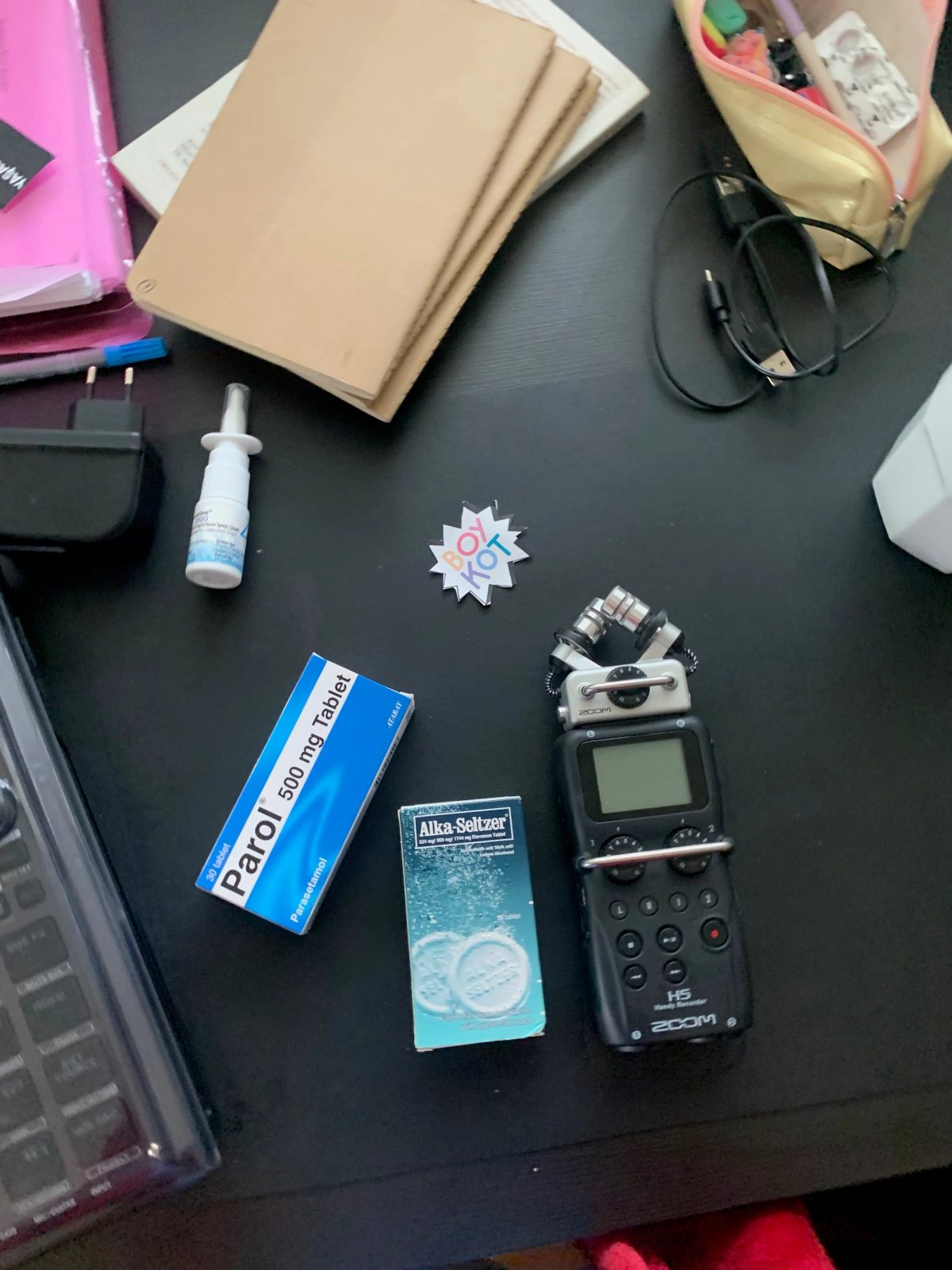
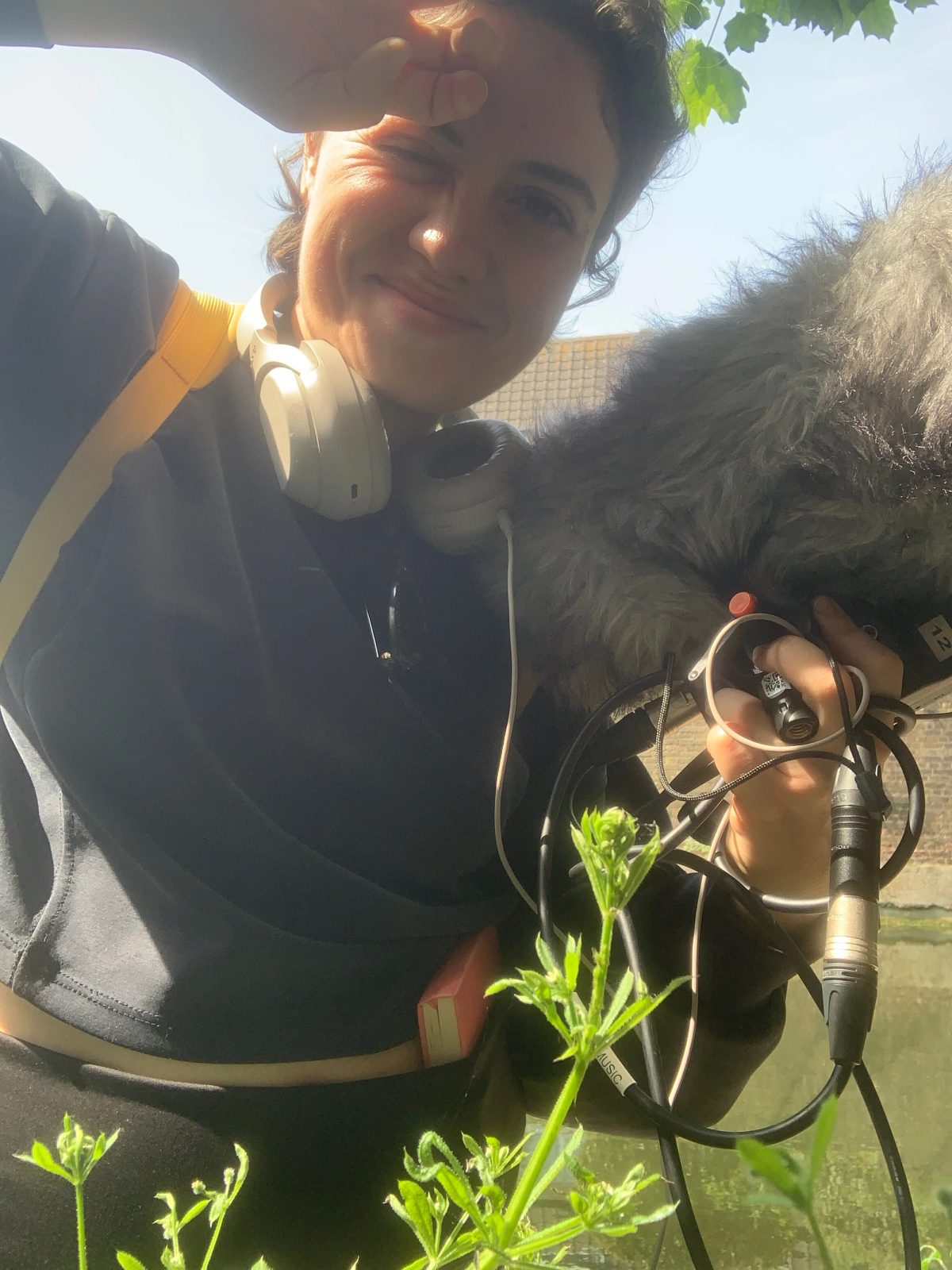
Collecting my raw material of everyday sounds is crucial, and there must be a recorder at hand to capture them. Field recordings can consist of anything encountered in daily life, be it at home or out on the street, or both: a sound coming from the street that you hear from inside your room. If I’m out with a purpose of recording, I usually take my handy recorder with me, but most of the time I use my smartphone. Sounds can be fleeting, and phones are fast; a smartphone mic keeps sounds within reach and recording simple, like a personal diary must be.
The more attentive the hearing becomes, the easier and natural it gets to decide when to record what. Field recording is never just a detached way of capturing sounds as independent materials out in nature, but instead, it’s about a discovery of what you like, what impacts you, what sounds you connect with and want to keep in your pocket.
Field recordings can capture all kinds of sonic material that can be transformed into a variety of elements in the journal. It can be an ambience in the making of the waves of life in the background, putting forth feelings of longitude or an impression of utmost immediacy and haste, communicating highlights of the day. It’s up to you and the soundscape to decide what your life’s sample pack will be made of, and to me, that collaboration of agency and randomness is where the fun lies.

A Wondrous Method: Soundwalking
Originally a research method that is certainly open to personal uses, soundwalking is adopted across fields of acoustic ecology, artistic practice and urban design. My daily life practice of it coincides with some key themes and characters associated with it: I prioritise listening while walking, and again, I keep myself aware that it requires an attentive focus on the sense of hearing. Its appeal to me in my creative practice doesn’t surprise me much, I always loved a type of walking that can easily be open to the conscious act of listening. It is a type of walk that gives me so much joy as I observe and absorb my surroundings, which might be considered idle and too slow by some. A wandering deeply engaged with the changing, shifting surroundings, with a curiosity in the mundane maintained throughout.
For Rebecca Solnit, it is easier to move in time while moving on foot and that the mind can start wandering from plans to recollections and finally, to observations.⁴ Once I started to walk with an intention to listen, it was more like a step-up rather than a whole new practice, a new observation with an intention to connect with the soundscape. Soundwalks are not only great ways to forage for sounds but also, they are so good at improving the attention given to sound on a daily basis. They can be made of a carefully crafted route or just a spontaneous walk, as long as they centre hearing.
One of the first things that can be noticed when soundwalking is the bodily sound of walking itself: the footsteps. They hold the clues on the surface one walks on, the pace and the mood of the walk. Sounds of the steps while walking (be it listened to consciously or not) are materials in the making of the walk. If there is a mix of rustling, swishing and a muffled crunching sound coming under my feet as I move, I know I’m walking on grass. Or sometimes, when the road feels heavy on my legs and I can hear a deep crackling and crunching under my feet, I sense the deep snow I’m walking on. Sound can be one of the more abstract of our senses, in the making of our perception. My footsteps are an important part of my collection for an autobiographical audio essay. Plus, they immediately give the sense of “me” to this sonic diary. Just like the sound of a pen on paper while writing, I am the one doing the sounding through walking.

A Connection: Stepping In
Say I am walking. This time, slow walk aside, I’m running to work or getting back home in cold, what impact do I leave in the sound world? What sounds do I leave hanging in the air apart from my footsteps, what are the sounds of connection and contact? How about the creaking metal gates of gardens when I open them and pass through, the plopping of rocks thrown to the river, a chesty cough at the end of a stubborn cold, hugging my friend with a plastic bag on my hand, thirsty for water, slapping my tongue against my palate and finally, getting a bottle and drinking like I never have.
This step is about focusing on the encounters of everyday life in the making of a day, the materials of touch between my body and the bodies of things and other people. I record these encounters, what is a diary without some connection to the other— and a conflict, a friction, a flirt? If I’m in a playful mood, I play with these things around me and make even more sounds —like singing under a bridge to capture the echo we make, me and the bridge, together. So, this step is about stepping in and sounding the connections I have throughout the day.
A Narration: Stories, Spoken Word and Voice
There is something direct and intimate about words and stories in the form of voice. Using written text, poetry and language in general are wonderful ways to stir the meanings of sound works. Their semantic ability is one of the reasons I include speech and narrative in my journal. One sound that does not tend to be momentary and fleeting —a sound that shapes most of my communication and brings singing and storytelling into being, that I hear every single day— is simply my own voice. Thus, I want to include it in my audio essay.
However, this is not the only reason; there is a rich history of using speech for its phonetic qualities in sound art and literature. Works that include sounds of a written text and language carry a certain hybridity made of meaning, rhythm, tonality and pronunciation. With a specific focus on listening, one can experiment with the role of these sonic aspects of speech, playing with the articulation of a feeling or an expression. And above all, knowing that laughter and crying are essentially sounds of our bodies amazes me all the time. Using voice holds endless possibilities, and whether for its meaning or its sound, I love the layers it brings to my work.
Finally: Questions to keep you going
Finishing this route in building an expression that is both sonic and literary at the same time, I want to leave some questions to linger and assist us in becoming aware of the world of sound. When I think of how I sense this world, I resonate with Salome Voegelin’s definition of listening: it is of exploration, it is utterly subjective and “continually, presently now”.⁶ So in order to let it change us and let us capture it, bend it, articulate our lives through it, I like having these questions at hand, very much: How do you hear the world around you when you are in love? Or when you are aware of injustice, what are the sounds you hear? What does the sonic world you’re in do to you when you’re angry? How about when you’re yearning? How does your self meet and unfold, within sounds? This last piece is by me, made by following a very similar route that I tried to set out.
Bio
günseli naz ferel(she/they) is a sound artist, DJ and researcher, born and raised in Istanbul, based in London. her research explores sonic ethnography, electronic dance music and emotions through the lens of affect theory with a focus on experiences of migration, feelings of belonging and being at home. some of the areas that she is focused on can be listed as: sound foraging and manipulation, producing sonic stories for live performances and radios, electronic dance musics, sociology of affect and music, opening up space for solidarity in art worldsshe is the co-founder of HUM, ambient-oriented event series and resident host at Netil Radio.
Bandcamp: https://g-un.bandcamp.com/music
IG: @gunsferel
Linktree: https://linktr.ee/gnazferel
²John L. Drever, “Listening as Methodological Tool: Sounding Soundwalking Method” in The Bloomsbury Handbook of Sonic Methodologies. 2021.
³From the book “Bodies of Sound: Becoming a Feminist Ear”, edited by Irene Revell and Sarah Shin. 2024, Silver Press.
⁴Rebecca Solnit, Wanderlust: A History of Walking, 2001, Penguin Books.
⁵Audio 5 file consists of excerpts from ‘Ithaka’, a poem by Constantine P. Cavafy and the voice of Frank O’Hara, reading his poem ‘Having a Coke With You’.
⁶Salome Voegelin, Listening to Noise and Silence: Towards a Philosophy of Sound Art, 2010, Continuum.
⁷ Audio file 6 is from my first album ‘etudes’, self-released on October 2025. https://g-un.bandcamp.com/music