ALWAYS BEEN HAPPENING IN THE DARK: IN CONVERSATION WITH TROY LIANG
CONVERSATION BY MOCO CHEN
CO-FOUNDER, ART DIRECTOR
2 SEPTEMBER 2026 — LONDON, UNITED KINGDOM
Troy Liang didn't set out to leave colour behind, but somewhere in his MFA at Goldsmiths, the saturated abstract landscapes he'd been painting stopped feeling like the point. What replaced them, starting in October 2025, was a body of black-and-white figurative work built less on invention than on observation: trail-cam footage, screenshotted interviews, meme gestures repeated until they stop meaning anything and start meaning everything. Liang treats these online fragments the way a diagnostician treats symptoms, looking past what they claim to show for what they accidentally reveal, and titles like So Close to Being a Real Man and I Don't Say Hi to Strangers read like captions caught mid-confession. His figures, half-animal, half-human, are never finished becoming something else, and his lighting borrows its cold, watchful quality from cameras built to catch deer rather than people. Shown at St James' Hatcham Church for the Goldsmiths degree show, the work trades one kind of witnessing for another, asking what it means to be observed, judged, and laughed at, sometimes all in the same glance.
You've said your first year on the MFA was spent making abstract landscape paintings in saturated colour, before this shift into black-and-white figurative work began around October 2025. What made you let go of colour specifically? Was it a rejection of colour itself, or did the black-and-white palette just serve these new subjects better than saturation could?
When I let go of colour in my practice, it was not a rejection of colour itself, but rather the outcome of a systematic shift in the content I intend to convey through my work. At the same time, however, it also changed my whole approach to viewing and thinking about the process of creation, and more specifically, the purpose of imaging. When I say "imaging," I mean it in a similar sense to its medical connotation: a process of identifying and visualising what exists within a social situation. Therefore, I think this shift embodies a move away from abstract venting towards a more concrete way of analysing a social situation. If the purpose of colour is to explore the unknown, then black-and-whiteness is there to accentuate the known, to see through overlooked truths, like a cold, scientific medical X-ray scan. So I would say that black-and-whiteness follows the change in what I want to say through a painting, rather than being a separate aesthetic decision.
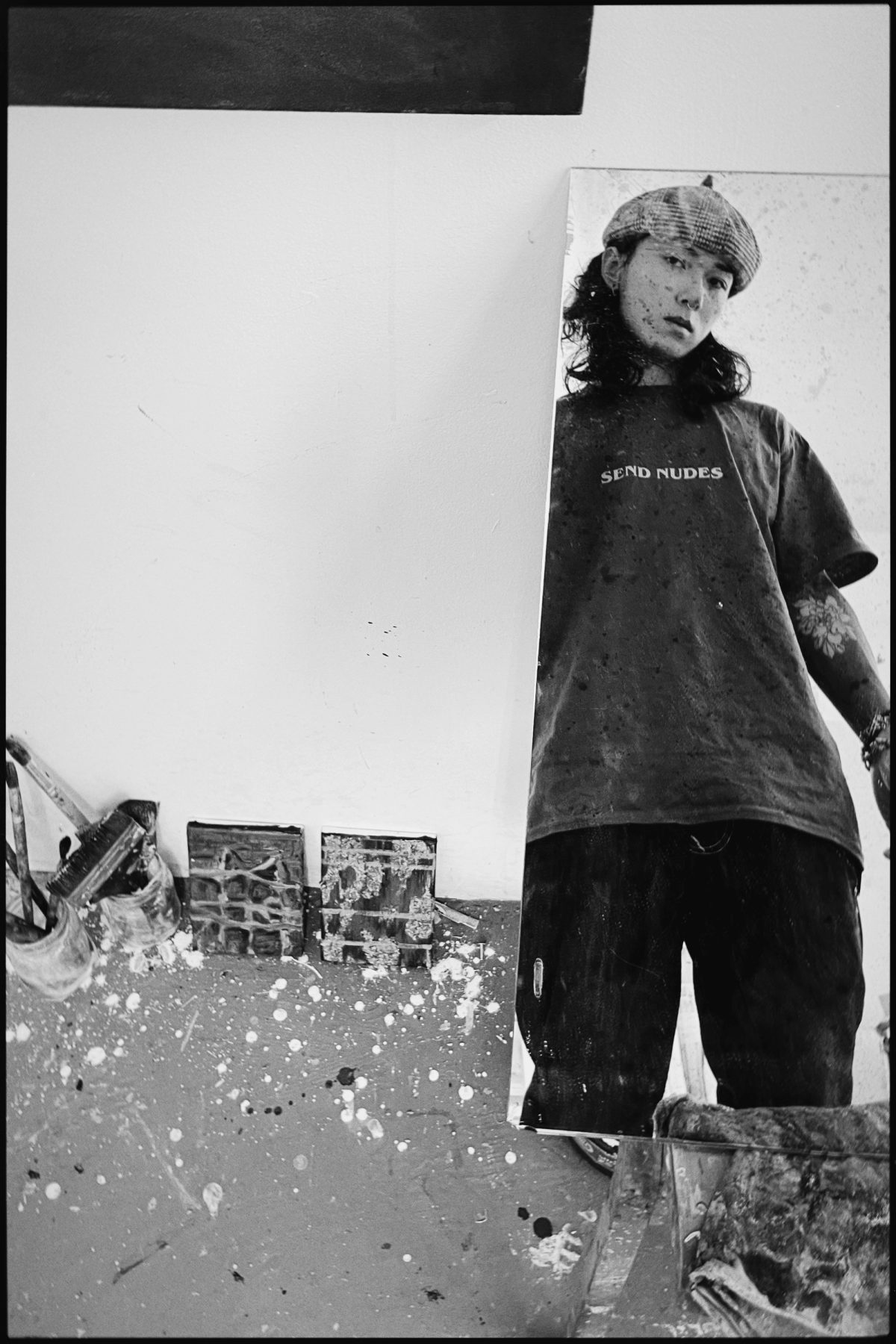
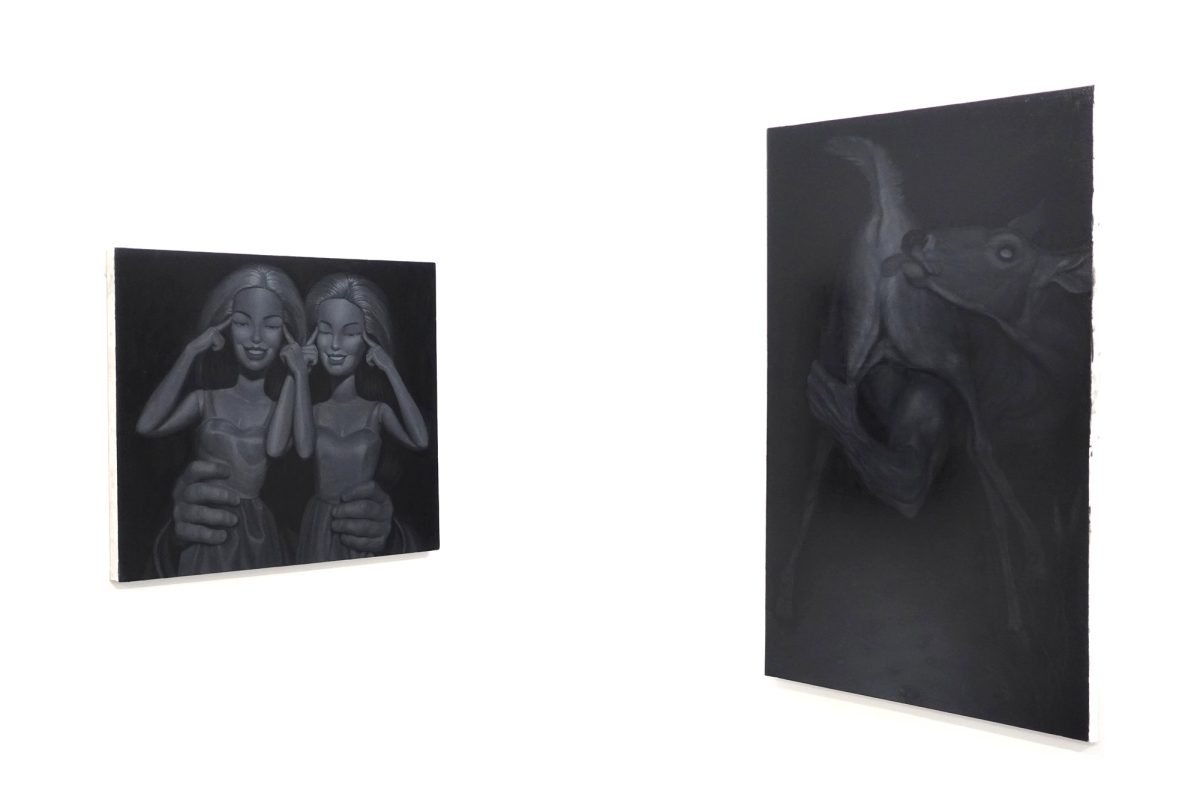
Left: Troy Liang, Artist Portrait
Right: The Goldsmiths MFA Degree Show
You describe the shift into this current body of work as a natural one, something that "should have happened years ago," even though you can't fully explain why. Looking back now, is there a specific image or moment from that October that you can point to as the actual turning point, or did it happen too gradually to locate?
Since the beginning of my undergraduate studies, which was five years ago, I had been trying to find a visual language and a set of motifs that truly resonated with me as an artist. I don't know where I got this weird idea that painting should only be about process and material, while narrative and figuration somehow belonged in a secondary position. But the fact is, looking back now, narrative and storytelling had always been huge inspirations for me since I was a kid. Comics and literature were the things that first inspired me to become a painter. However, once I entered art school and started studying art formally, I seemed to forget all of that. So when I said that this should have happened years ago, what I meant was that I should have realised earlier that what I wanted had actually been with me all along. I should have remembered why I started painting in the first place, and that a figurative, relatively realistic visual language was always what I wanted. I think there is also a certain level of violence that can be embodied in the visual language of realism: this almost narcissistic obsession with constantly trying to prove something, to convince others, and the insecurity that emerges whenever you are confronted with your own incompetence. Luckily, I think this kind of visual language fits perfectly with my studies of male-dominated online communities, because, in a way, this is exactly what those men are like.
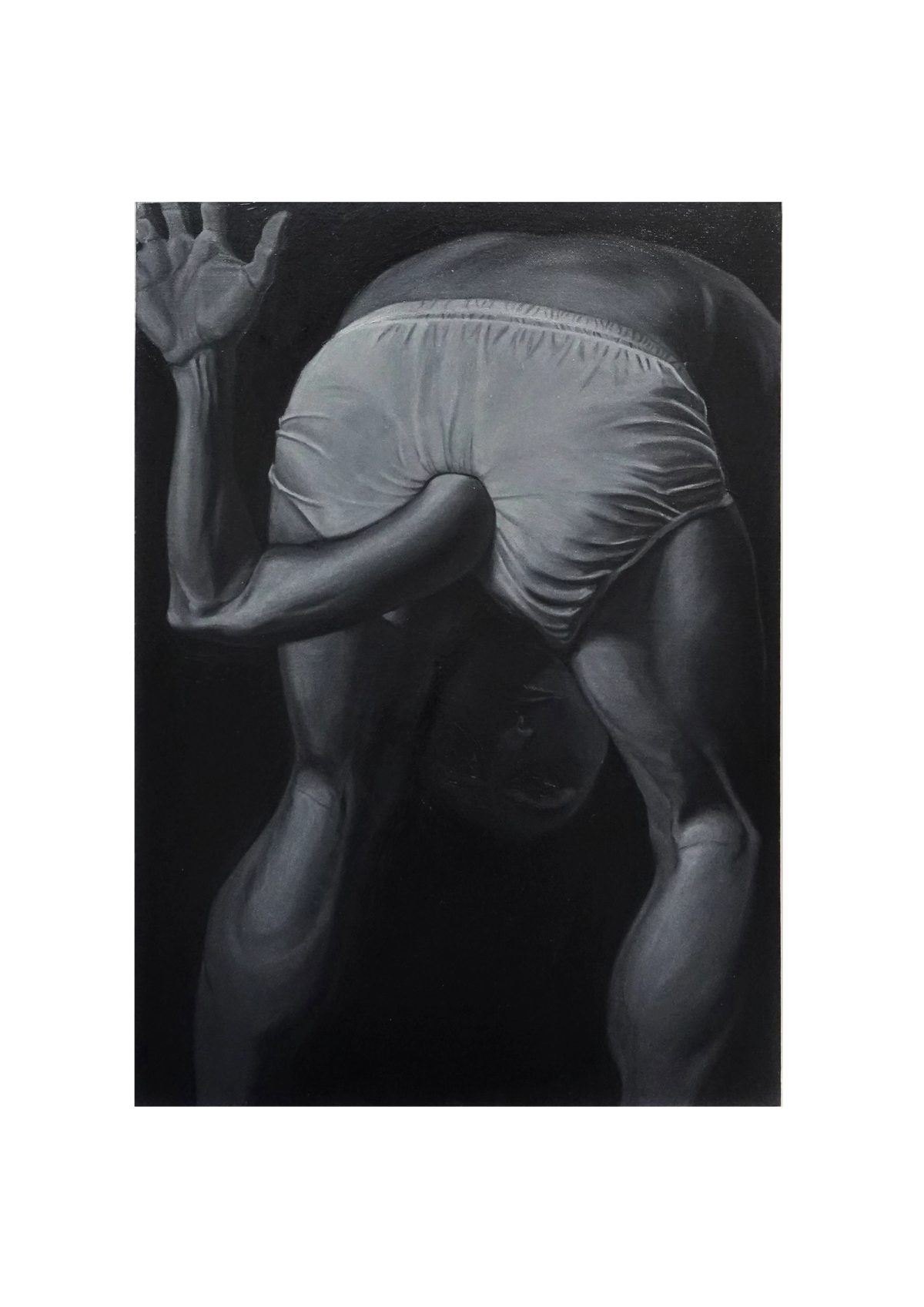
Titles like "So close to being a real man" and "I don't say hi to strangers" read like captions lifted straight from the voice of the images themselves: half confession, half meme. Do the titles come to you before the painting, or do you paint first and let the image tell you what it's already saying?
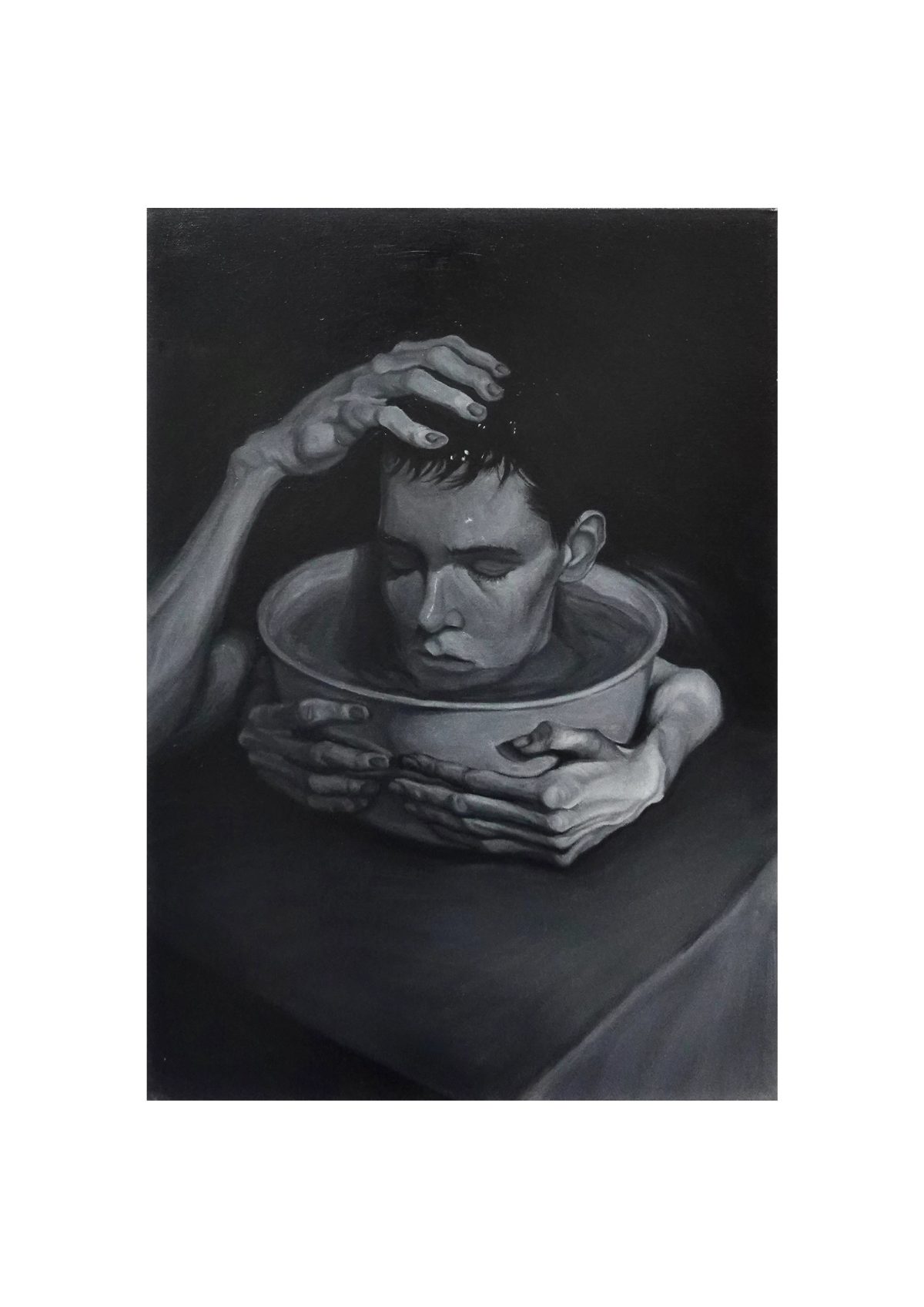
Most of the time, I finish a painting before thinking about its title. However, the concept of the painting is always clear to me before I start. I just need to find the right words to articulate it, and that eventually becomes the title. I think there is a vague principle behind the way I approach titles: I try to make them sound like a joke, or to point out that there is a joke within the painting. Humour is very important in my practice because laughing is a form of judgement, and judgement is a form of participation. So by inviting the viewer to laugh at an image, I intend to place them within the same narrative, asking them, in a way, to participate in and repeat the same absurdity shown in the painting.
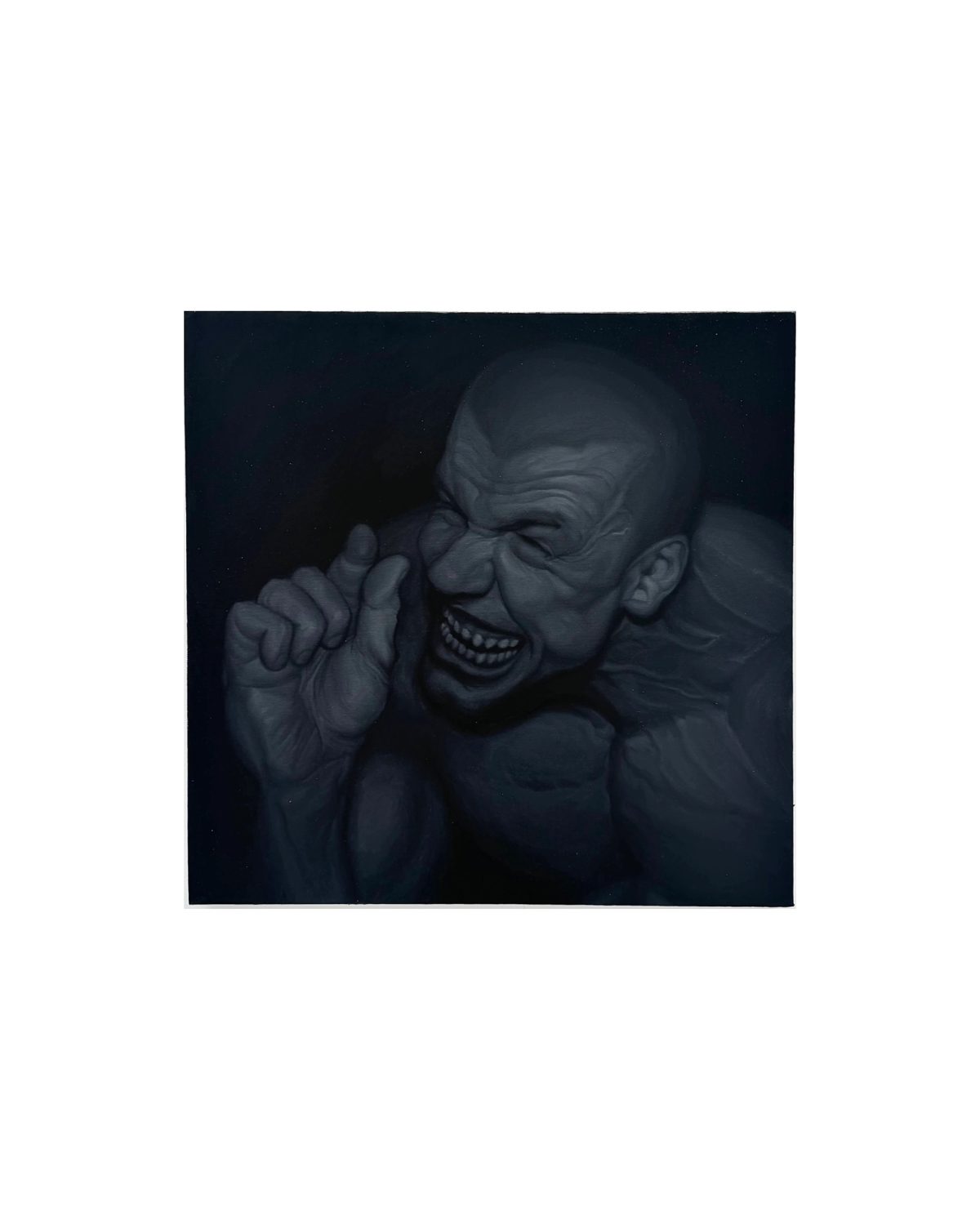
Left: I Don't Say Hi to Strangers, Troy Liang, 2025, oil on canvas, 70 x 50 cm
Right: So Close to Being a Real Man, Troy Liang, 2026, oil on canvas, 70 x 70 cm
"If the purpose of colour is to explore the unknown, then black-and-whiteness is there to accentuate the known, to see through overlooked truths, like a cold, scientific medical X-ray scan."
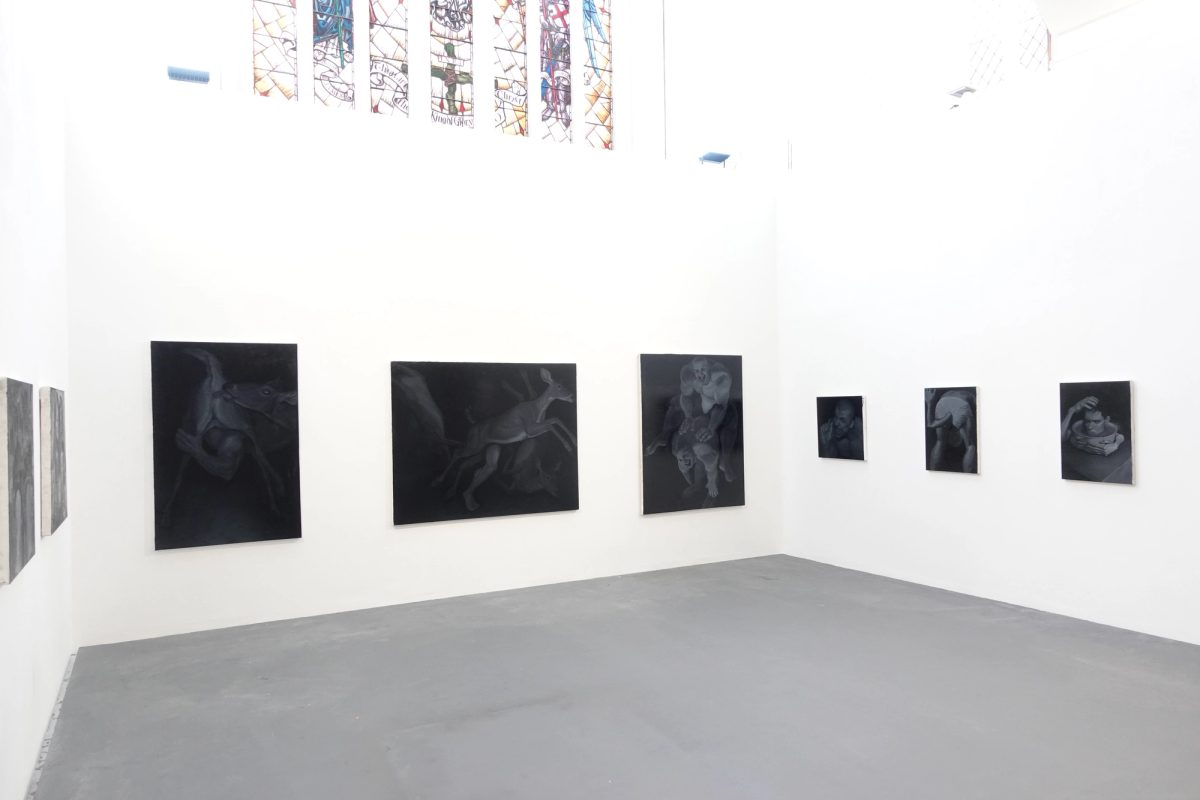
The Goldsmiths MFA Degree Show
"Share with the Lord's people who are in need" uses a reference photo taken from an Twitter account called "trailcam." What draws you to trail-cam footage specifically, images taken by machines watching for animals, as raw material for paintings about very human anxieties?
If you look closely at all of my paintings, you will notice that a kind of trailcam-like lighting appears throughout my work. I want my paintings to possess the same voyeuristic quality as a trail camera, as if there were a living presence hidden in the darkness, constantly observing everything that is happening. I think this visual concept functions as a metaphor in itself: it suggests that everything taking place within the paintings has, in some sense, always been happening in the dark.
Your bio says you're interested in the absurdity embedded in cyber behaviours, and how that absurdity can reveal something closer to the essence of human nature than sincerity does. Is there a piece of online material you've come across that felt too disturbing or too sad to use, even though it fit that logic?
There was one, although it was not necessarily a piece of online material: Kohei Yoshiyuki's The Park series. I was planning to make some paintings based on the series, but eventually gave up. The work frightened me because it was documentary photography, and because it felt unbearably raw. What disturbed me was not the graphic content itself, but that the series reveals the limitless edge of human desire. It kind of reminds me of the club scene in Gaspar Noé's Irreversible, where you feel trapped in this loud, dark, never-ending loop, watching everyone turn into desire-driven beasts.
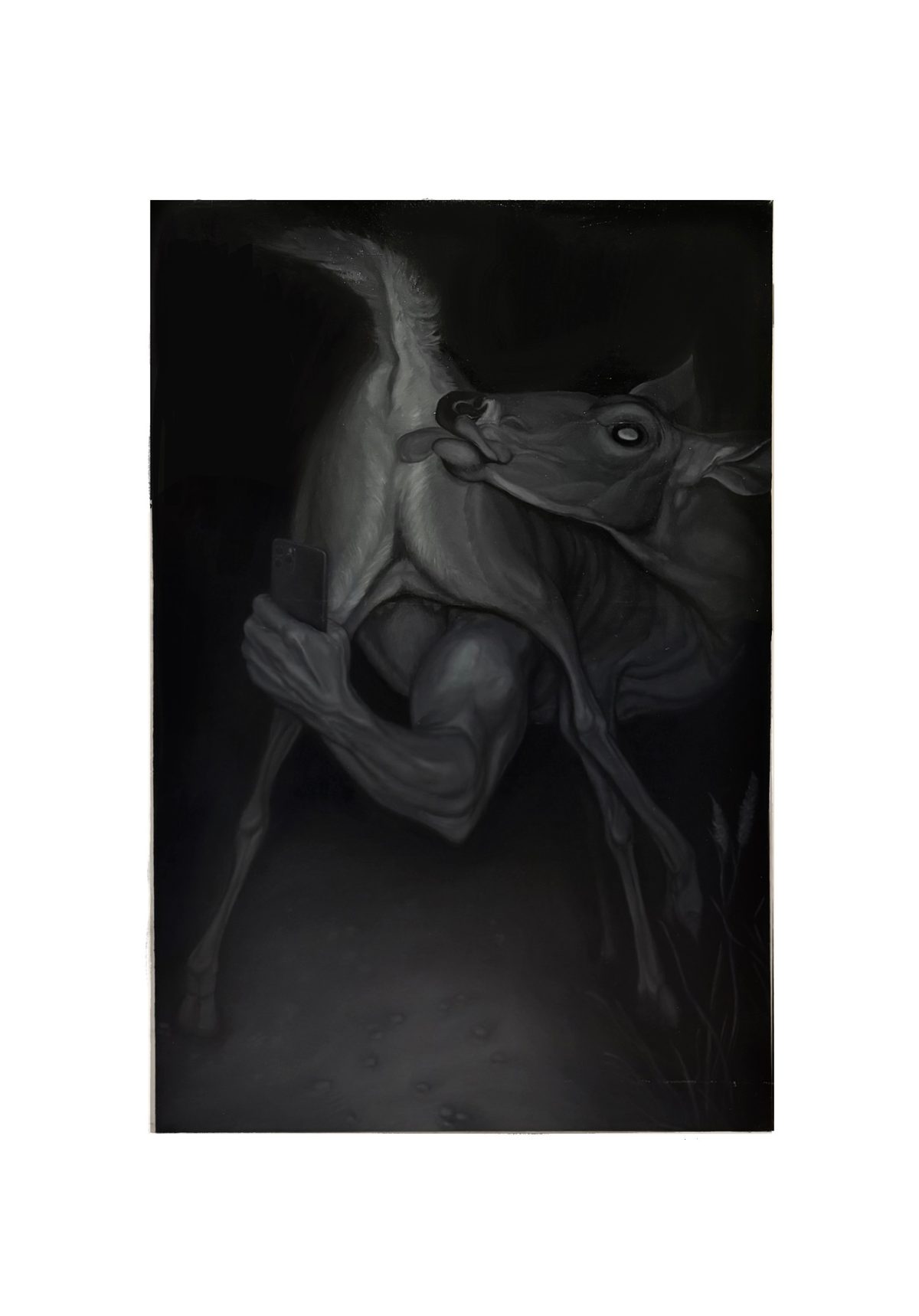
Left: Whoever Dies with the Most Tools Wins, Troy Liang, 2025, oil on canvas, 70 x 50 cm
Right: Share with the Lord's People Who Are in Need, Troy Liang, 2026, oil on canvas, 100 x 150 cm
"There's a certain level of violence in the visual language of realism: this narcissistic obsession with proving something, convincing others, and the insecurity of confronting your own incompetence."
"Guys send me shoes because they want to see me dangle a special pair" borrows its title from an interview with an online feet-pics seller. When you're translating someone else's real, specific words into a painting, do you feel a responsibility to that person's actual voice, or does it become raw material the moment it enters the work?
I don't necessarily feel responsible for representing a person's actual voice, because I don't think there are specific individuals in my work. I might use an individual perspective as a way of entering a particular subject, but the intention is always to comment on a broader context, phenomenon, or situation. I believe that, in the internet age, identity doesn't belong entirely to us. Who we appear to be online is produced through an ongoing relationship between ourselves, other users, and the technological environment we participate in. When you open someone's Instagram profile, for example, you encounter an identity assembled from images, captions, comments, interactions, and the way the platform organises their visibility. Rather than simply expressing an already complete individual, these different elements collectively participate in producing that person's online identity. The distinction between individual and collective identity therefore becomes increasingly difficult to maintain, because who we are online is always being shaped in relation to wider technological systems. Therefore, I don't think there are actual individuals in my paintings. They are not stories about specific people, nor are they stories about me. Rather, I see them as collective portraits of digital identities.
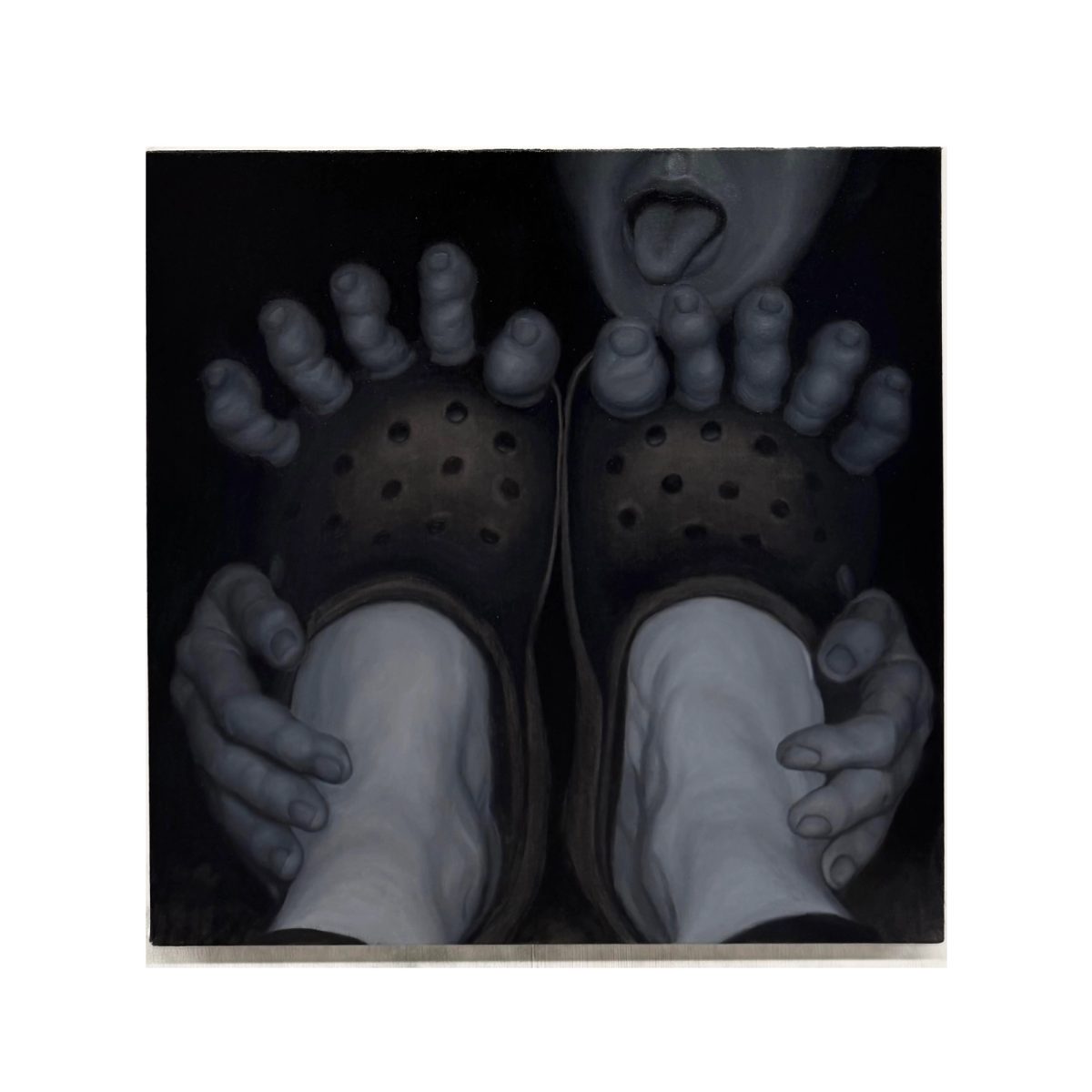
Guys Send Me Shoes Because They Want to See Me Dangle a Special Pair, Troy Liang, 2025, oil on canvas, 100 x 100 cm
The animal and human forms in your work (deer, horses, werewolf-like hybrids) often seem caught mid-transformation, neither fully one thing nor the other. Are you painting a moment of becoming something else, or a moment of losing what they already were?
I think what I was trying to capture was a never-ending process of transformation. As I mentioned above, I don't see online identity as something that reaches a final or complete form. It keeps changing according to the environments, interactions, and systems through which it passes. This means that the figures in my paintings are always trapped in a state of 'becoming', never fully fixed or complete.
You've said the materiality and physical presence of painting remain just as important to you as the virtual source material. What does oil paint let you do to an internet image that the image couldn't do on its own? Where specifically does the translation add something rather than just relocate it?
There are mainly two aspects we can discuss when considering what the physical presence of painting brings to an online image.
The first is speed. As the context surrounding an image can change almost as quickly as the image circulates, what an image seems to mean can depend heavily on what appears around it, who shares it, and the community in which we happen to encounter it. Meme images are a good example. The same meme image can be used to comment on different situations or contexts. As an image is repeatedly reused, the situation from which it originally emerged becomes less decisive in determining how it is understood. Each new caption, repost, or context attaches the image to a different situation, so its meaning is continually modified through use rather than remaining fixed by its original reference. From this perspective, the image begins to function less as a representation of something specific and more as an active device that operates differently depending on where and how it is used. Its circulation is therefore not simply a means of distributing meaning; it becomes one of the processes through which meaning is produced. So here, the meaning is not about what an image represents in content, but about what it does in circulation.
However, painting introduces a completely different temporality. Something that might normally appear on a screen for only a few seconds becomes an object that takes weeks to make and asks for a much more sustained form of attention. This slowing down, in a way, forces the referential meaning, the content of the image, to become visible again, while also giving viewers a way of examining how the pace at which we consume images influences what we notice, what we overlook, and ultimately how we interpret them. Works such as Thomas Ruff's Jpegs series and Christine Wang's recent paintings both illustrate aspects of this condition.
The second aspect is authorship. Putting the image into a painting also makes my own position much harder to remove from it. Online, the same image might pass through thousands of relatively anonymous accounts; once I choose to paint and exhibit it, that choice inevitably becomes associated with me and with the wider concerns of my practice. Once I bring the image into my own practice, its interpretation is also shaped by my position as the artist, the intentions behind the work, and the particular context in which the painting is presented. The image therefore enters another set of associations through the process of becoming a painting. Its previous meanings do not disappear, but they begin to coexist with the context that I create around it as an artist.
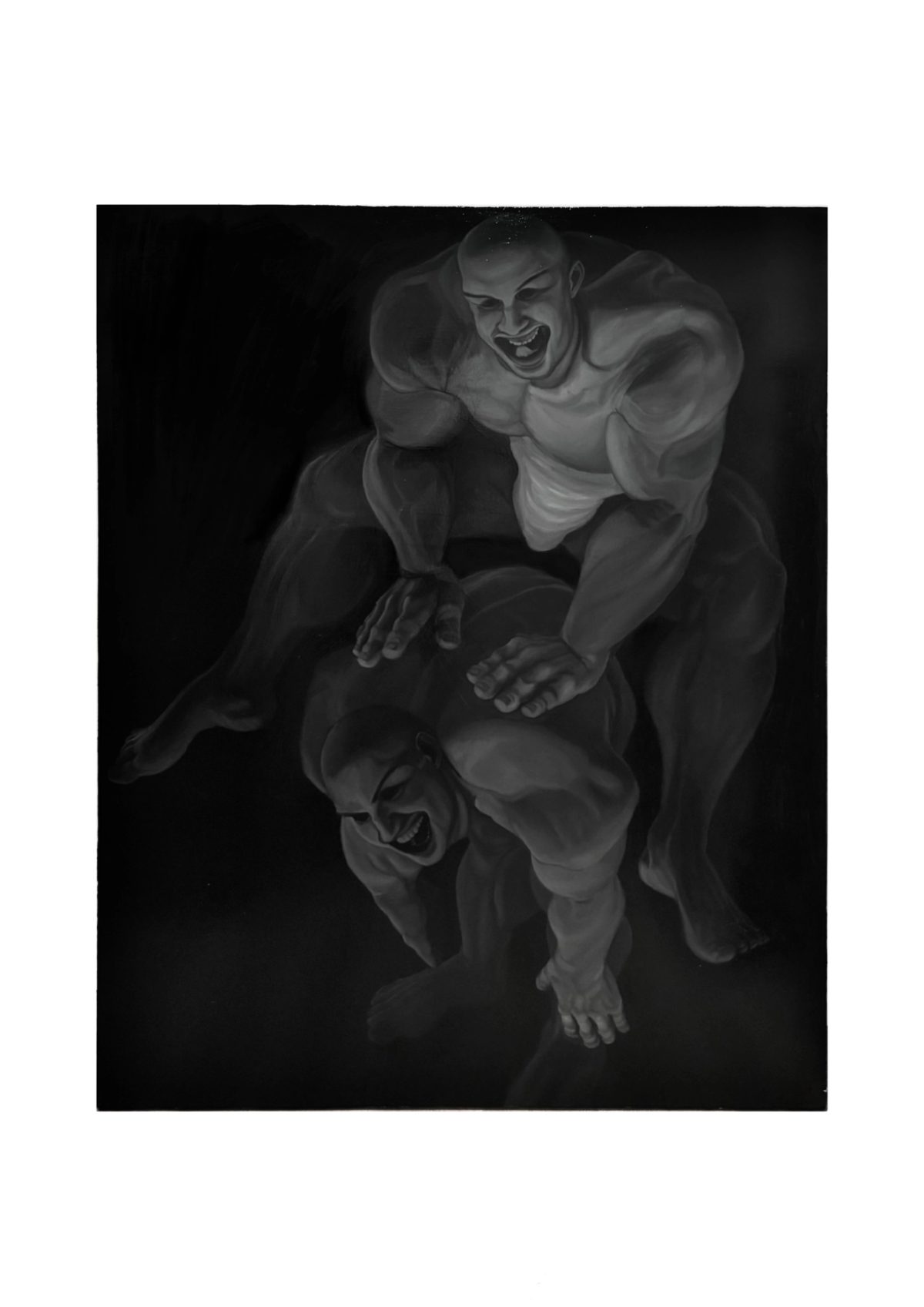
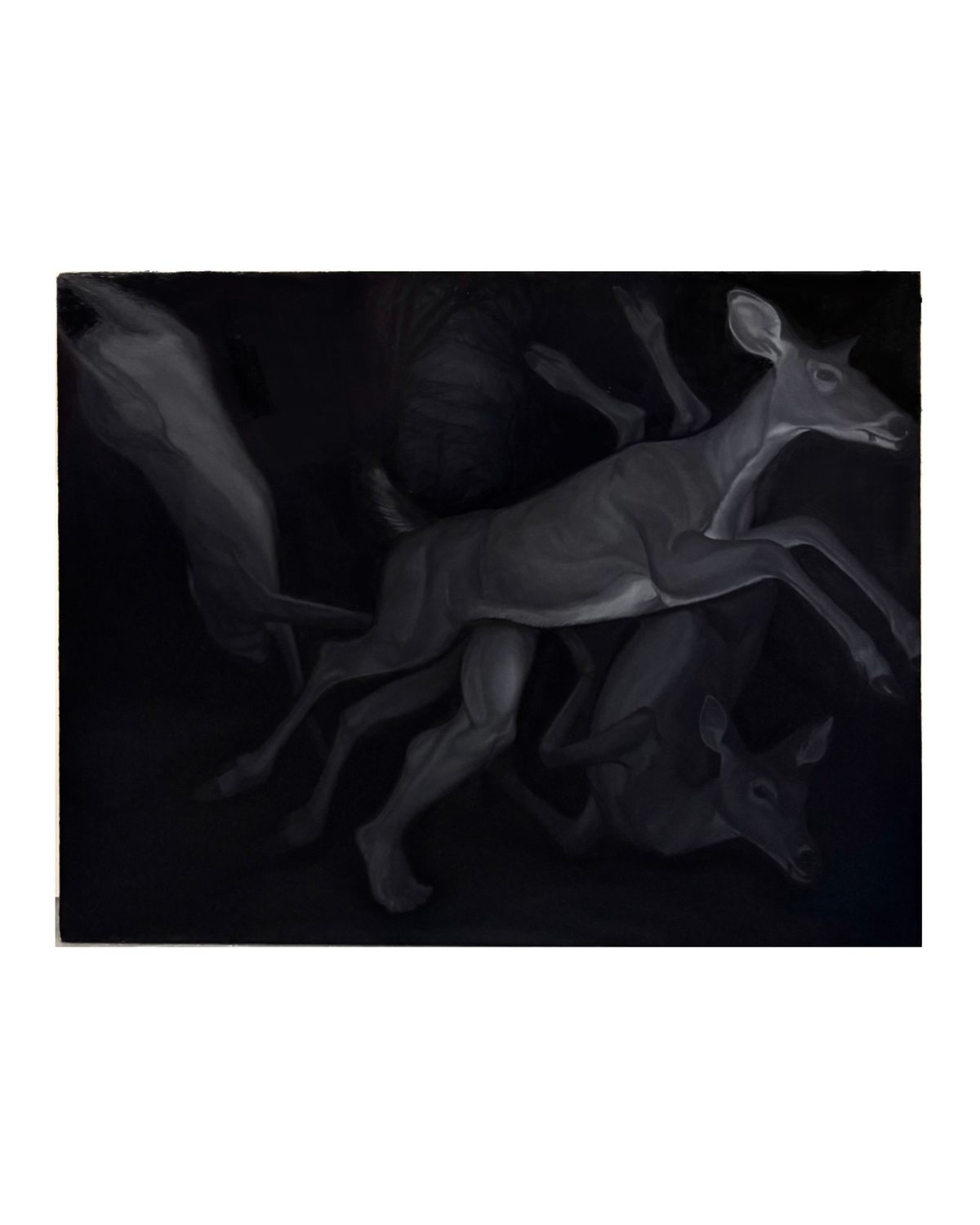
Left: You Cannot Play with Us, Troy Liang, 2026, oil on canvas, 150 x 120 cm
Right: When the Hunters Forget Their Faces, Troy Liang, 2026, oil on canvas, 175 x 140 cm
"Humour is very important in my practice because laughing is a form of judgement, and judgement is a form of participation."
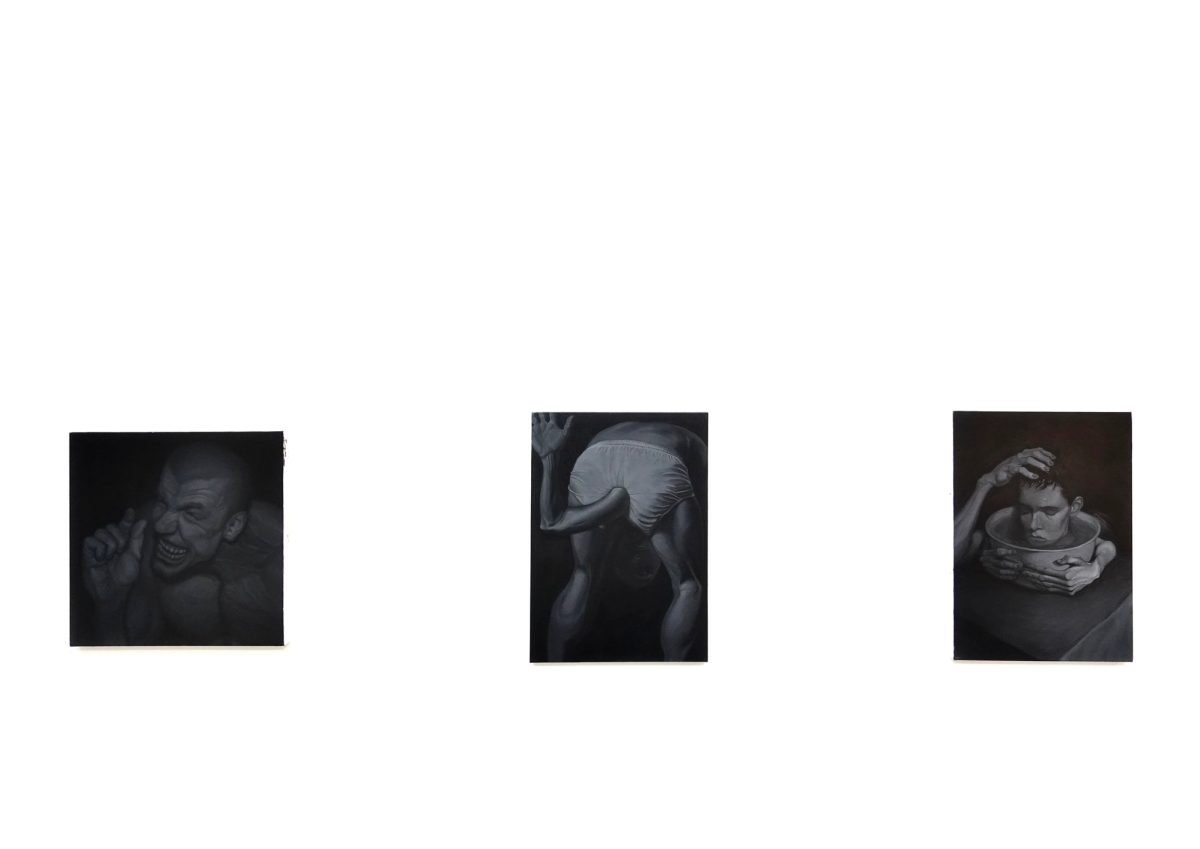
The Goldsmiths MFA Degree Show
"I hate you insincerely" shows two identical Barbie-like figures gesturing at their own temples in unison. Are they mirroring each other, mocking each other, or is that meant to be the same person split in two?
I think they are meant to function as something like an abstract visual sign without an actual identity. I want to talk a little more about gesture here, because it is the central point of this painting. Normally, we understand a gesture because we have learned how to read it within a particular social context. If I make a heart shape with my hands, for example, you probably recognise it as an expression of affection, not because the movement has that meaning naturally, but because we have both learned the convention surrounding it. However, in the internet age, gestures can sometimes lose this stability. The "six-seven" meme is one example. The gesture itself does not refer to an external object; instead, it creates a self-referential loop, simply signalling that you recognise the trend and know how to participate in it. In that sense, the gesture becomes less about delivering a particular message and more about demonstrating familiarity with a shared behaviour. As more and more people repeat the same gesture, the individual body itself becomes something more like a temporary carrier for a visual pattern rather than the source of its meaning. Eventually, both gesture and body are reduced to visual signs that can circulate on a massive scale and be manipulated within the attention economy. In the painting, the gesture and the Barbies function in a similar way. They become visual signs that can be manipulated, repeated, and celebrated. This is why I think this form of racism online does not necessarily come from hatred; sometimes it comes from entertainment, repetition, and the desire to participate. However, I also think sometimes celebrating ignorance can be even more dangerous than openly expressing hate.
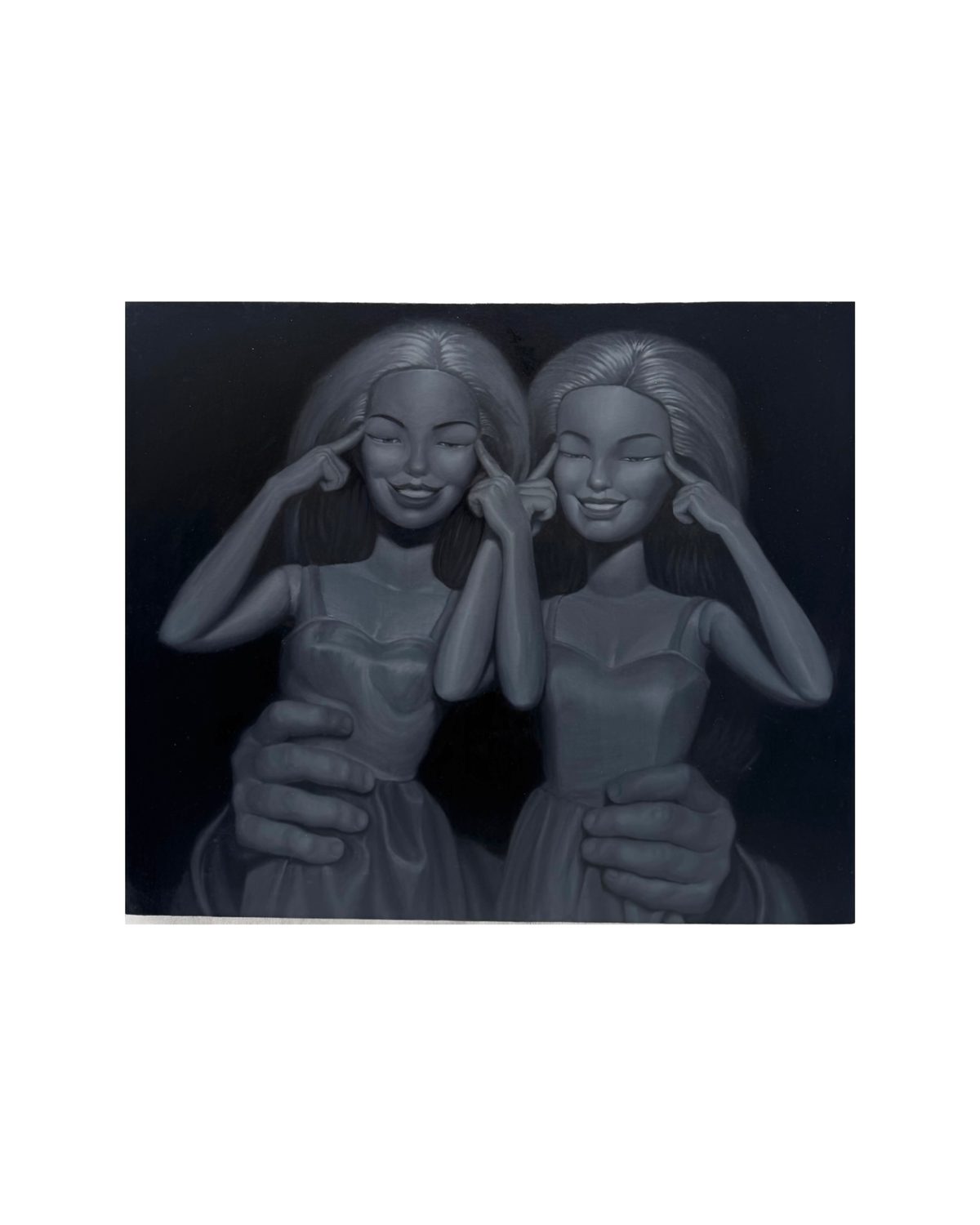
I Hate You Insincerely, Troy Liang, 2025, oil on canvas, 90 x 76 cm
You've showed at St James' Hatcham Church for the Goldsmiths degree show, a genuinely sacred space, distinct from a white cube gallery. Does painting bodies this exposed and this online inside a church change anything about how the work lands, or is that friction part of the point?
I think the space definitely creates a unique dynamic between the work and the sacred, historical atmosphere of the church. It makes the paintings feel more confrontational and more eerie, bringing out their violent qualities in my work and making the whole installation feel almost ritualistic. My work already has a certain sense of drama, and the church functions almost like a stage, especially with the enormous stained-glass window acting like a kind of spotlight. I think the space also makes some of the contradictions within the work much more visible. The friction becomes part of the experience: between the sacred and the profane, permanence and circulation, spirituality and objectification, and between the virtual bodies referenced in the paintings and the spiritual history held within the church itself. In that sense, the space does not completely change the meaning of the work, but rather intensifies questions and tensions that were already there.
Cover Image: I Don't Say Hi to Strangers, Troy Liang, 2025, oil on canvas, 70 x 50 cm