ACTIVE INTERVALS BY YUJIN JUNG
VISUAL ESSAY BY YUJIN JUNG
18 AUGUST 2026 — LONDON, UNITED KINGDOM
We invited Yujin Jung to write alongside her own work, a trace left beside each image, a fragment of thought as unresolved as the paintings themselves. What follows are residues: partial, provisional, offered at the threshold between what is seen and what remains withheld.
Biography
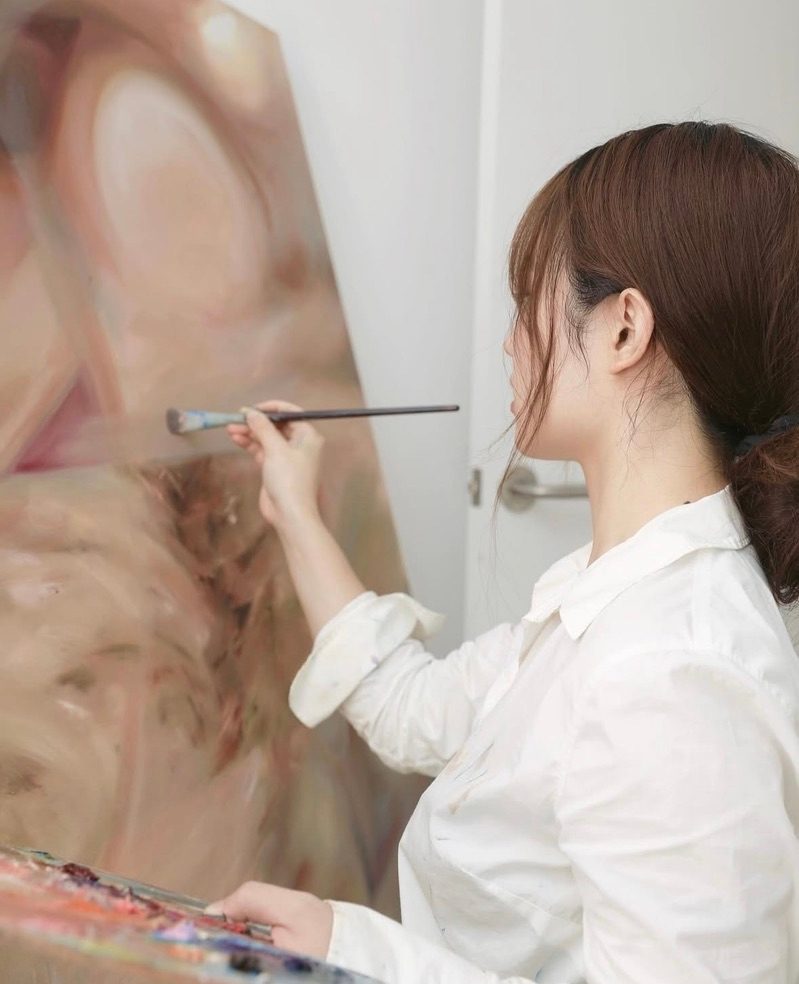
Yujin Jung (b. 2000) is a Korean painter based in London. She completed her BA in Fine Art at Chelsea College of Arts, University of the Arts London, and is currently completing her MA in Painting at the Royal College of Art. She has exhibited in London and Seoul. Growing up around advertising sets where her father worked, Jung became attuned from an early age to the ways images are staged, framed, and transformed before being presented. This proximity to the constructed nature of visual reality, alongside her experience of living between Korea and the UK, informs her ongoing interest in visibility and invisibility, belonging and distance, and the shifting space between transparency and opacity. Working primarily in oil, Jung creates layered paintings that move between abstraction and recognition. Through repeated blurred forms, shifting surfaces, and ambiguous spatial structures, her images remain open and unresolved, never fully clear, yet still recognisable.
TACTILE MIRAGE, 2026
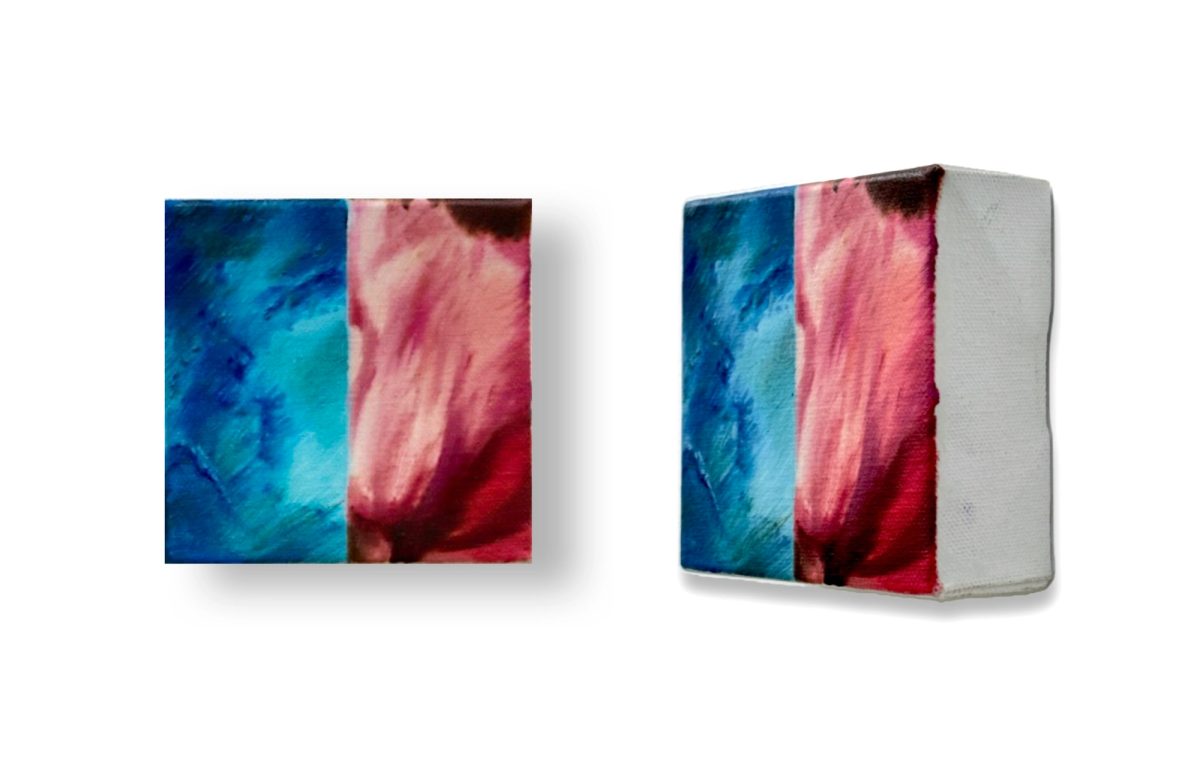
Yujin Jung, Tactile Mirage, 2026, Oil on canvas, 10 × 10 cm
Tactile Mirage juxtaposes two radically different distances of seeing: a satellite image sourced from Google Maps on the left, and a close-up photograph of a tulip on the right. One is produced through extreme remoteness, the other through extreme proximity. Placed side by side, however, the distinction between these distances begins to collapse. Once translated into paint, the mapped terrain and the folds of the flower lose their original scale and recognisability, becoming fields of colour, texture, and surface. The distant appears unexpectedly tactile, while the intimate becomes unfamiliar and abstract.
This juxtaposition reflects a contemporary visual condition in which images move constantly between incompatible scales and viewpoints. We encounter landscapes from above, bodies through magnification, and remote places with an apparent immediacy, often without fully registering the distance through which they have been mediated. Created at the beginning of my time at the Royal College of Art, Tactile Mirage opened a question that continues to shape my practice: how might painting hold together these conflicting distances, and what happens to recognition when the remote and the intimate are made to occupy the same surface?
BLUE APERTURE, 2026
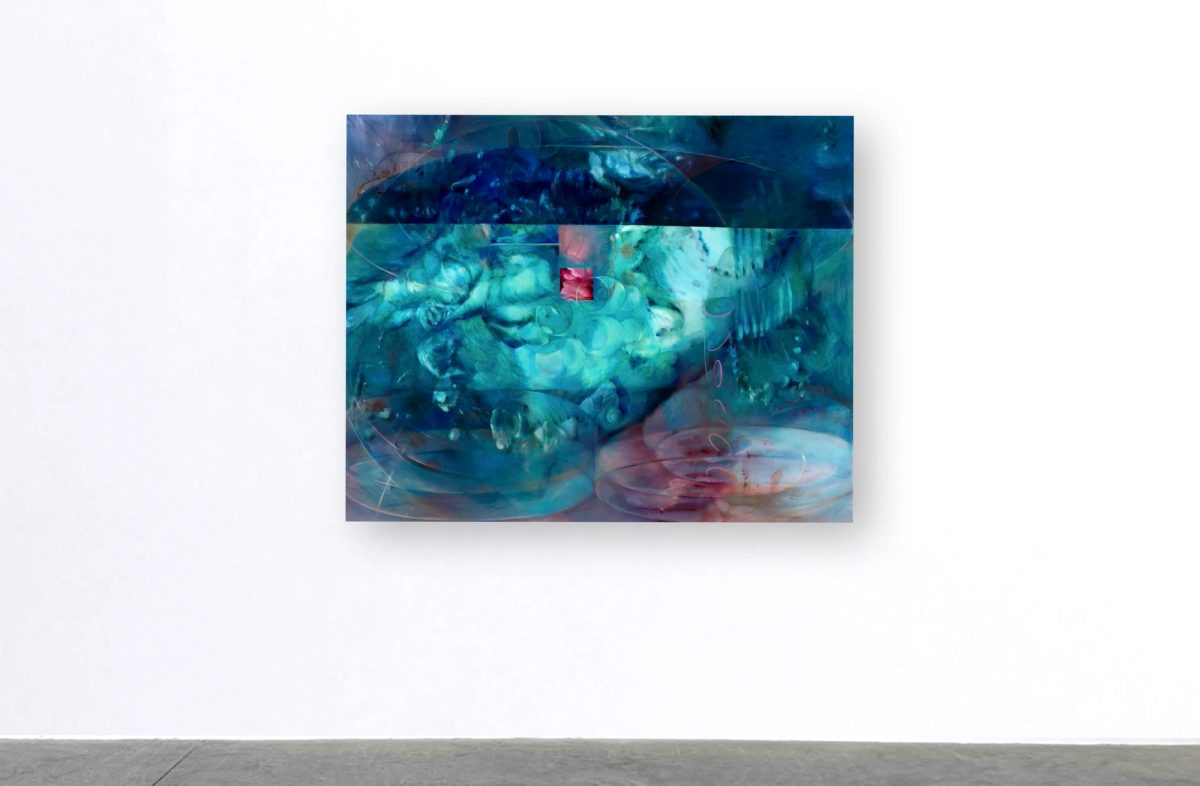
Yujin Jung, Blue Aperture, 2026, Oil on canvas, 150 × 120 cm
Blue Aperture brings fragmented images, shifting viewpoints, and contrasting surfaces into a single field. Circular forms, partial figures, and sections of landscape appear through layers of blue, while a small pink square interrupts the composition like a concentrated point of focus. Rather than guiding the viewer towards one stable image, the work moves between multiple scales and perspectives. The horizontal divisions suggest different visual registers, as though several images were being viewed, cropped, and reorganised at once. Painterly gestures remain fluid, while geometric structures impose moments of order and restraint.
Through this tension, Blue Aperture considers how seeing is shaped by selection. What becomes visible is never the whole image, but a framed and mediated portion of it. The painting therefore asks whether an opening necessarily gives access, or whether it can also determine the limits of what we are able to see.
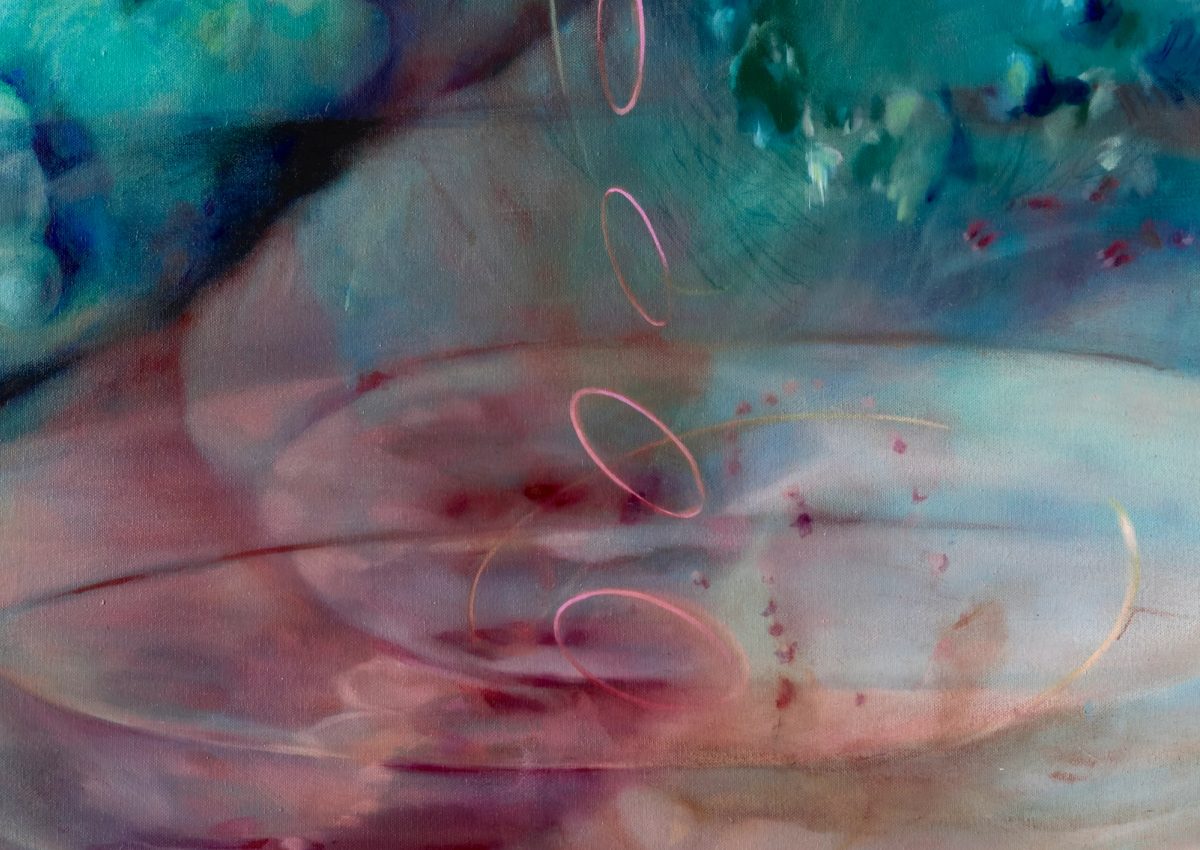
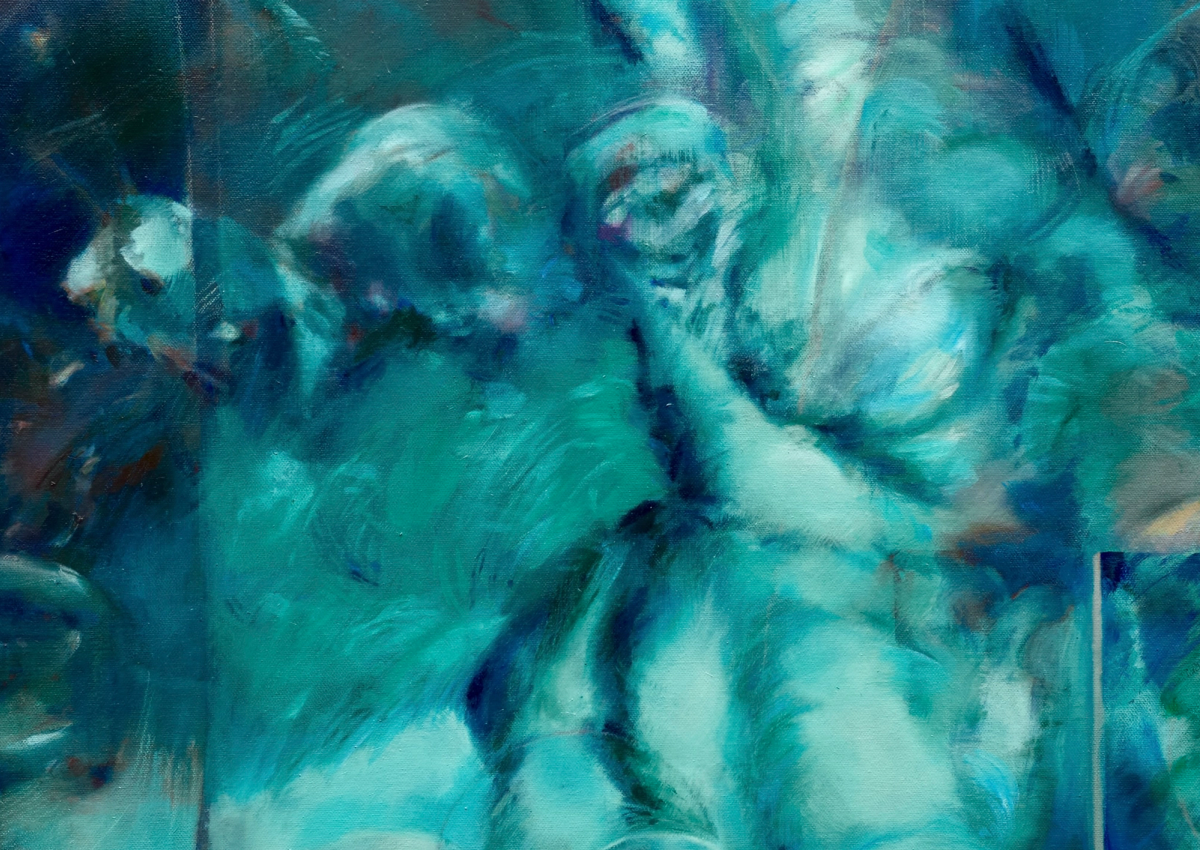
Yujin Jung, Detail Shot of Blue Aperture, Oil on canvas, 150 × 120 cm, 2026
BLUE APERTURE PROCESS
The painting was built through an extensive process of repeated layering. I applied, removed, blurred, and repainted images many times, allowing earlier marks to remain partially visible beneath later surfaces. Some sections were thinned until they became translucent, while others were made denser through accumulated paint.
Rather than following a fixed composition from the beginning, I allowed the image to develop through continual adjustment. Forms were covered, displaced, and reintroduced; divisions were sharpened and then softened again. This repeated movement between concealment and revelation produced a surface in which no single layer remains fully dominant.
The process mirrors the way images are encountered today: cropped, overlaid, circulated, and repeatedly reframed. In Blue Aperture, the final image is not the resolution of these layers but the temporary point at which they remain in tension.
"For me, painting slows vision down, creating a form of silent communication where meaning is sensed before it is fully articulated."
Choreography of Seeing, 2026
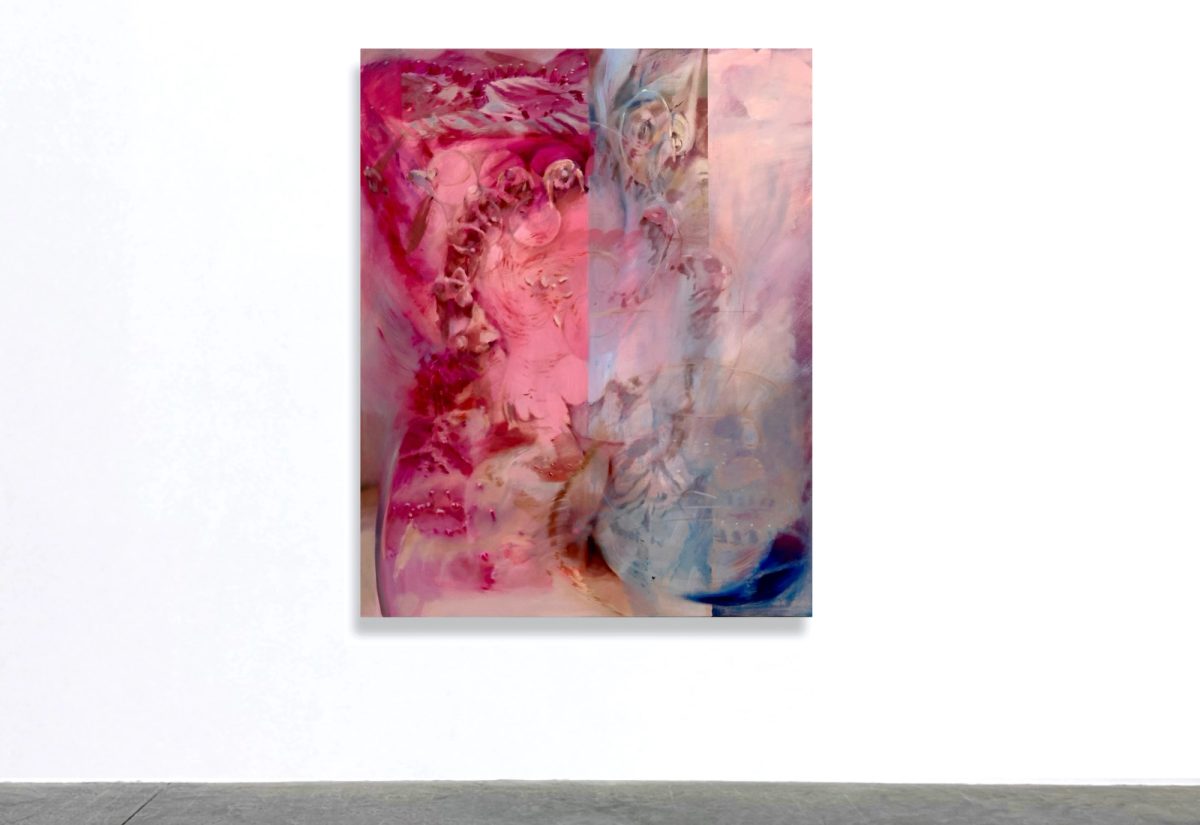
Yujin Jung, Choreography of Seeing, Oil on canvas, 150 × 120 cm, 2026
Choreography of Seeing unfolds through a series of partial encounters. On one side, a group of figures forms a circle beneath an elevated viewpoint; on the other, a face surfaces through pale veils of paint, reflection, and erasure. The composition never settles into a single scene. Instead, it holds several distances, temporalities, and modes of attention in suspension.
The circular gathering suggests intimacy, belonging, and collective rhythm, yet the aerial perspective places the viewer outside it. By contrast, the face appears physically closer, but remains less accessible, partially obscured and difficult to retain in focus. This reversal is central to the work: distance can produce an illusion of coherence, while proximity may unsettle recognition.
Built through repeated layering, removal, and repainting, the surface preserves traces of earlier images beneath later ones. Rather than resolving these fragments, the painting allows them to remain active, moving between closeness and estrangement, visibility and concealment, participation and observation.
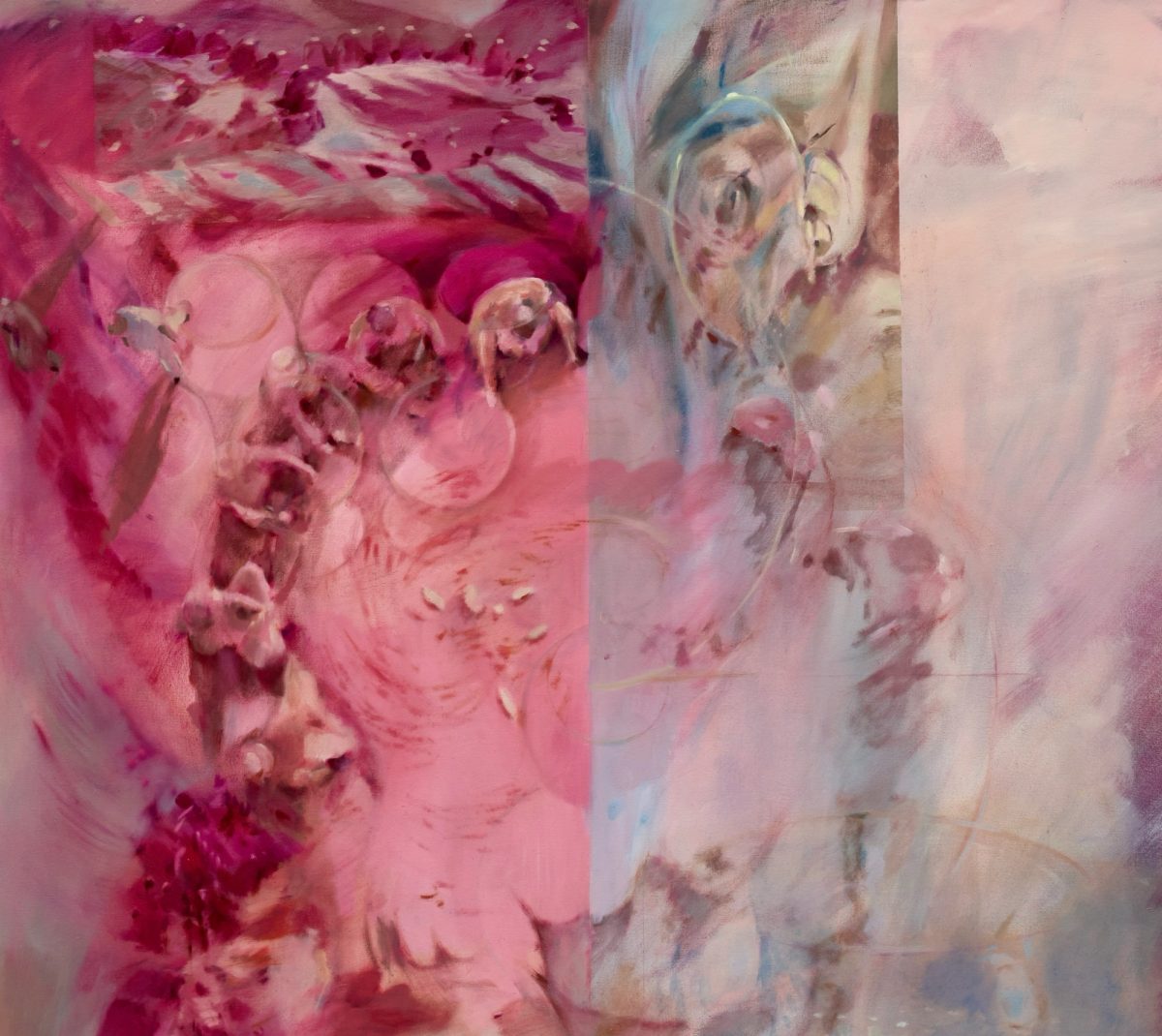
Yujin Jung, Choreography of Seeing, Oil on canvas, 150 × 120 cm, 2026
Sediment without Ground, 2026
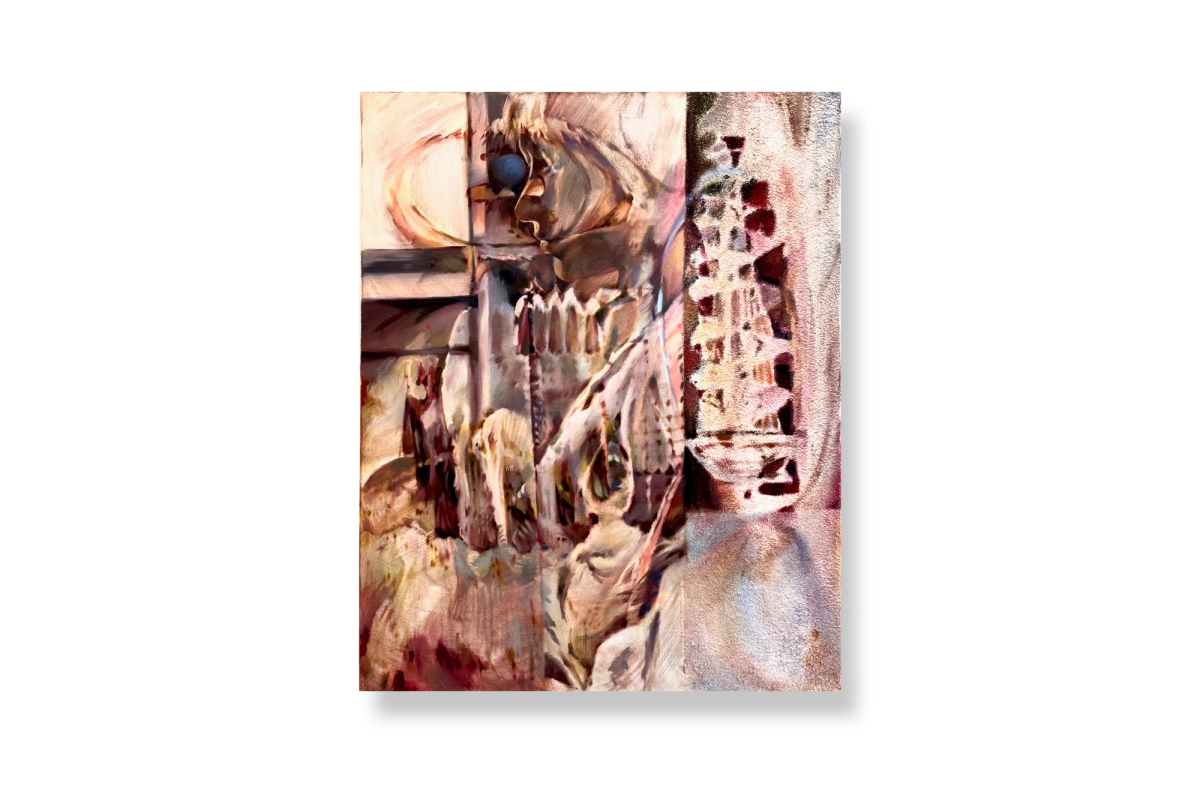
Yujin Jung, Sediment without Ground, Oil and texture paste on canvas, 60 × 75 cm, 2026
Sediment without Ground brings together architectural fragments, partial figures, and compressed spatial divisions that refuse to settle into a stable scene. Forms appear to accumulate across the surface like deposits: some remain recognisable, while others are eroded, displaced, or absorbed into the surrounding paint.
The title refers to sediment as something formed through gradual accumulation, but here there is no secure ground on which it can rest. The image seems built from residues of different places and moments, layered without resolving into a coherent landscape. Vertical divisions interrupt the composition, creating the sense that several views have been compressed, cropped, and placed beside one another.
Texture paste gives parts of the surface a coarse, almost granular density, while thinner passages of oil paint remain fluid and unstable. This contrast allows the image to move between material presence and visual dissolution. What initially resembles architecture or a populated environment begins to lose its certainty when viewed more closely.
"Painting allows a form to hesitate, contradict itself, and preserve the traces of earlier decisions, holding multiple readings without settling into a single meaning."
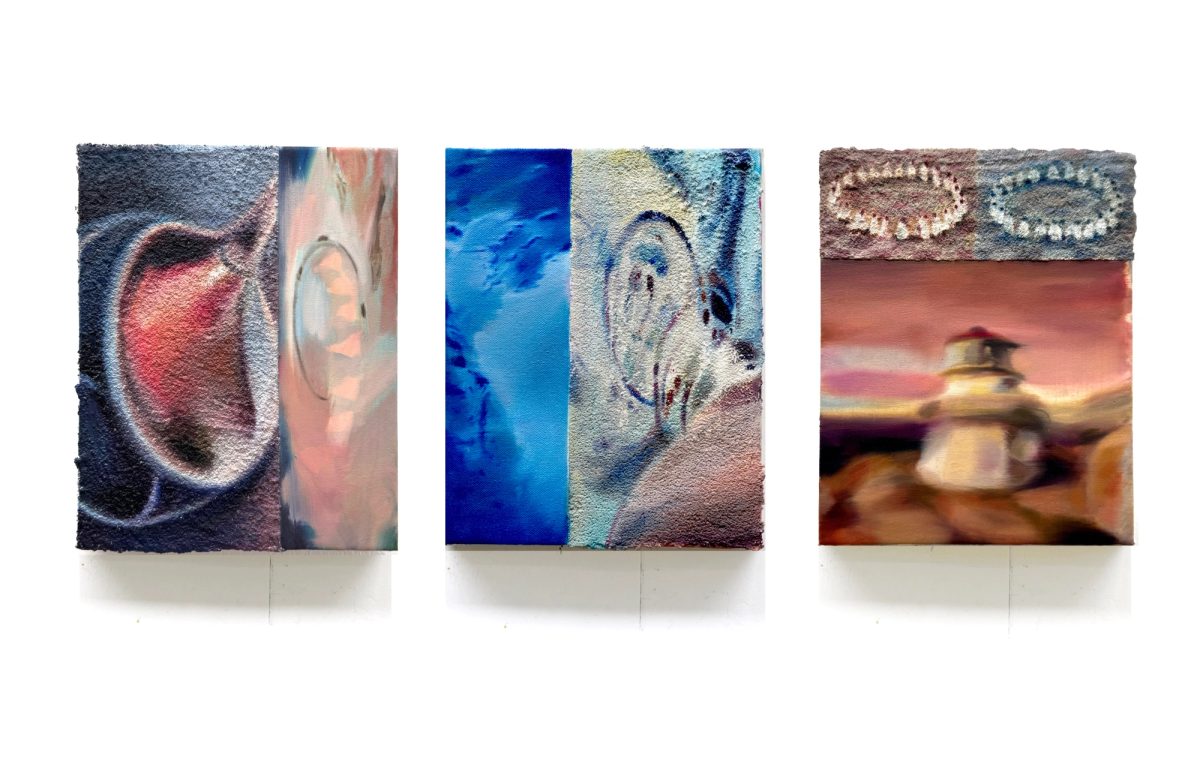
Too Empty to Stay Silent; What I Almost Grasp Beneath the Marine Surface; Returning Without Arrival, 2026
Yujin Jung, Too Empty to Stay Silent; What I Almost Grasp Beneath the Marine Surface; Returning Without Arrival, Oil and texture paste on canvas, 20 × 25 cm, 2026
These three paintings are structured through a recurring tension between smooth and heavily textured surfaces. Across both conditions, the images resist immediate recognition, but through different painterly means. On the smoother passages, forms are blurred, thinned, and softened through paint. On the coarse surfaces, they are interrupted by the physical irregularity of the material itself.
The contrast is therefore not between clarity and obscurity, but between two different forms of uncertainty. One dissolves the image optically; the other fragments it materially. In each painting, seeing becomes an unstable negotiation between what the image appears to reveal and what the surface withholds.
The titles extend this tension through states of absence, incompletion, and return. Too Empty to Stay Silent suggests that emptiness is not passive, but capable of producing its own pressure and resonance. What I Almost Grasp Beneath the Marine Surface holds the image at the edge of recognition, where visual access remains incomplete. Returning Without Arrival turns return into a repeated movement without resolution or final destination.
Together, the works question the assumption that visibility is equivalent to access. An image may remain present without becoming fully legible, while proximity may intensify uncertainty rather than overcome it. The series asks whether sustained looking brings us closer to meaning, or instead makes the limits of perception more apparent.
When Watching Turns Sweet, and Peaks Turn to Pastry, 2025
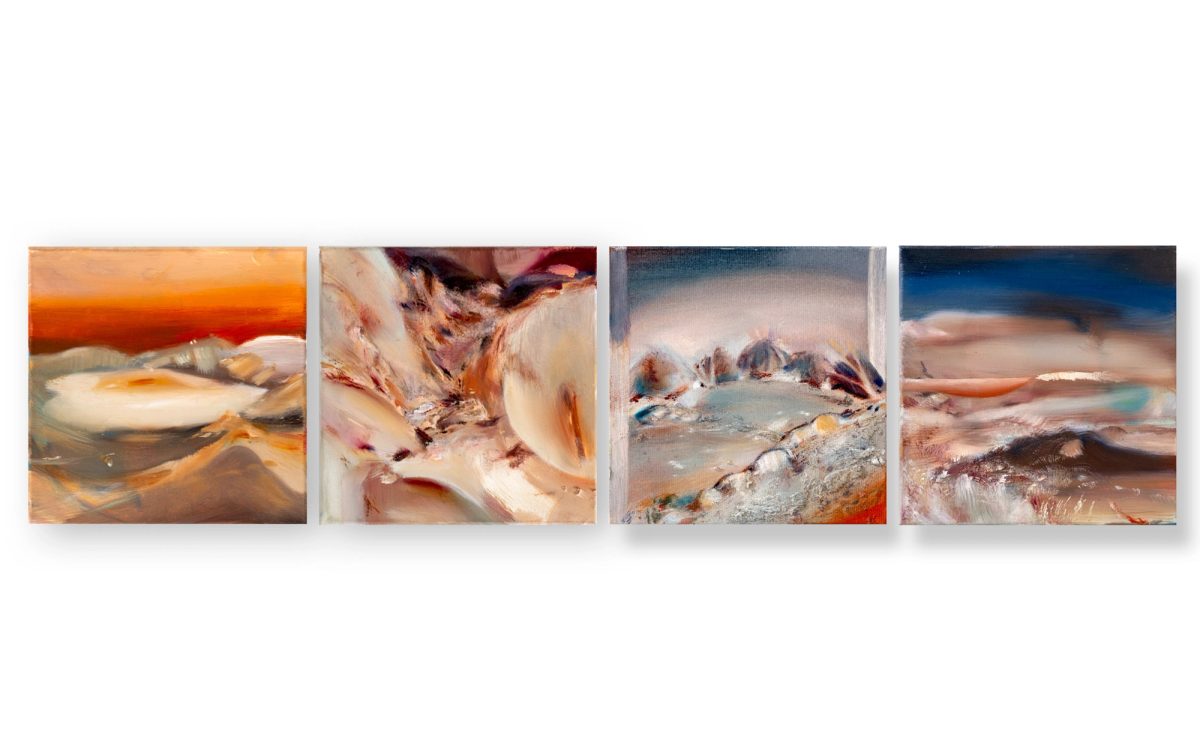
Yujin Jung, When Watching Turns Sweet, and Peaks Turn to Pastry, Oil on canvas, 30 × 30 cm (4), 2025
This four-part painting reflects an earlier exploration of semi-abstraction in my practice. Each panel retains the suggestion of a landscape, peaks, valleys, and horizons, while allowing these forms to shift into folds, icing, flesh, or pastry-like surfaces. The image remains recognisable, yet never settles into a single identity.
Rather than allowing abstraction to replace representation, I seek a coexistence between perception and sensation. The viewer may perceive the structure of a distant landscape while simultaneously encountering the colour, rhythm, and physical movement of paint at close range. Recognition and bodily sensation remain active together, without one fully resolving the other.
The title reflects this perceptual slippage. Through sustained looking, monumental peaks begin to appear soft, sweet, and almost edible. Seeing does not simply identify what is present; it transforms the image through association, memory, and desire. The work therefore asks how painting might keep an image open, between landscape and substance, distance and touch, what we recognise and what we feel.
I Think We Are Being a Cake, 2025
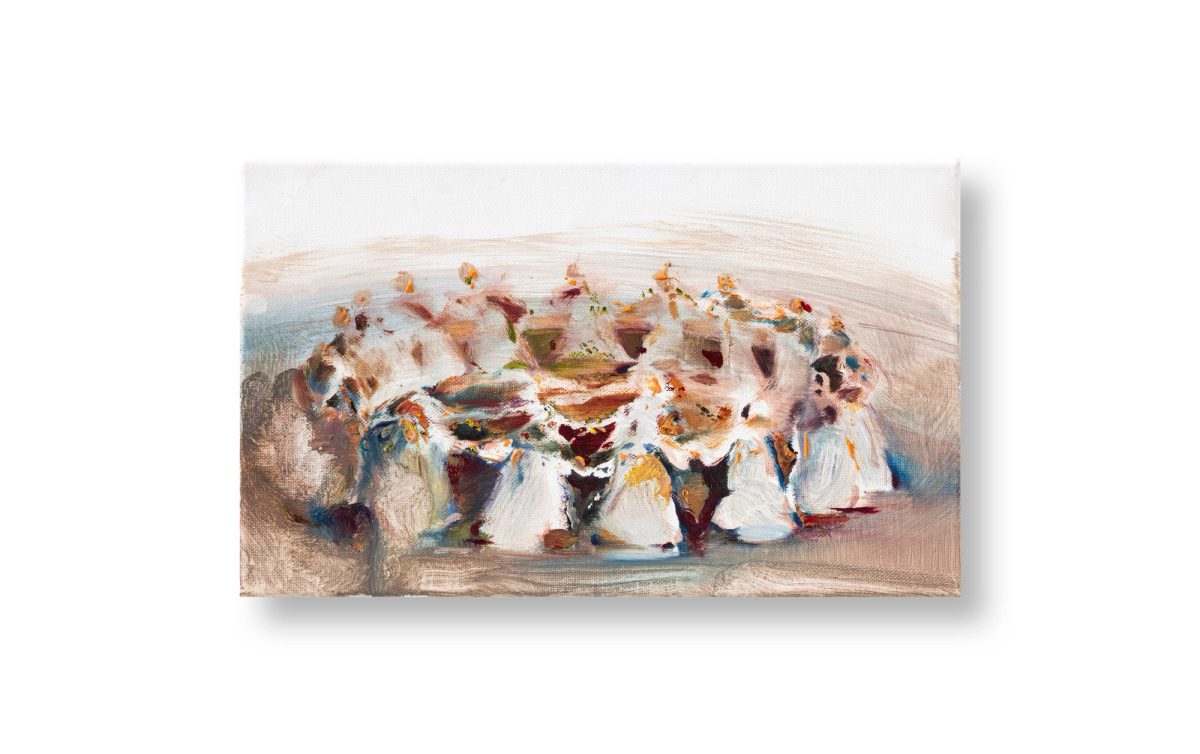
Yujin Jung, I think we are being a cake, Oil on canvas, 35 × 27 cm, 2025
I Think We Are Being a Cake depicts a circular gathering loosely drawn from Ganggangsullae, a traditional Korean communal dance built around repetition, collective movement, and shared rhythm. In this painting, however, the circle is reimagined through Byung-Chul Han's concept of the digital panopticon: a condition in which participation appears voluntary and self-expression feels liberating, while observation becomes continuous, decentralised, and increasingly internalised.
I think of our image-saturated age as a contemporary form of Ganggangsullae performed beneath a digital gaze. We willingly enter systems of visibility, producing and circulating images of ourselves in order to connect, belong, and be recognised. Yet the same gestures that promise freedom also make us more available to scrutiny, measurement, and control. The circle therefore becomes double-edged: it suggests community and intimacy, while also forming a closed structure in which everyone is both participant and observer.
The title introduces a deliberately absurd shift in perception. From a distance, the circular group begins to resemble the decorated edge of a cake. A communal ritual slips into spectacle, and the figures themselves appear almost arranged for consumption. This visual ambiguity reflects the instability of contemporary visibility, where lived experience is repeatedly aestheticised, displayed, and transformed into content.
Rather than presenting surveillance as something imposed entirely from outside, the painting considers how it is sustained through our own desire to appear. It asks whether visibility genuinely grants agency, or whether the freedom to be seen quietly draws us further into systems whose limits remain difficult to recognise.
"In contrast to the seamless and persuasive visual material produced through advertising, painting allows me to keep its construction visible."
Beyond the Gaze, 2024
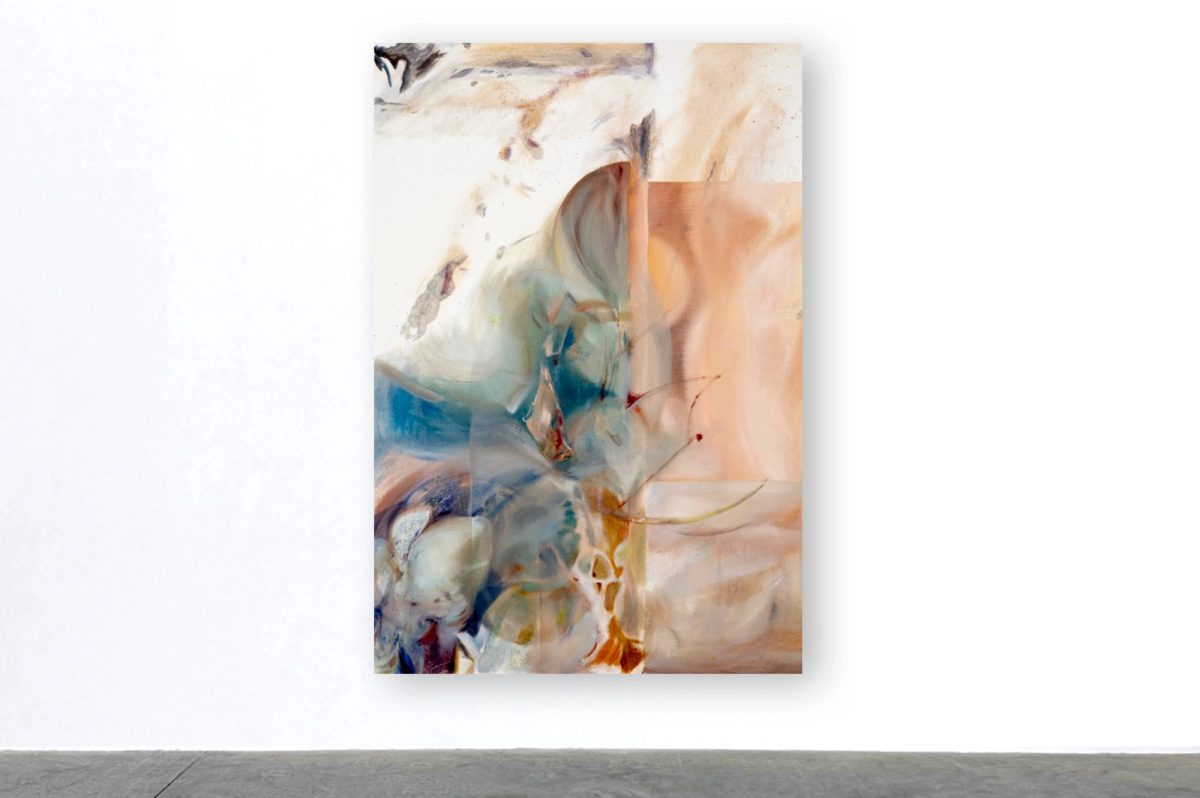
Yujin Jung, Beyond the Gaze, Oil on canvas, 112 × 162 cm (4), 2024
Beyond the Gaze was inspired by the experience of looking at an image through a glass of water. The glass seems transparent and promises direct access to what lies beyond it, yet its curved surface bends, enlarges, and displaces the image. This reminded me that seeing never occurs without mediation: even the structures that appear most transparent can quietly determine how an image becomes visible.
The painting began with a fragment of a cake, an image associated with sweetness, attraction, and immediate visual pleasure. I used this seductive form as a metaphor for the way contemporary images draw us in through their apparent accessibility. Through repeated layering, rotation, and repainting, however, the cake gradually lost its stability. Recognisable elements were concealed, displaced, and absorbed into the surrounding paint, moving the image between figuration and abstraction.
This process echoes the way visual information is selected, reframed, and transformed before it reaches us. Just as the glass alters what is seen while remaining almost invisible itself, the systems mediating contemporary images often disappear behind an impression of transparency. The painting therefore does not attempt to restore the original image or correct its distortion. Instead, it preserves the point at which recognition becomes uncertain.
By delaying immediate identification, Beyond the Gaze invites perception and sensation to operate together. The viewer may search for familiar forms while responding to colour, movement, and the physical presence of paint. The concealed portrait extends this process, rewarding sustained attention while revealing how easily an image can remain unnoticed within plain sight. The work asks what lies beyond the first impression, and whether seeing more clearly necessarily means understanding more deeply.
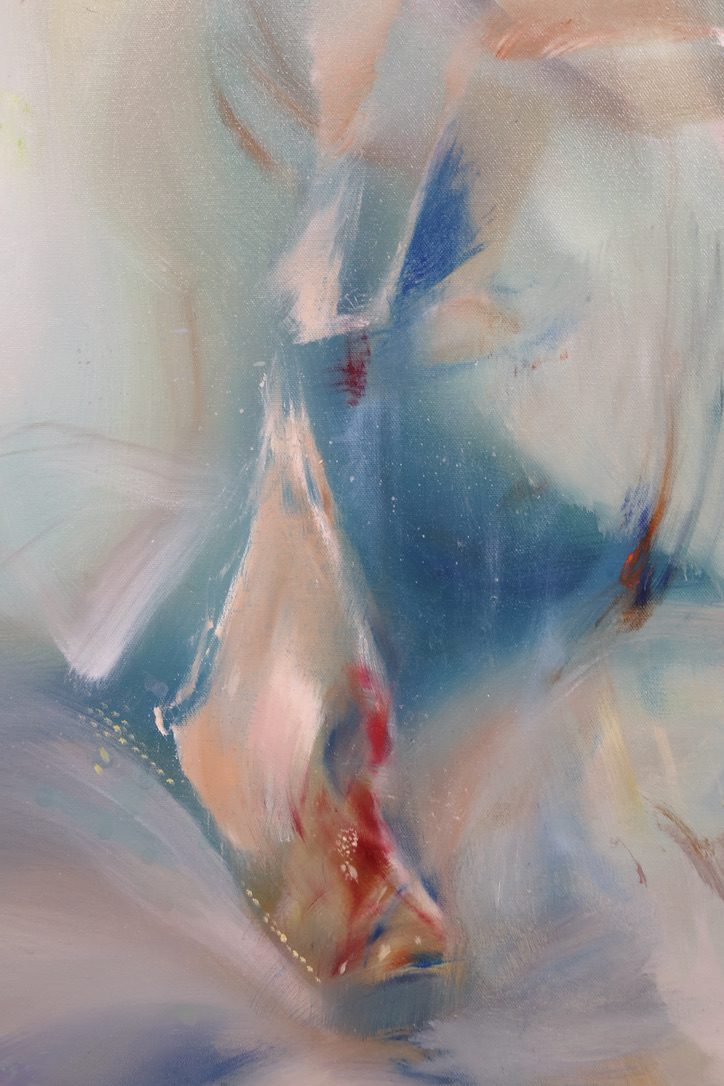
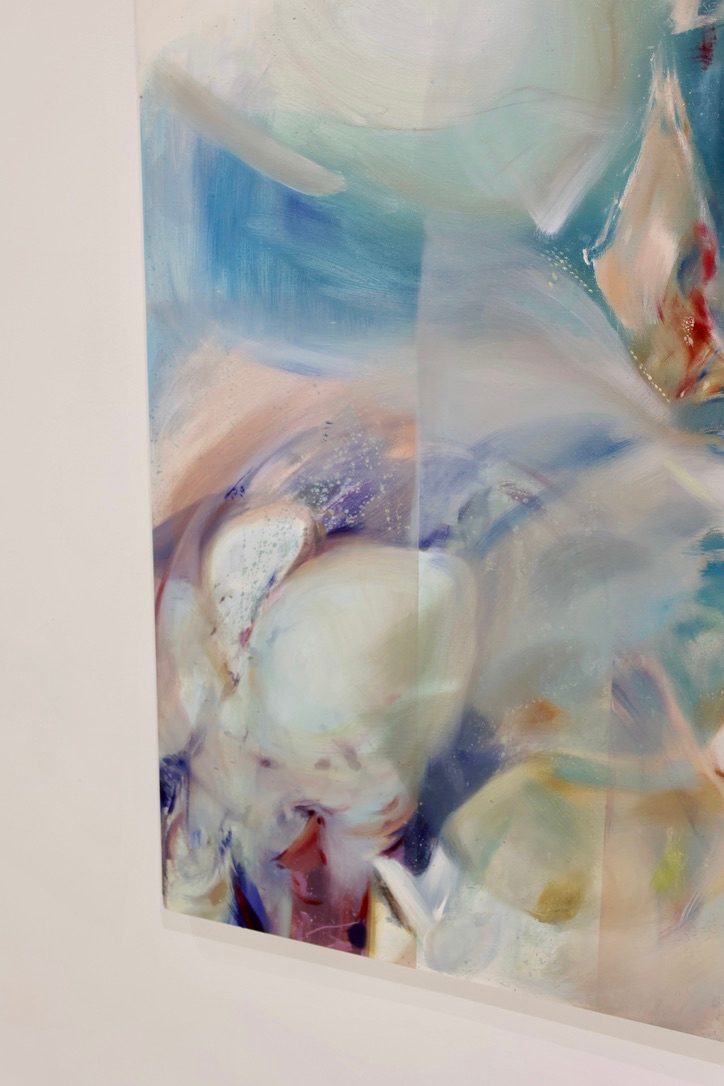
Yujin Jung, Beyond the Gaze, Oil on canvas, 112 × 162 cm (4), 2024
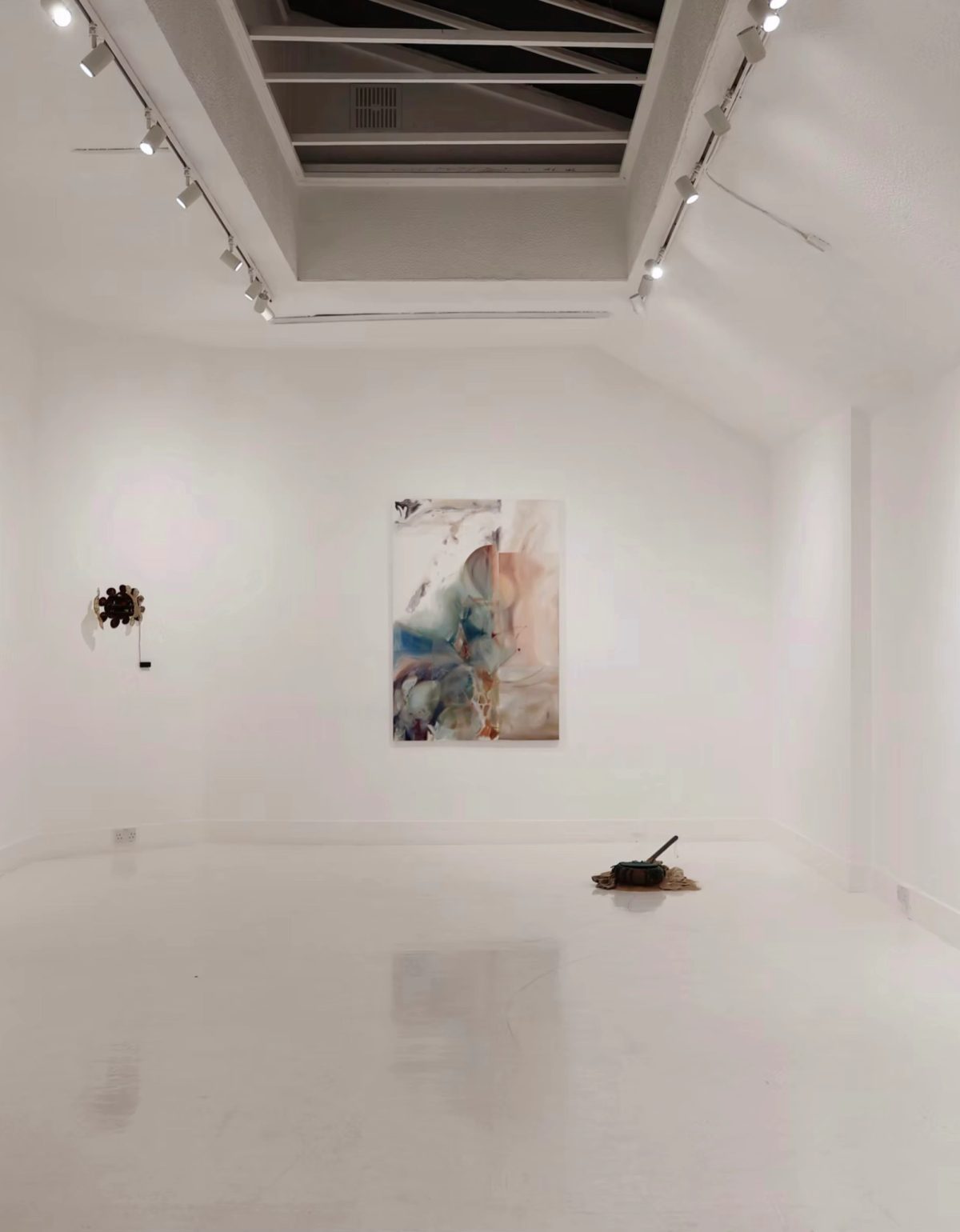
Yujin Jung, Beyond the Gaze, Oil on canvas, 112 × 162 cm (4), 2024
Seems Both Distant and so Close, 2026
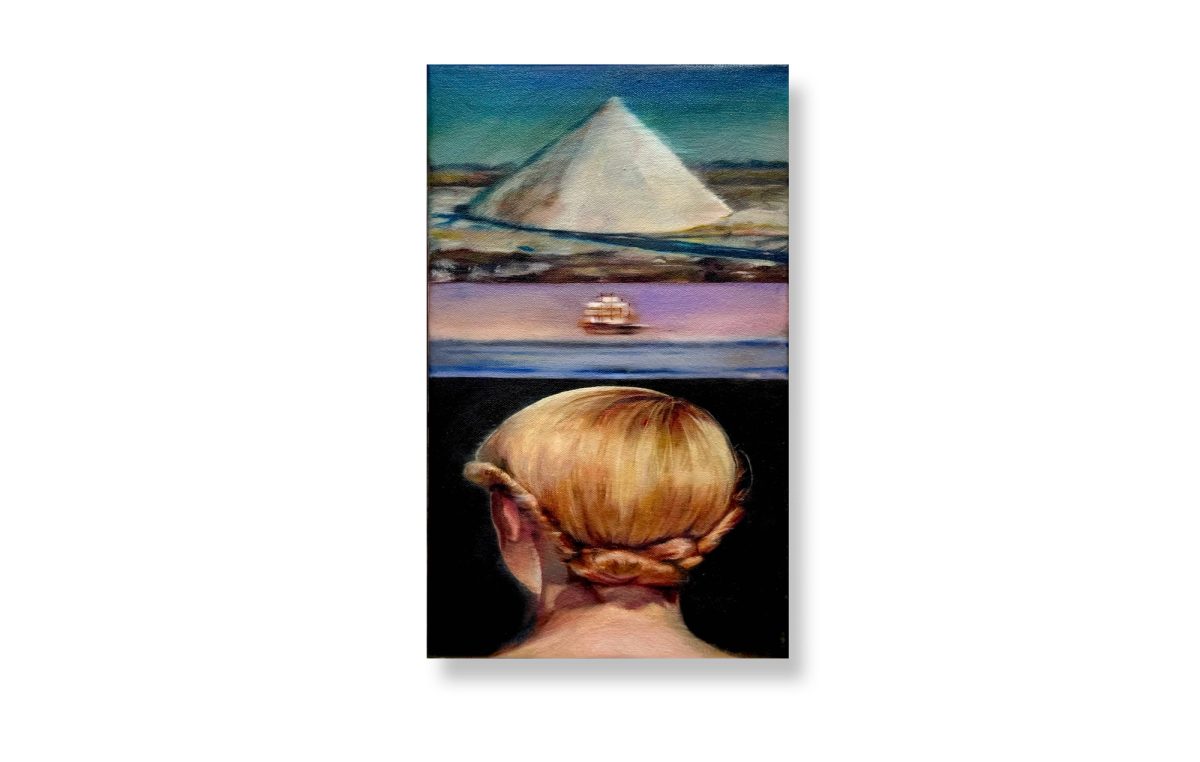
Yujin Jung, Seems Both Distant and So Close, Oil on canvas, 27 × 45 cm, 2026
Seems Both Distant and So Close brings together three images held at different perceptual distances: a mountain of salt, a small ship crossing the horizon, and the back of a woman's head in the foreground. The composition moves between landscape, passage, and bodily proximity, yet these elements never fully merge into a continuous scene.
The figure appears physically close, but remains inaccessible; her face and gaze are withheld from the viewer. Beyond her, the ship suggests movement toward a distant place, while the salt mountain appears monumental yet strangely artificial, hovering between a natural formation and a constructed image. The painting therefore complicates the relationship between proximity and knowledge. What is nearest is not necessarily the most available, and what appears far away can acquire an intense psychological presence.
The work reflects on distance as more than a spatial condition. Distance can be emotional, perceptual, and mediated by the images through which we imagine places, people, and possible destinations. By compressing incompatible scales into a narrow vertical composition, the painting holds longing and detachment, intimacy and estrangement in the same field. The title describes this unresolved state: the sensation of being drawn toward something that remains, despite its apparent closeness, beyond reach.
"At times, I introduce deliberate gaps and empty spaces, not as complete absences, but as active intervals where what is withheld can remain present and open to thought."
Mapping the Mysteries, 2023
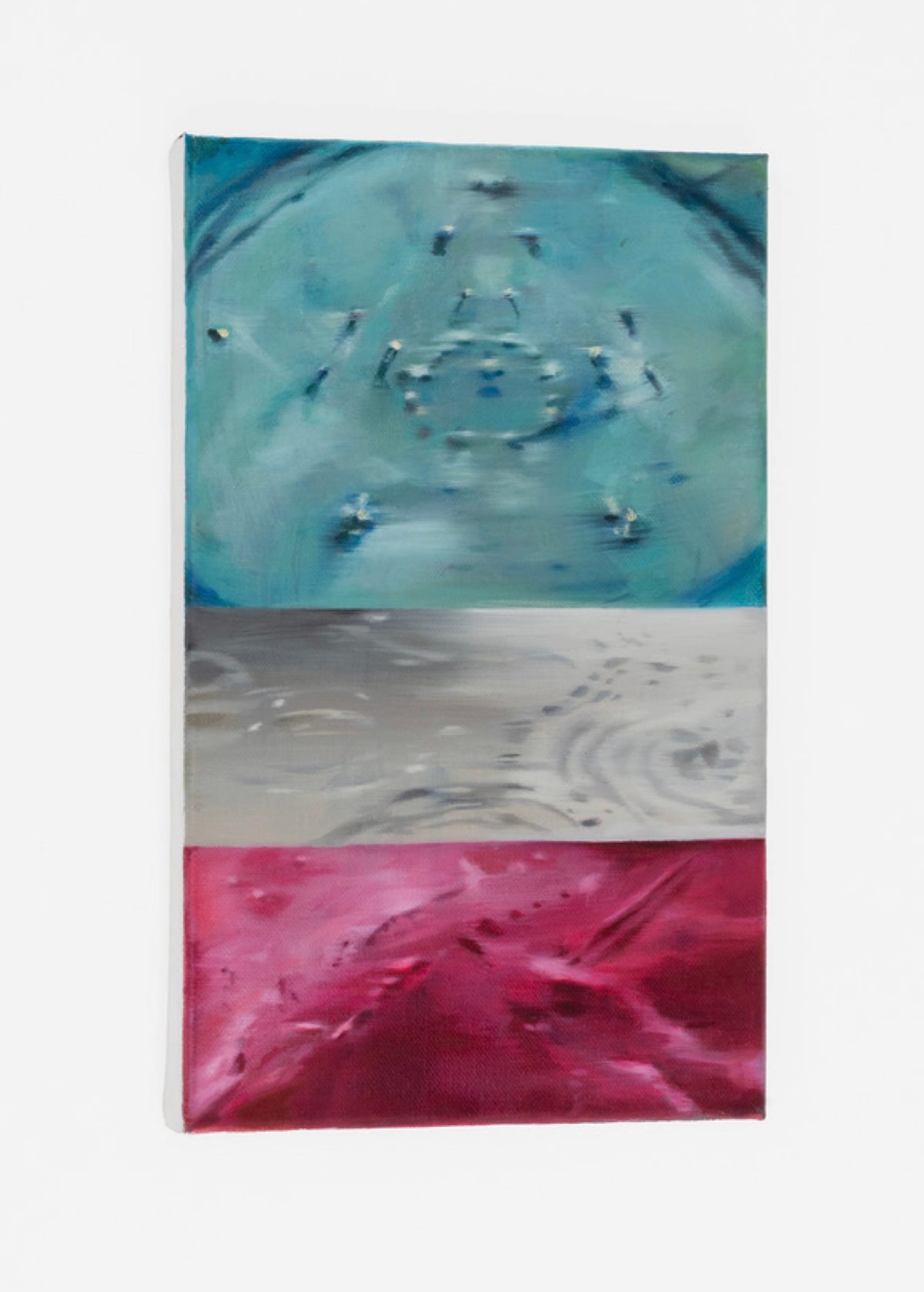
Yujin Jung, Mapping the Mysteries, Oil on canvas, 35 × 27 cm (2), 2023
Mapping the Mysteries emerged from an early interest in how maps, diagrams, and aerial images promise to organise what remains difficult to understand. The composition is divided into distinct horizontal fields, each suggesting a different system of orientation: a blue expanse viewed from above, a pale transitional zone marked by traces and ripples, and a saturated lower section that resembles an unstable terrain.
I was interested in the authority carried by mapped images. They appear to translate the world into something legible, measurable, and navigable, yet they inevitably depend on selection, distance, and abstraction. What is omitted can be as significant as what is shown. The title therefore contains a contradiction: mapping suggests knowledge and control, while mystery refers to what resists being fully located or explained.
The circular formation in the upper section resembles a gathering seen from an elevated perspective, but the surrounding blur prevents the scene from becoming completely identifiable. Below it, marks that could be read as footprints, currents, or coordinates offer signs of movement without revealing a clear origin or destination. Rather than guiding the viewer toward one stable interpretation, the painting presents orientation as partial and provisional.
The work reflects a question that has continued throughout my practice: whether systems created to make the world more visible genuinely bring us closer to it, or whether they replace lived complexity with an image that only appears complete.
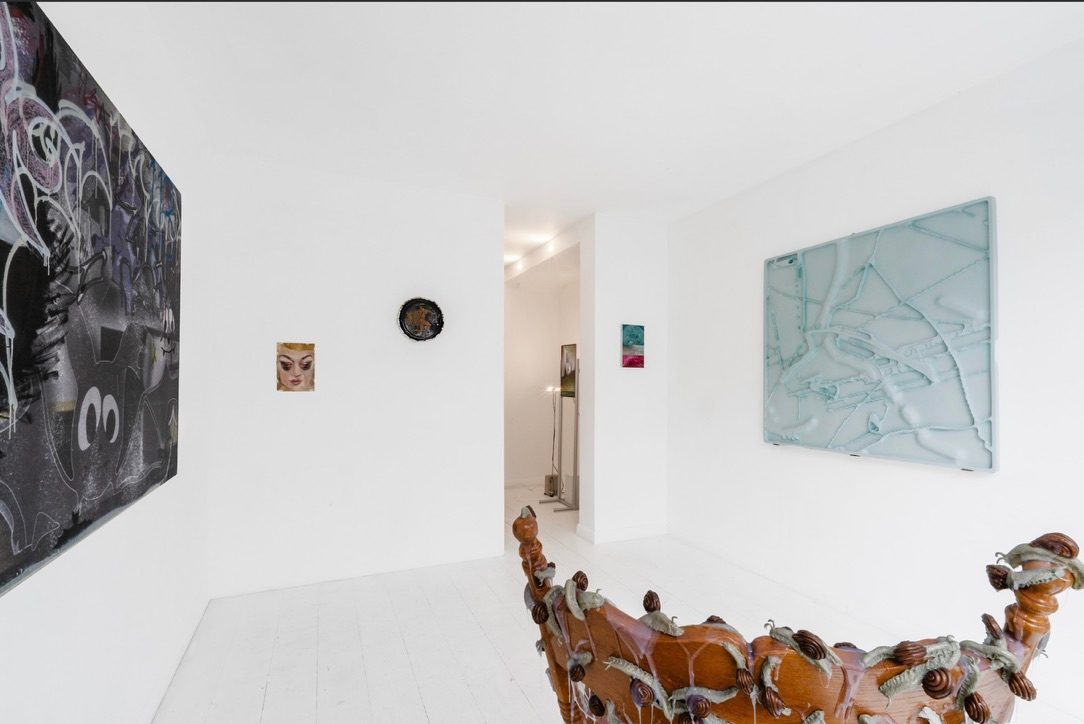
Yujin Jung, Mapping the Mysteries, Installation shot, 2025, Group show, "The City Listens Back," Purist Gallery, London, UK