A TRANSPARENT, DISTORTING MEMBRANE: IN CONVERSATION WITH HAYNE PARK
CONVERSATION BY SELIN KIR
CO-FOUNDER, CURATOR
25 FEBRUARY 2026 — UNITED KINGDOM
Hayne Park speaks from within a practice that resists hard edges. Glass, in her hands, is neither obedient nor fixed. It curves, yields, thickens, slips. What begins as lighting becomes a question of proximity. Light is treated as a membrane, something that filters and distorts rather than clarifies. Transparency is never pure. It carries gravity, tension, and the trace of force. Across different contexts, her works do not change identity so much as alter their distance from us. This conversation lingers in that in-between condition, where material has its own agency, where ambiguity is not protected but produced, and where each work finds its place not by decision, but by a quiet impulse that determines where it wants to reside.
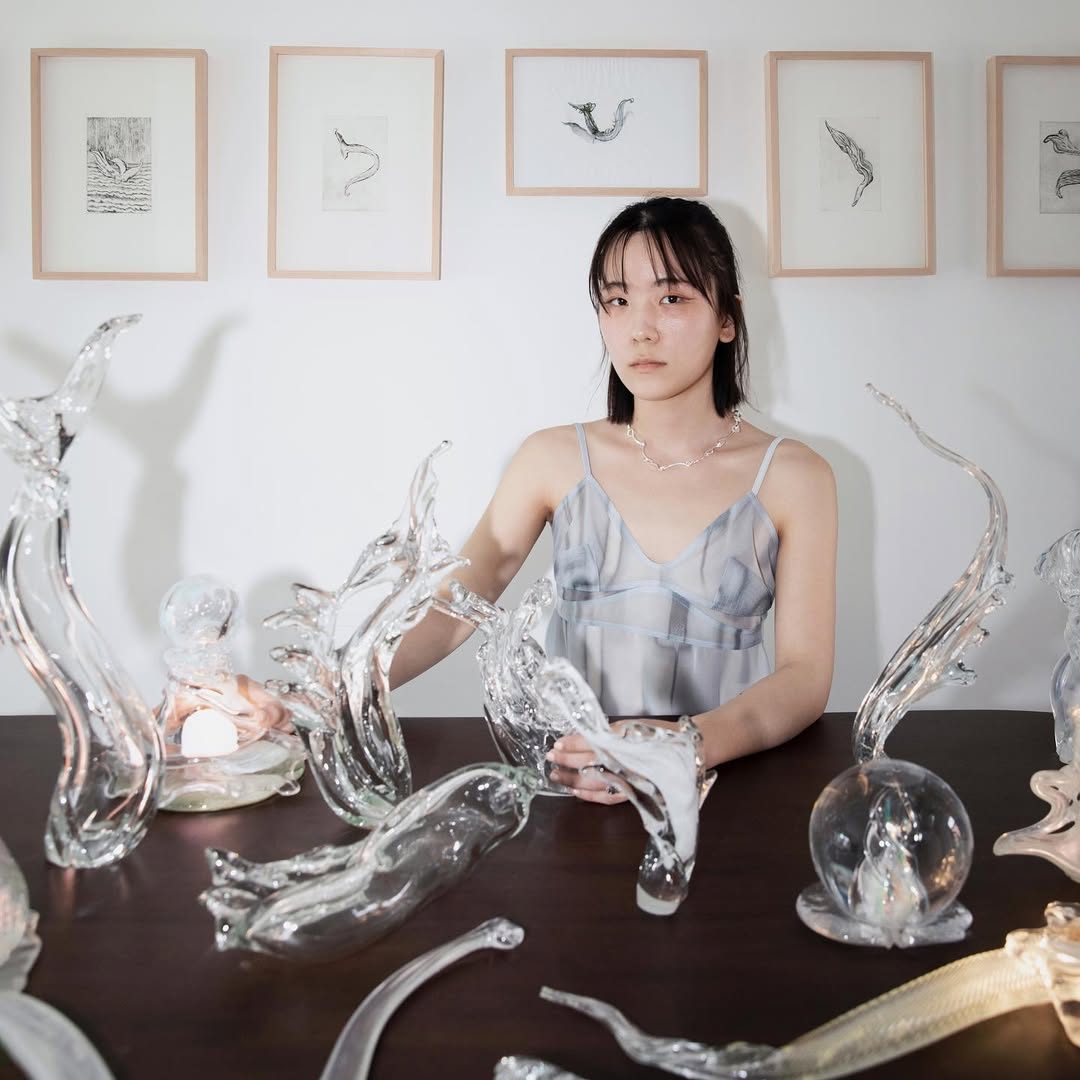
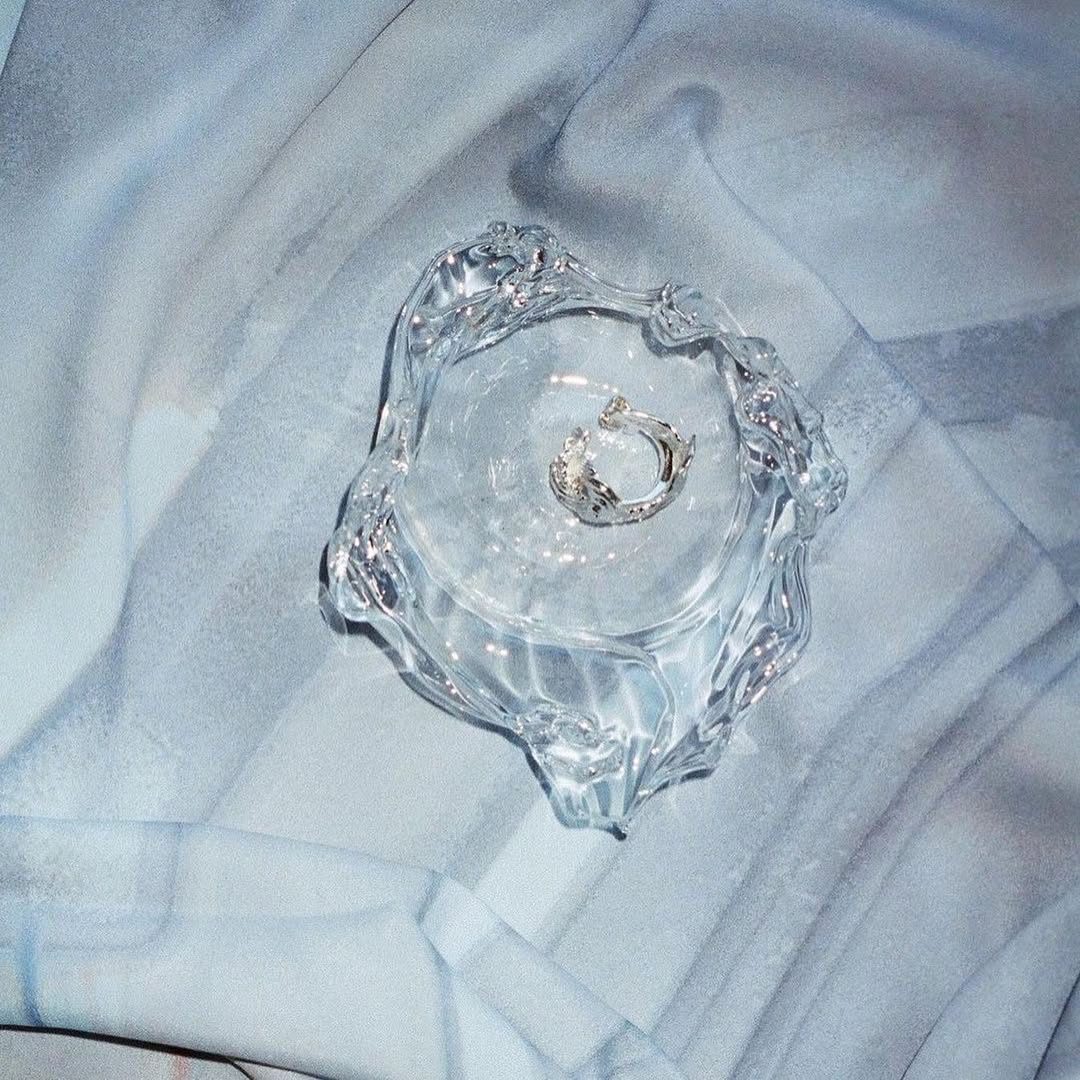
POSTED @WITHREGRAM • @LOWCLASSIC_SEOUL
SPOTTED IN GLORYHOLE’S WORKROOM: HAYNE PARK WEARING THE NEW SEE-THROUGH STITCH DRESS WITH A SEASONAL PRINT INSPIRED BY THE CHARACTER OF GLASS AND LIGHT.
Your practice moves between sculpture, wearable objects, and installation.
When you begin a new piece, what signals whether it wants to exist on the
body, in a space, or somewhere in between?
Some of my works end up being placed on the body, but often this begins with a kind of impulse. I might be quietly looking at a piece, rolling it in my hand, and then suddenly trying it on my wrist. If that unconscious impulse doesn’t happen, the work usually finds its place in space rather than on the body.
For me, the idea of something existing somewhere between body and space feels closest to my current practice, so that part of the question is particularly interesting. Lately, I’ve been working on pieces that function almost like membranes or screens. Through glass, the body can still be seen, so perhaps it’s fair to say that these works exist in between.
I don’t think this comes from a desire to extend the body through glass. Instead, I want to see the body through this transparent yet distorting membrane. The signal for that desire feels like an extension of the same impulse I mentioned earlier, a quiet, intuitive moment that suggests where the work wants to reside.
Glass is central to your work, often treated as something soft, responsive, and bodily rather than rigid or monumental. What drew you to glass as a primary material, and how has your relationship to it evolved through making?
My first reason for choosing glass was actually quite practical. I wanted to make lighting. If I wanted to create and sell lamps, glass felt like the most natural material to begin with. When I thought of lighting, I immediately thought of light bulbs. Because glass transmits light, it seemed like the most efficient material for building a luminous outer shell.
Later, during graduate school, I began working with glass more seriously and tried to understand its material qualities in my own way. Glass, in its semi-liquid, unfixed state, forms through the forces I apply and through gravity. But during this process, I began to feel that glass itself also had its own will or force. Forms don’t fully yield to my intention, and I never wanted to completely control the inherent qualities of the material, its tendency toward curves, its liquidity.
Realizing that this material carries something like its own vitality, even if calling it a “will” may sound irrational, marked a shift in my relationship with glass. Since then, it has felt less like a material I control and more like something I work alongside.
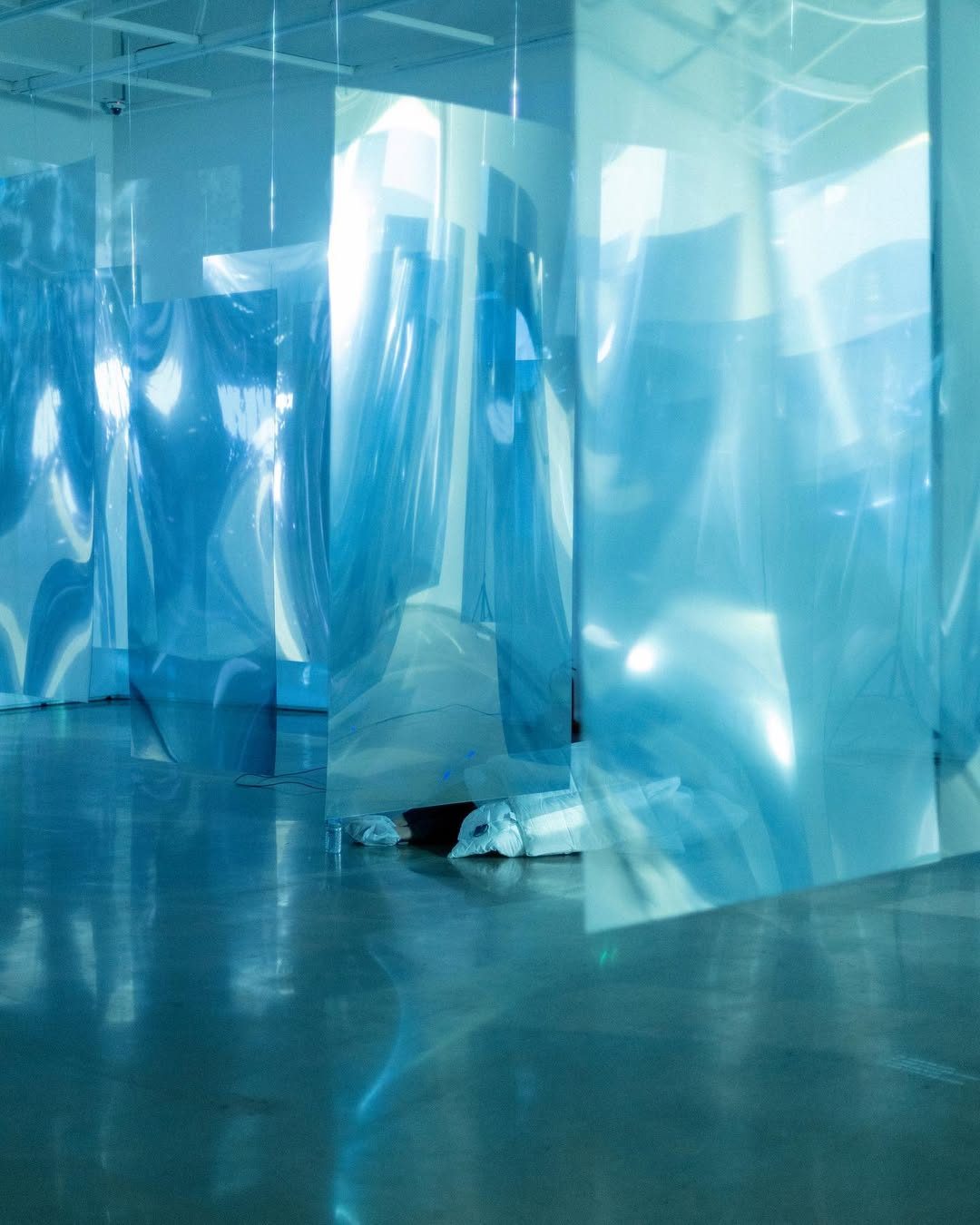
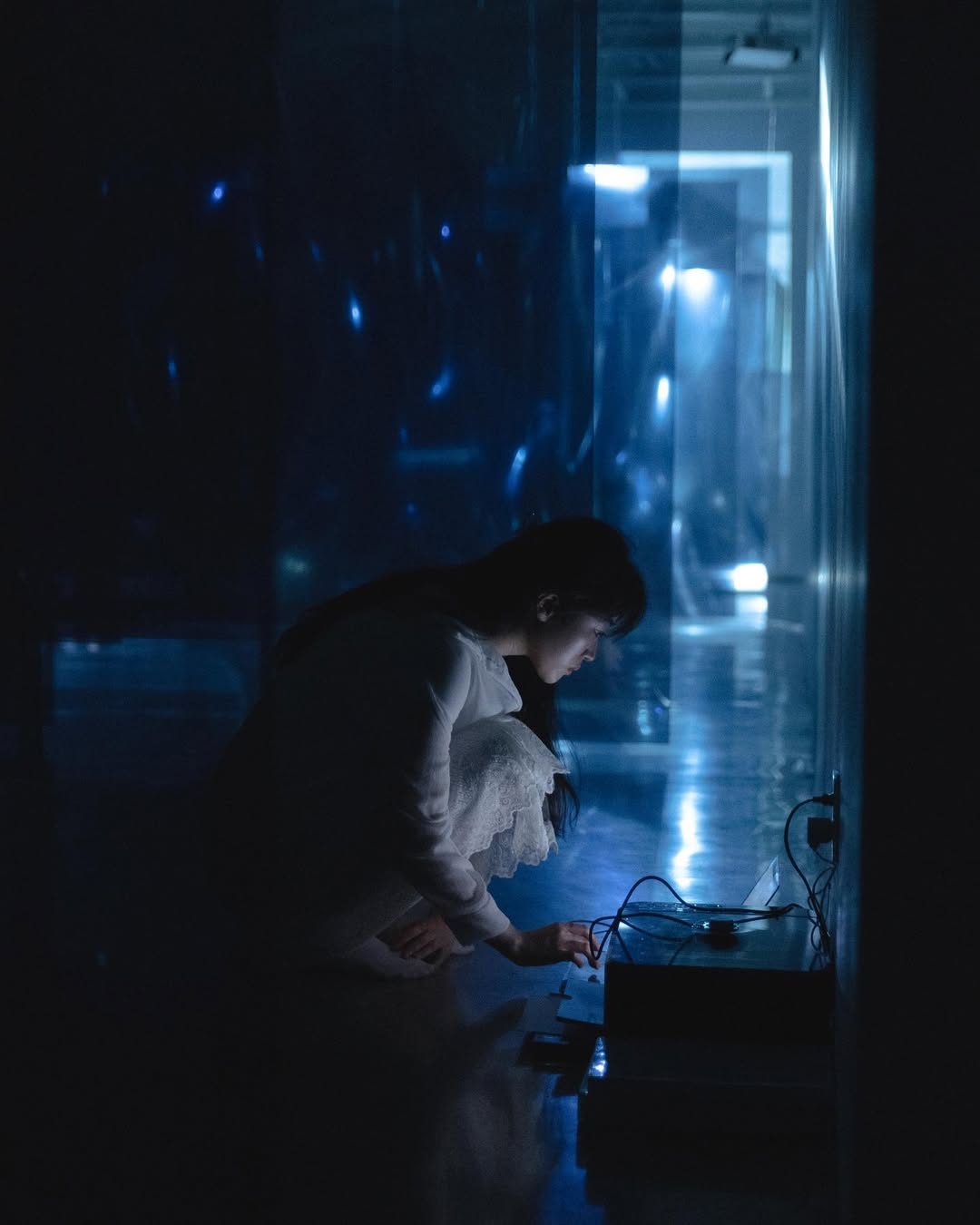
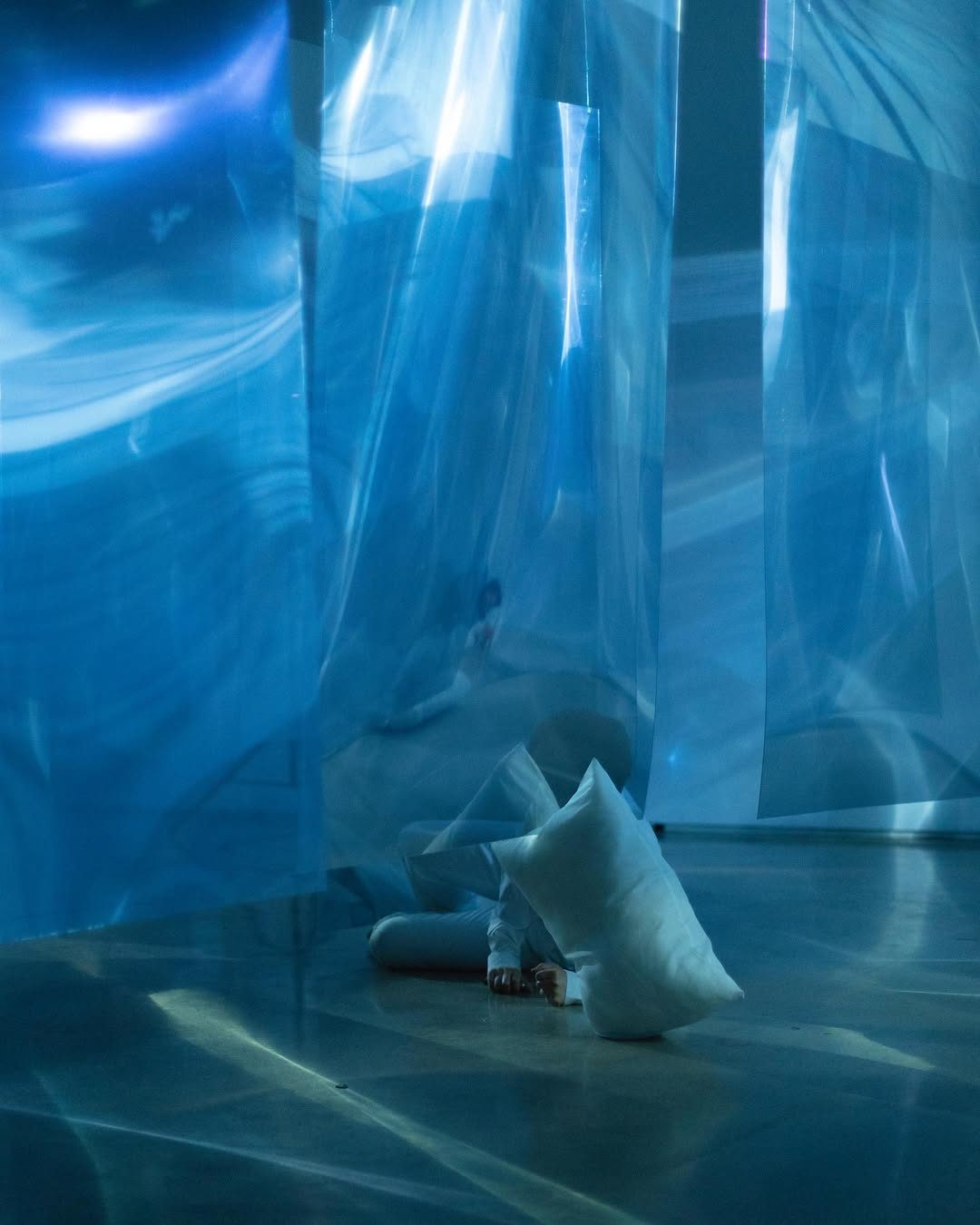
HETEROCHRONIE
Performance
Directed by Kim Mihyun (@koldsleep)
Spatial Design by Park Hyein (Gloryhole Light Sales)
Photography by Okto Lee (@okto_lee)
You describe light as something that can be kept close and offer comfort, even a sense of vitality. When translating this belief into artificial lighting, what qualities, material, form, atmosphere feel most essential for you to preservethat sense of “aliveness” in everyday space?
The most important quality I want to preserve in light is that it remains something you can look at, something that doesn’t overwhelm or blind. I’ve always loved keeping a single dim, warm light on in a dark room. In fact, that feeling was the beginning of my desire to create lighting. It’s similar to quietly watching a candle flame.
When you observe a candle closely, it has multiple layers. The color at its core differs from the color at its outer edge, and simply watching it can feel warm and meditative. For that to happen, light must first be something you can observe. It shouldn’t be too bright, and there should be something to discover the longer you look.
For this reason, I tend to construct layered structures. In many of my lamps, the light source is wrapped first with feathers and film, then enclosed again within one or two layers of glass. These four layers surrounding the light create a condition in which the light can be quietly observed over time. Preserving that layered, contemplative quality is what matters most to me.
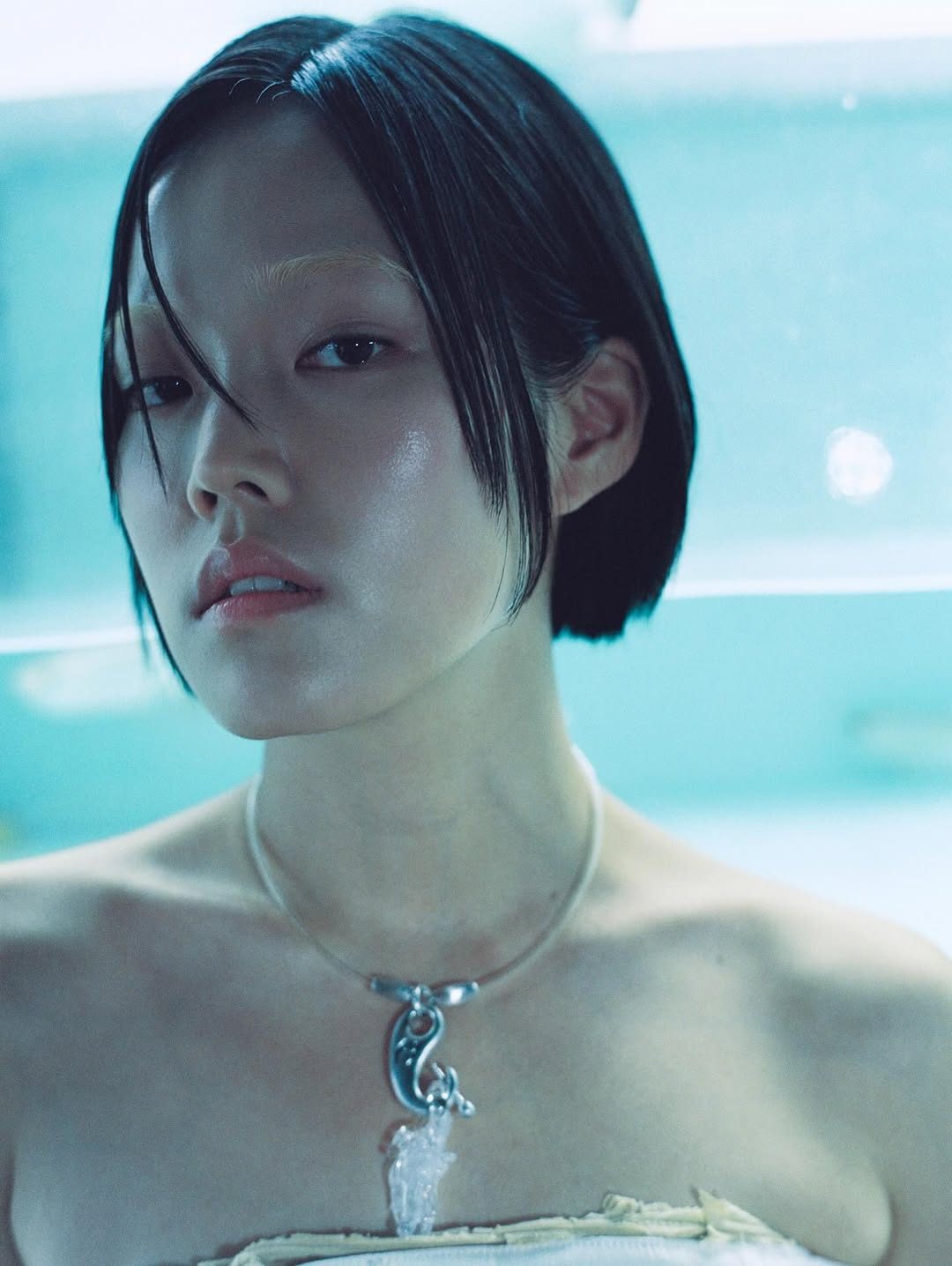
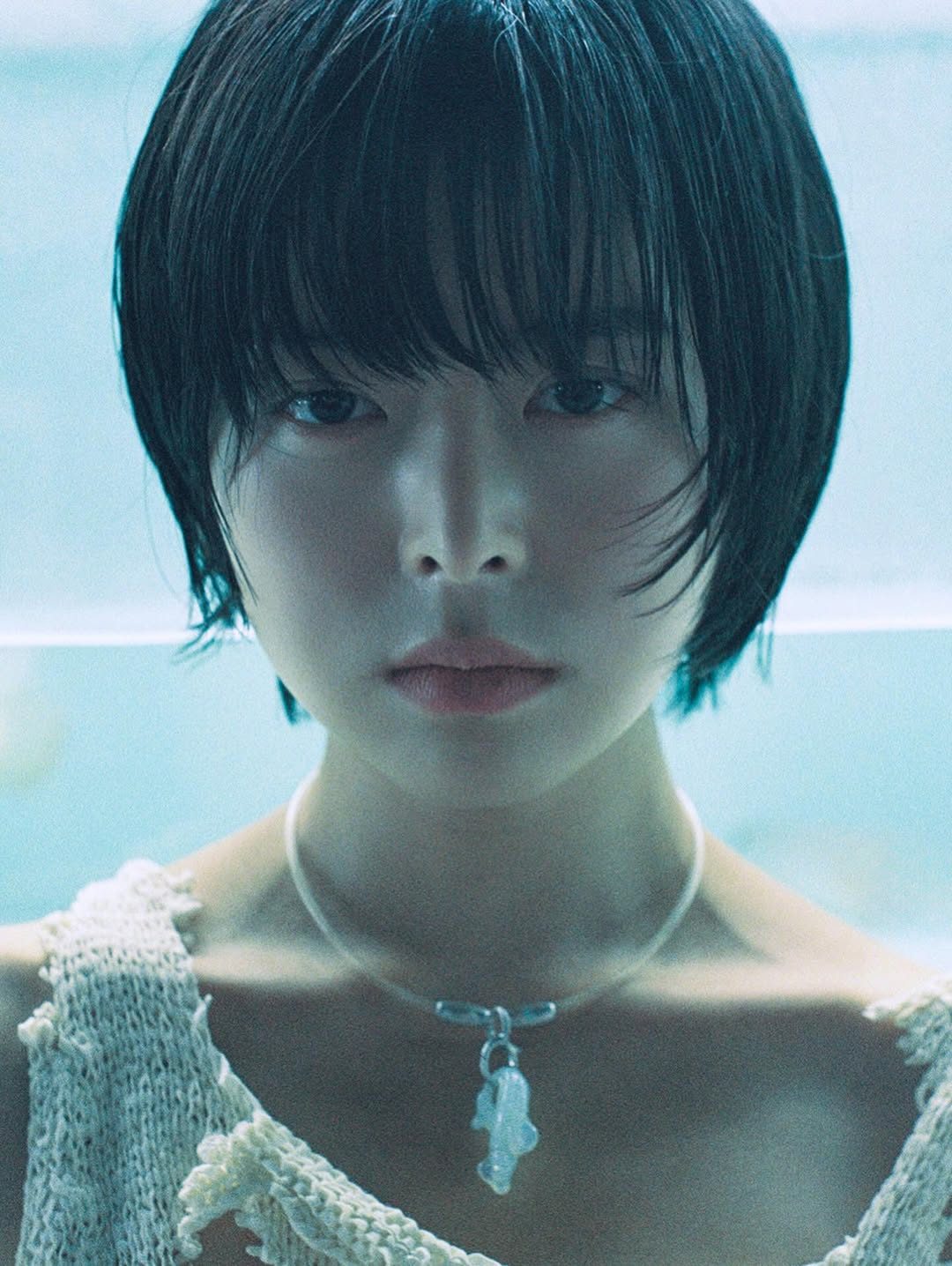
AP-NEEDLE, HEUHIKE BRAND LOOKBOOK. (PHOTO BY NIKOLAI AHN, COURTESY OF HEUHIKE)
“I don’t think this comes from a desire to extend the body through glass. Instead, I want to see the body through this transparent yet distorting membrane.”
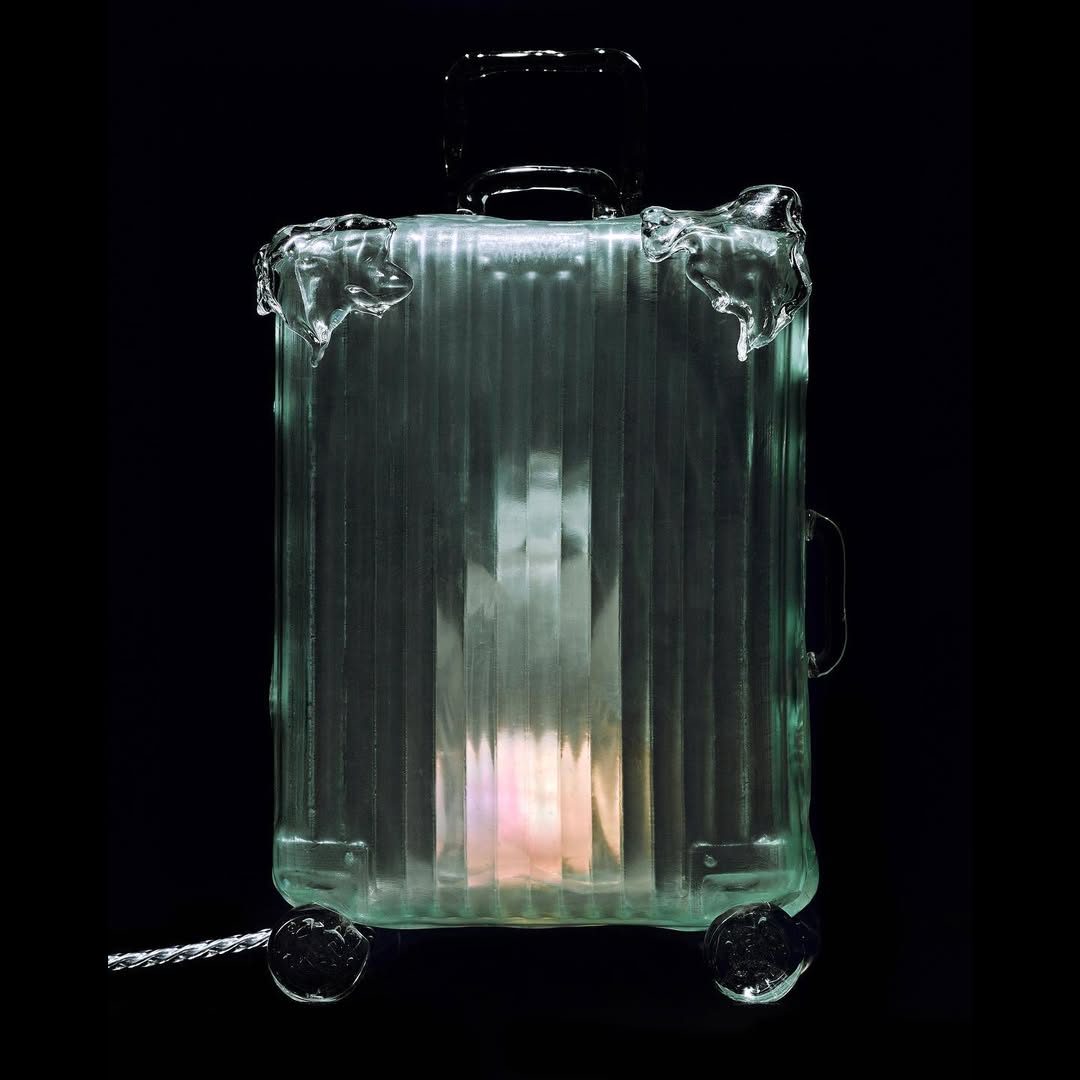
GLASS RIMOWA ORIGINAL CABIN
A SCULPTURAL INTERPRETATION OF THE RIMOWA ORIGINAL CABIN, REALISED ENTIRELY IN GLASS. THE WORK TRANSLATES THE ICONIC SUITCASE INTO A TRANSPARENT FORM, SUSPENDING FUNCTION BETWEEN OBJECT AND SCULPTURE WHILE PRESERVING ITS STRUCTURAL PRECISION.
Several of your forms resemble organs, tools, or speculative devices without fully settling into one category. Do you see this ambiguity as something that emerges naturally through process, or is it something you consciously protect?
The ambiguity doesn’t arise completely naturally, nor is it something I consciously try to protect. It seems to appear in the space between those two intentions. The more I try not to be ambiguous, and at the same time resist making something too specific, the more it begins to surface.
It feels similar to tension, a state where two forces are pulling against each other. On one side, there is a desire to articulate something precisely. On the other, there is a desire to keep a certain openness intact. The forms seem to emerge within that tension, rather than from a fixed decision.
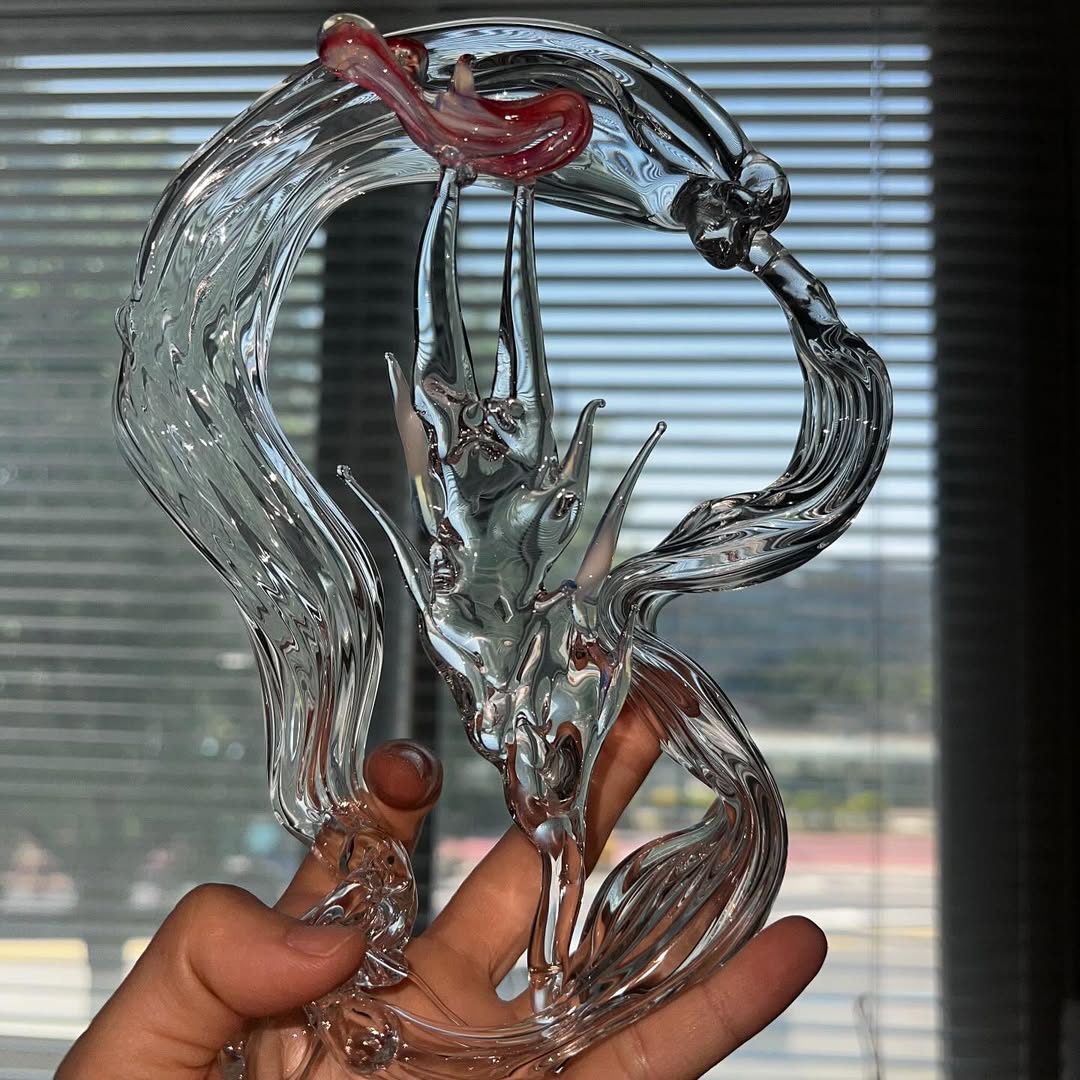
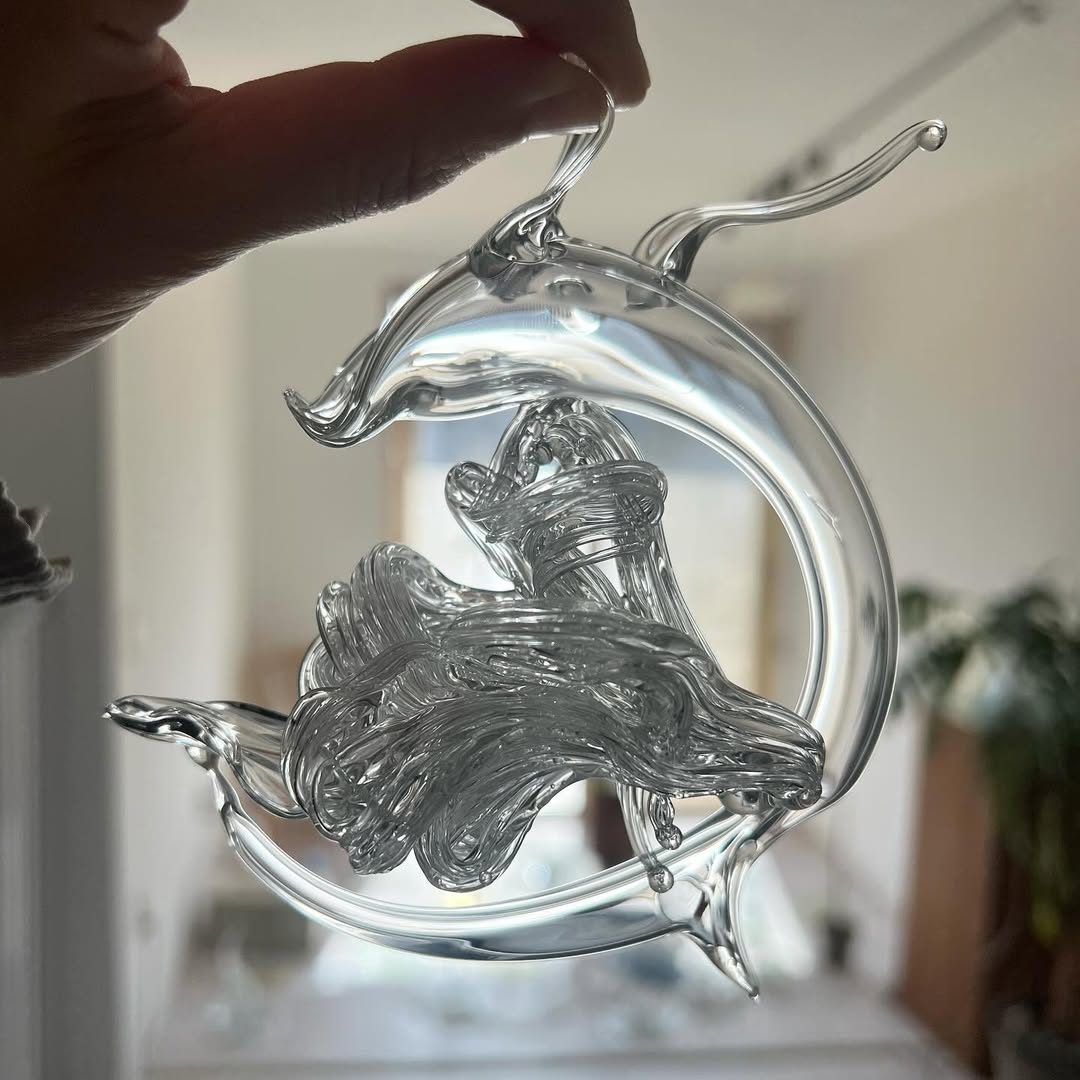
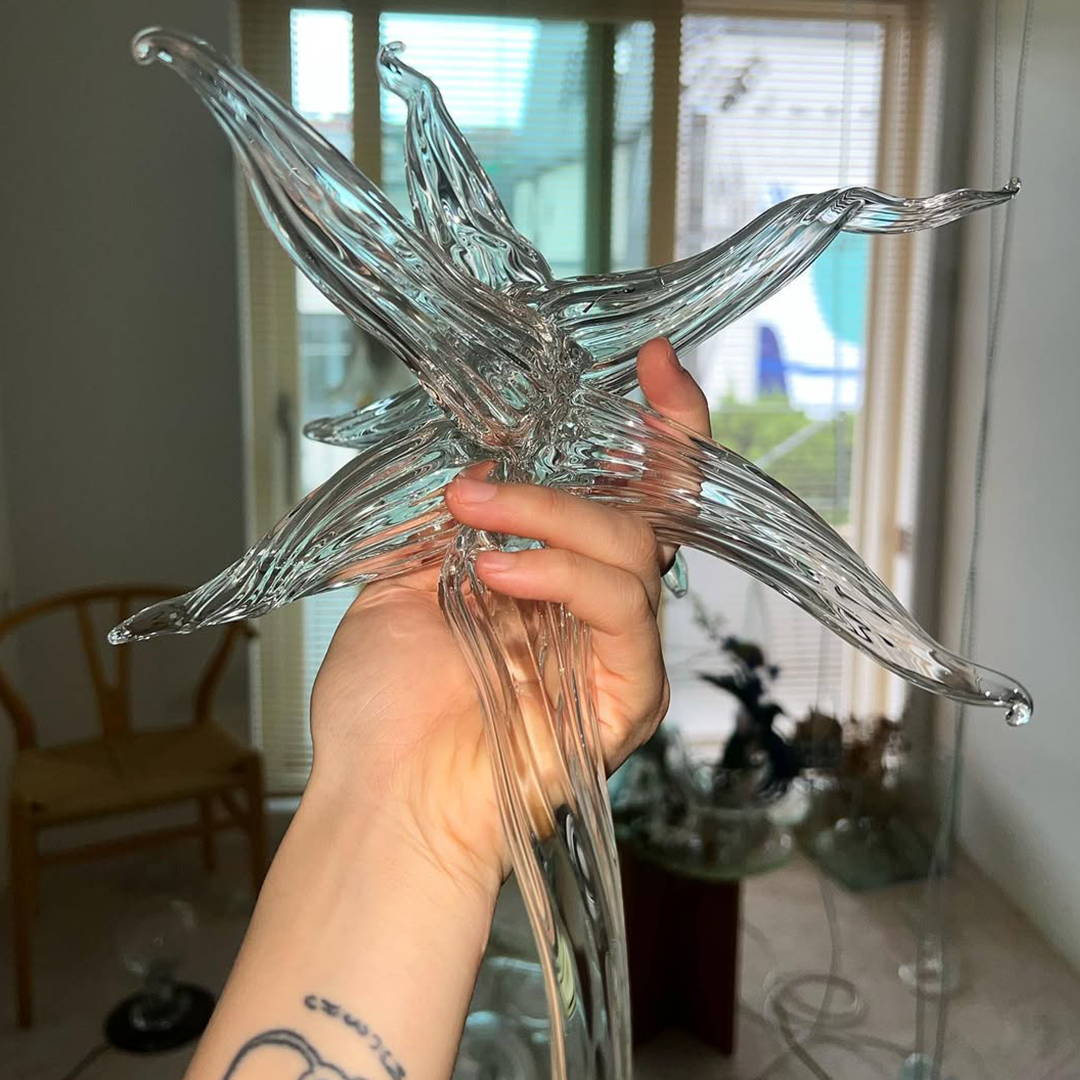
Your work appears across different contexts: exhibitions, editorial shoots, fashion collaborations, and personal adornment. How do these settings change the way the work is read, valued, or physically encountered?
When a work exists across different contexts, it inevitably means that it will be read differently depending on where it is placed. I actually feel a sense of freedom when my work moves through these various environments. Rather than being confined to a single framework, it can shift and be reinterpreted at different speeds within each setting.
In that sense, the fact that I work with glass feels like the most essential truth, while distinctions such as artist, craftsperson, or designer begin to feel less significant. Each context changes the way a work is experienced. In a gallery, materiality and concept tend to be foregrounded. Within fashion or editorial environments, the work is encountered more directly through the body, image, and movement. When it exists as personal adornment, it operates within a much more intimate temporal and physical proximity.
These different environments do not fix the meaning of a work, but rather shift the distance and tempo at which it is experienced. I prefer for my works to remain alive in this way, continuously moving between positions, bodies, and conditions of light, rather than settling into a single definition. The changes that occur across contexts feel less like reinterpretations and more like the addition of new layers.
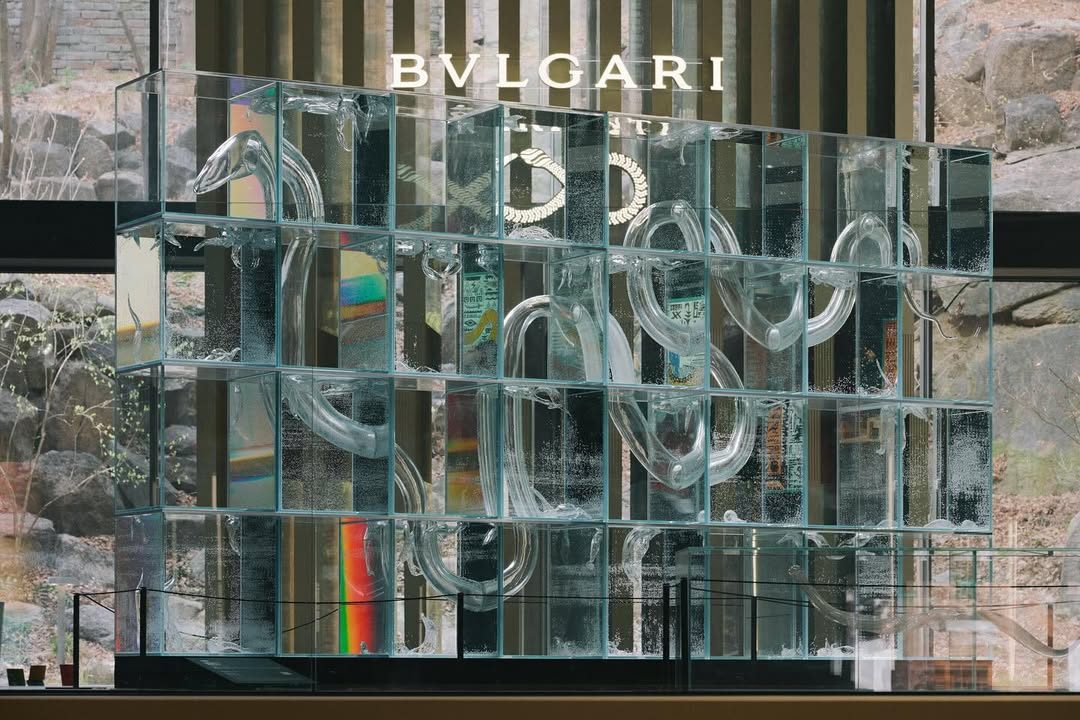
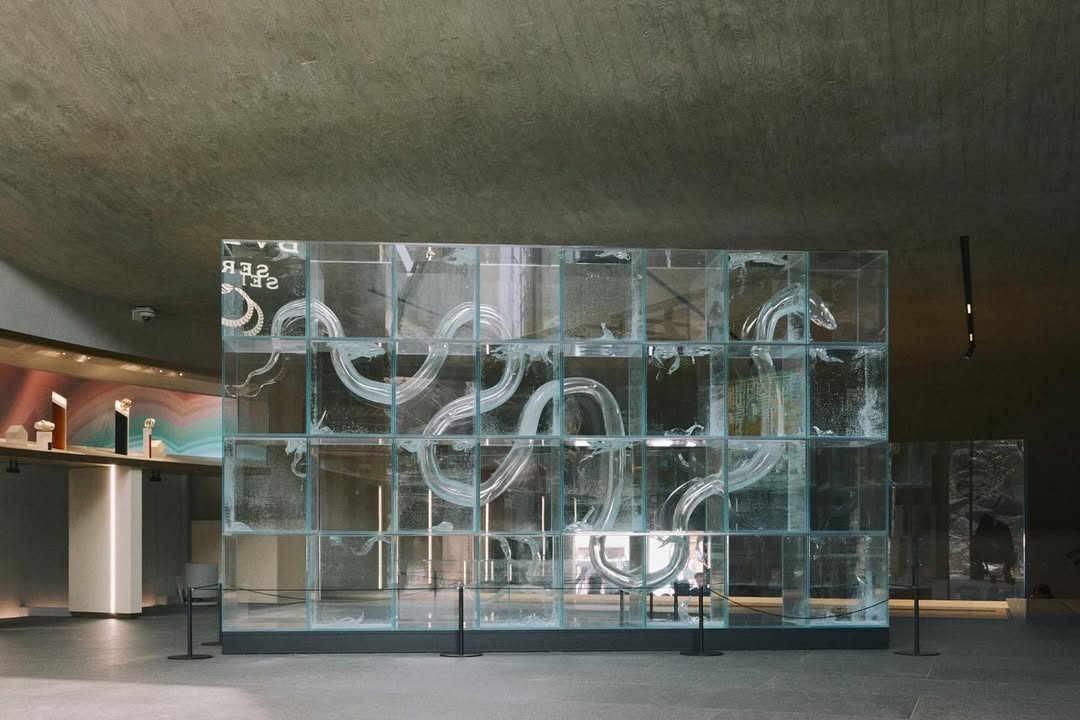
SERPENT
GLASS, WATER
320 CM X 40 CM X 188 CM
160 CM X 40 CM X 40 CM
GLASS PRODUCTION SUPPORT: HEONCHEOL KIM, HYUNGJIN PARK
COMPOSED OF 32 TANKS, THIS SCULPTURAL WORK VISUALIZES REBIRTH THROUGH GLASS, WATER, AND THE FORM OF A SNAKE. AS THE SNAKE SHEDS ITS SKIN AND GLASS TAKES SHAPE THROUGH HEAT, THESE PROCESSES OF TRANSFORMATION CONVERGE WITH WATER AS A SOURCE OF LIFE, EVOKING REBIRTH, TRANSFORMATION, AND EVOLUTION. SEGMENTED GLASS ELEMENTS GATHER INTO A SINGULAR FORM, LEAVING NEW TRACES BEHIND.
PHOTO: SIHOON KIM (@EM_SIHOON)
Process plays a visible role in how you share your practice, through studio footage, making sequences, and moments of transformation. What does documentation offer you beyond record keeping, and where do you draw boundaries around what remains unseen?
In an image-dominant era like ours, documentation sometimes seems capable of replacing the physical object itself. Hearing this question brings back a particular memory. Two days before the opening of Liquid Veil, which I had installed on the surface of a river, there was a heavy storm. The installation nearly came apart, and several elements were washed away. Fortunately, I had documented the installation process through photographs and video, so traces of the work before it was altered by the storm were preserved.
Because a work can never be permanent, physically or conceptually, I find meaning in the still image as a suspended moment between something functioning and something eventually failing. Documentation holds that paused time.
At the same time, I don’t feel the need to reveal everything. Documentation preserves the time of a work, but if it begins to explain too much, it can dissolve the tension that keeps the work alive. I tend to share the material transformations and the traces of time that truly existed, while intentionally leaving aside sensations that have not yet found language or that sit too close to the core of the work.
The boundary between what is revealed and what remains unseen isn’t fixed. It is usually determined by whether sharing something would dilute the density the work needs to maintain. I prefer documentation to exist not as explanation, but as another layer that quietly affirms that the work once lived.
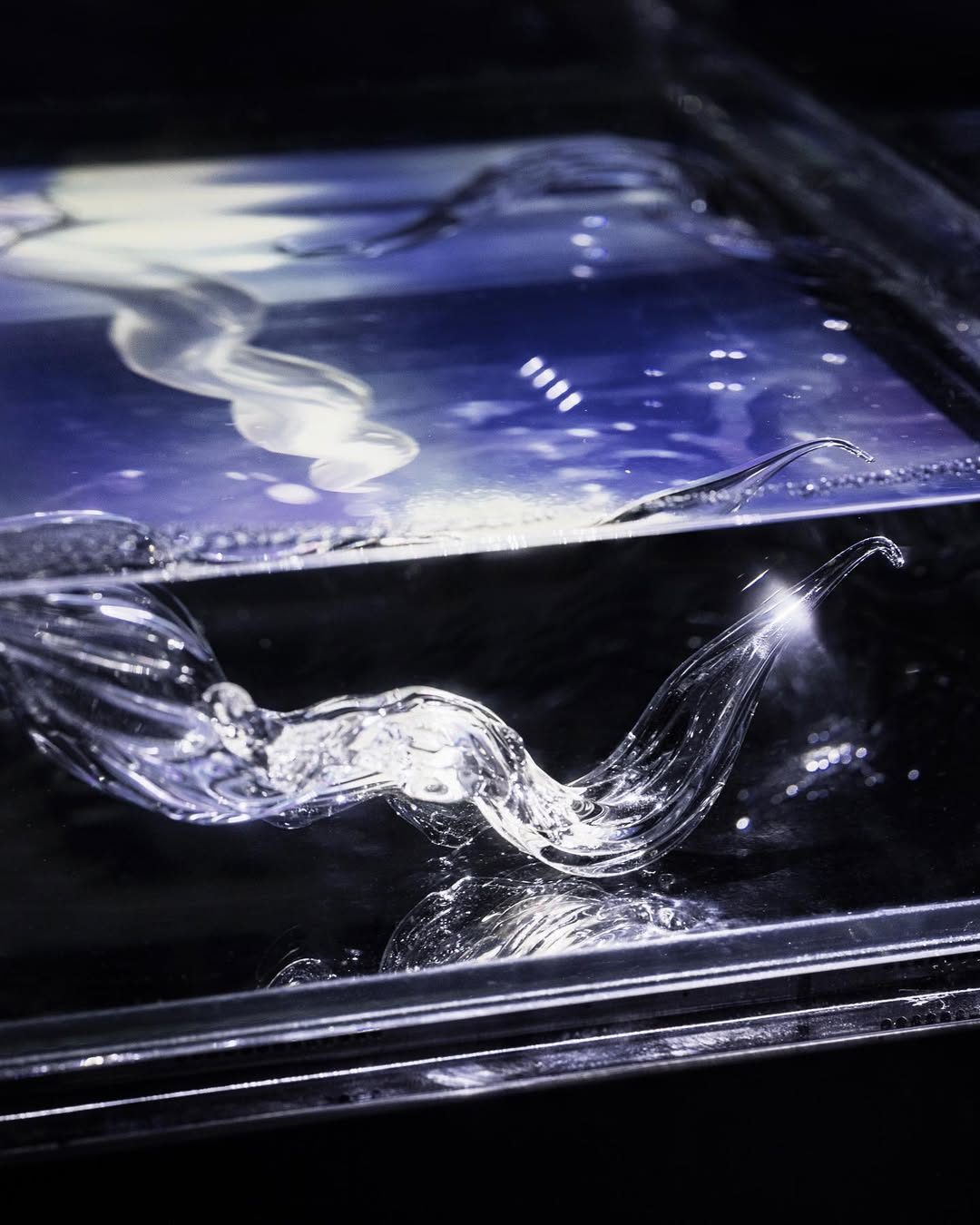
TODAY MARKS THE FINAL DAY OF DILUVIAL. THE ARTIST WILL BE PRESENT AT THE EXHIBITION UNTIL 8 PM. VISITORS ARE WELCOME WITHOUT A RESERVATION.
PHOTO AND VIDEO: YONGJUN CHOI (@___YJC)
“Preserving that layered, contemplative quality is what matters most to me.”
As your practice moves between art and commerce, how has engaging with theart market, selling works, producing editions, building a brand shaped the way you think about value, authorship, and sustainability as an artist today?
I began my artistic practice through a business support structure that required me to establish a brand. From the beginning, I was working between artworks and products under the name of that brand, and I never felt the need to separate my artistic identity from it. In that sense, my positioning has always been somewhat unusual.
This allowed me to move fluidly between craft, commerce, design, and contemporary art. Rather than relying solely on galleries or institutions, I initially sold works outside of the traditional art system and learned to sustain my practice independently. That independence made it possible to move more freely between contexts.
Although I focused heavily on lighting in the early stages, my continued reflection on what glass means to us today helped my practice evolve into something more multidimensional. If I had chosen only one system and remained fully inside it, I might not have developed the same sense of autonomy, resilience, or sustainability. Moving between these structures has continued to shape how I understand value and authorship, not as something fixed by a single system, but as something that evolves through practice.
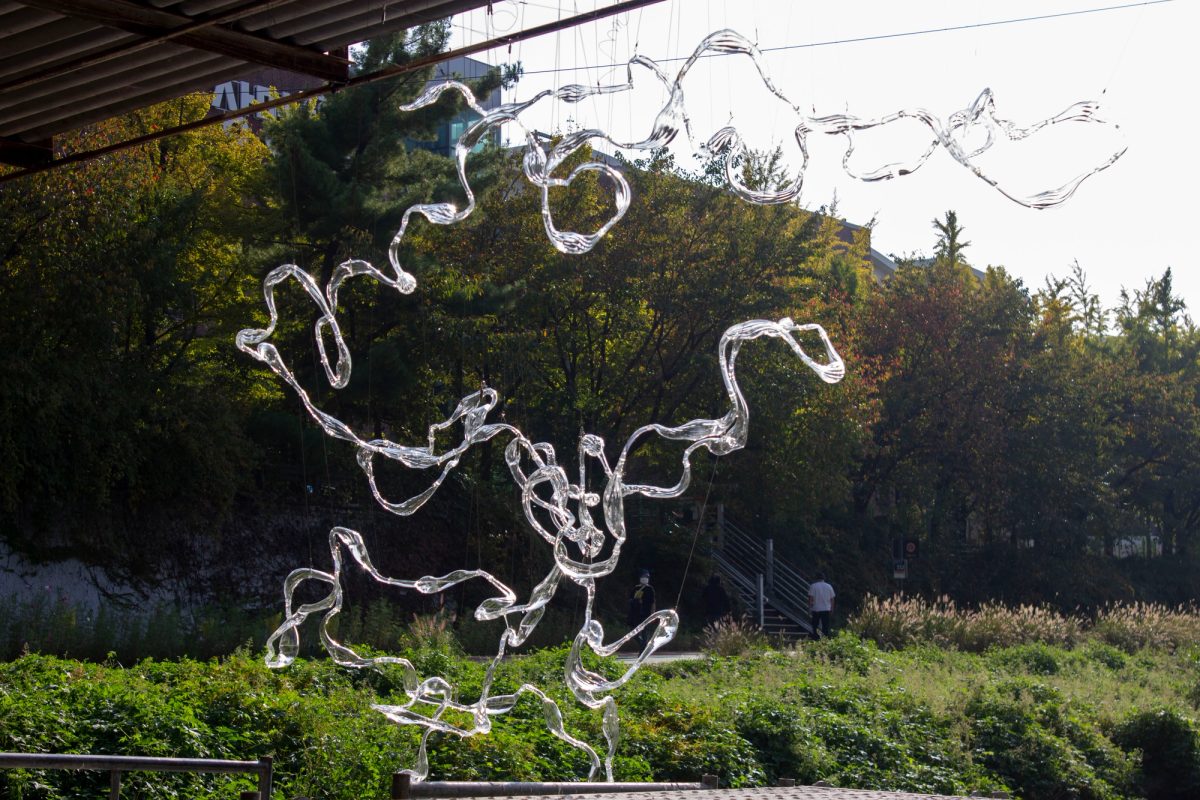
LIQUID VEIL INSTALLED OVER A RIVER, GLASS, RIVER WATER, PUMP, VARIABLE INSTALLATION, 2024. (PHOTO BY THE ARTIST)
Your work sits deliberately between art object and functional product. How do you personally navigate this ambiguity in practice? Are there moments where one side (artistic autonomy or functional responsibility) feels in tension with the other?
My practice began with lighting, but rather than trying to answer whether something is a lamp or an artwork, I was more interested in allowing works that take the form of lighting to enter everyday life. Over time, as I began making works that no longer functioned as lighting, I had to confront a different question: why are functional and non-functional works valued differently?
At times, this felt like a responsibility. Functional objects are often perceived as having less value than non-functional artworks. It might seem, at first glance, that the presence of function itself creates this difference. But the more I considered it, the more I realized it was not about whether a piece functions as a lamp or not. It was about whether the work is approached as a product or as a material and conceptual inquiry.
For me, navigating this ambiguity depends largely on clarifying my own approach. At the same time, I don’t feel the need to correct or object if someone perceives my work as a product. That perception is simply another way the work enters the world.
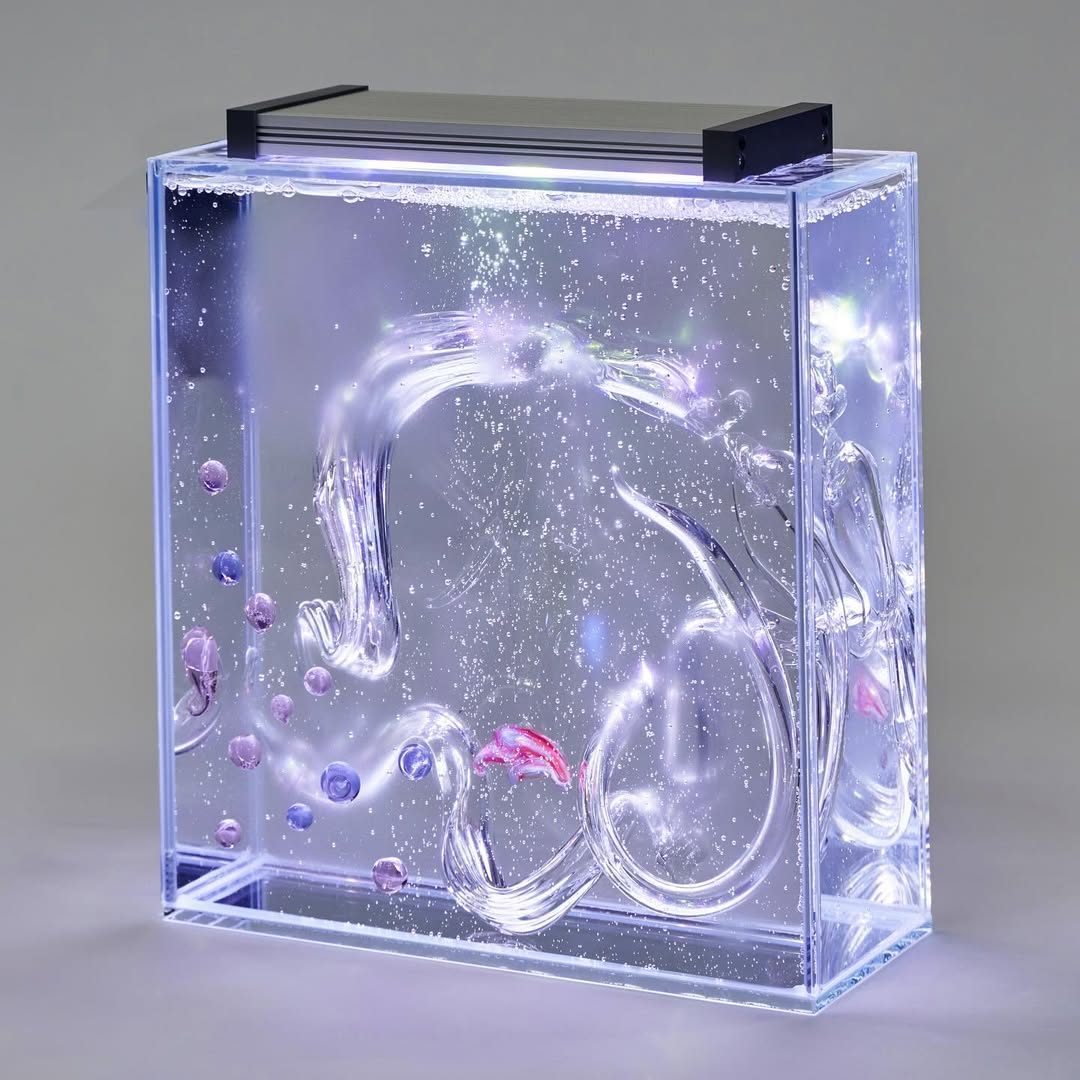
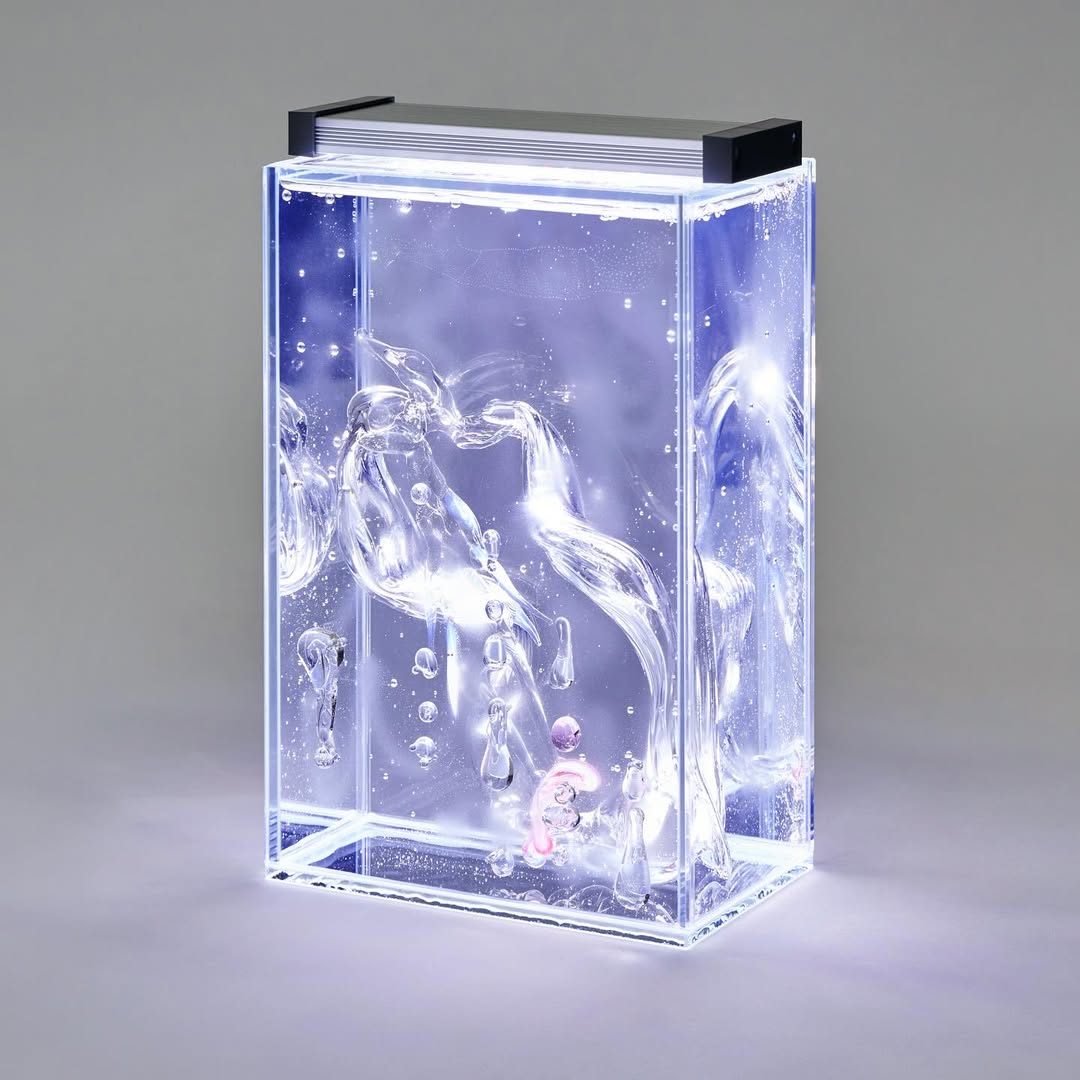
CRYONICS PROTOTYPE (SERIES)
2025
GLASS, SLIME, LED
DRAWING FROM CRYONICS, A PRESERVATION METHOD THAT SUSPENDS BODIES AT –196°C, THIS WORK CONSIDERS GLASS AS A MATERIAL ARRESTED IN MOTION. FROZEN FROM ITS LIQUID STATE AT 1000°C, THE FORM APPEARS HELD BETWEEN FLOW AND STILLNESS, SUSPENDING ANY PROMISE OF FUTURE REVIVAL.
Finally, as your practice continues to move between material experimentation, wearability, installation, and collaboration, what kind of object, condition, or scale are you most curious to explore next?
I am increasingly interested in structures that exist close to the body but do not fully belong to either wearable object or sculpture, something that operates almost like an environment in proximity to the body.
I am also drawn to works where the density of sensation feels greater than the physical scale of the material itself, environments in which light, temperature, and transparency operate together almost like an ecosystem. For my next exhibition, I am currently preparing variable glass installations combined with lighting. Through these works, I hope to continue exploring light as an immaterial presence and to create situations in which the materiality of space and light can be felt again.
“Realizing that this material carries something like its own vitality marked a shift in my relationship with glass.”
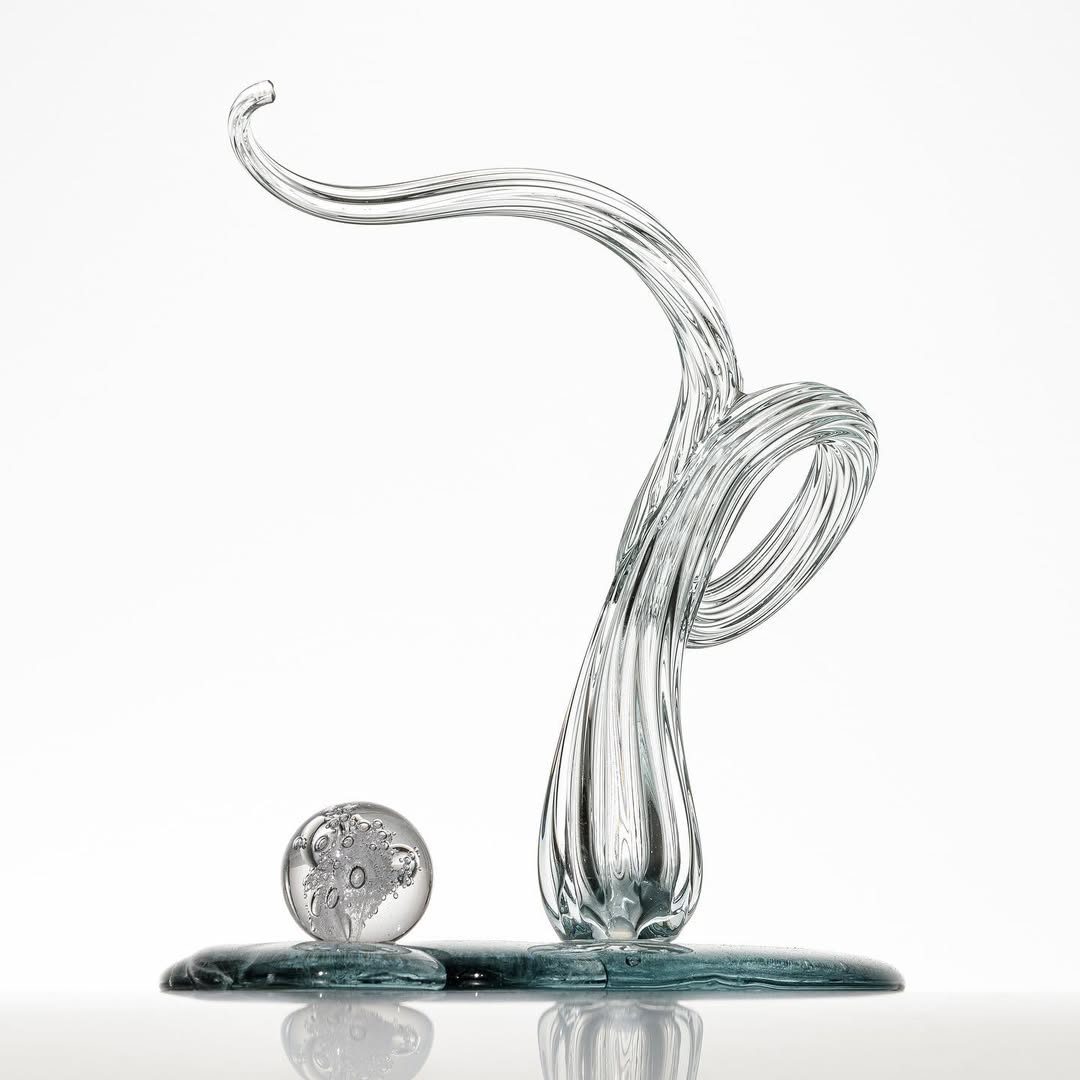
ON VIEW AT @OHDEAR.KR: A GLASS OBJECT BY HAYNE PARK.
PHOTO: @TABIAL.A
COVER IMAGE:
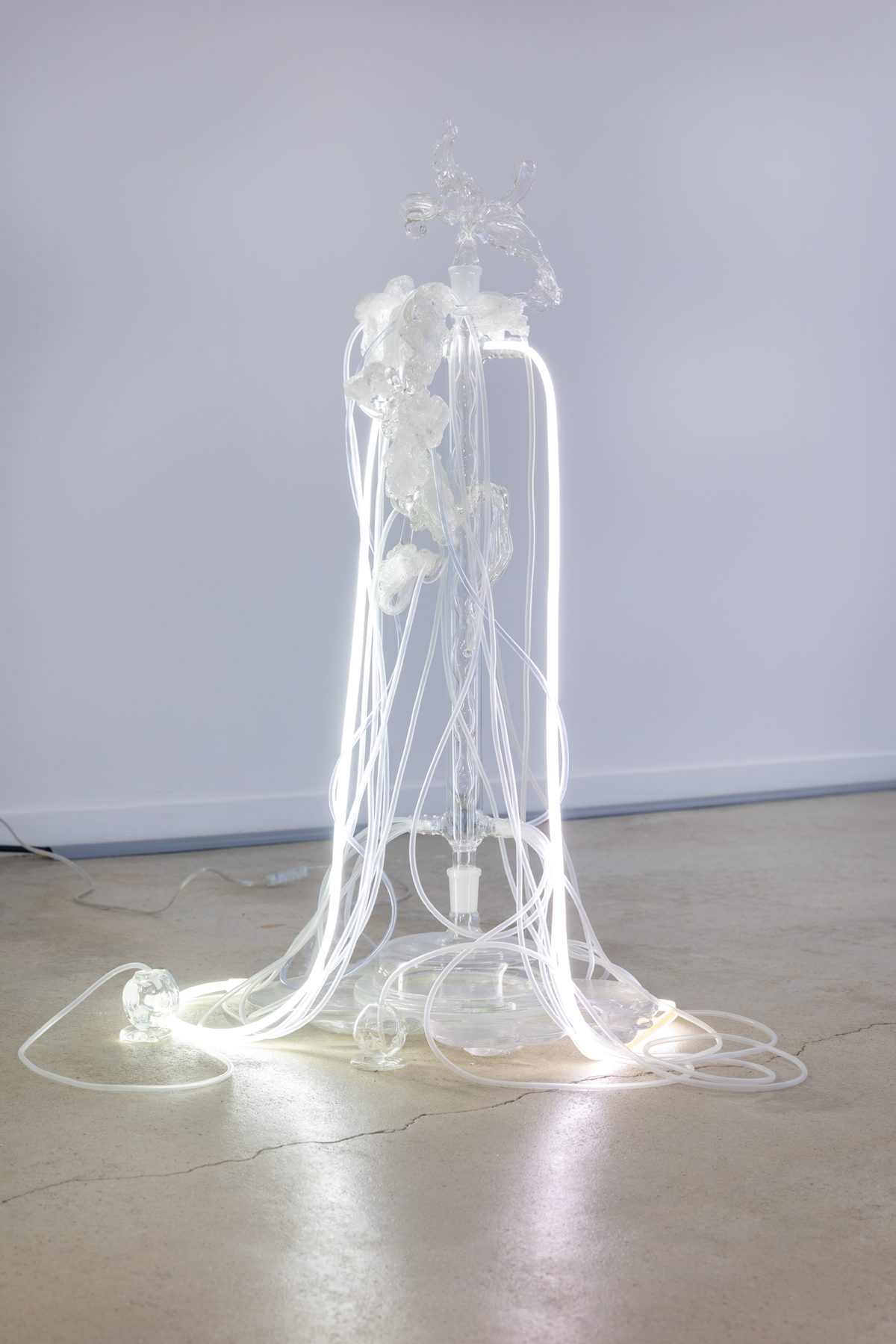
FUME, GLASS, FLEXIBLE LED, 90 CM, 2025. (PHOTO BY AHINA ARCHIVE, COURTESY OF THE ARTIST)