JUST A PIECE OF FLESH PERFORMING EXISTENCE: IN CONVERSATION WITH LORENA BUTA
CONVERSATION BY MOCO CHEN
CO-FOUNDER, ART DIRECTOR
14 MAY 2026 — UNITED KINGDOM
There is a phrase Lorena Buta uses to describe the experience of depersonalisation: just a piece of flesh performing existence. It is the kind of sentence that stops you, not because it is dramatic, but because it is precise. It names something most people have felt but never quite found words for, that uncanny loosening from oneself, the sense of watching your own life from a slight distance. For Buta, this is not a metaphor. It is the psychological territory she has inhabited, returned to, and built an entire artistic practice around. Working almost exclusively in monochrome, she renders dolls, porcelain figures, and human fragments with hyperrealistic precision, only to dissolve them into something blurred, dreamlike, and slightly out of reach. The result is painting that does not illustrate dissociation so much as induce it. In this conversation, she speaks about growing up across cities, living inside an unfinished project, and what it means to make deeply vulnerable work in an increasingly public world.
You were born in Oradea and moved to Timișoara for digital media studies before eventually settling in Bucharest for fine arts: a trajectory that crosses disciplines and geographies at a formative age. How did relocating through different cities and fields of study shape the way you think about identity and belonging, and do you see that rootlessness reflected in your work?
I think relocating between different cities at a formative age made me realize that I exist as a self-contained entity rather than someone entirely rooted in a specific place. Moving from Oradea to Timișoara and later to Bucharest showed me that identity can survive outside familiarity, outside geography, almost as something autonomous moving through different environments and emotional climates.
Each city and field of study shaped the way I perceive reality. Studying digital media awakened a strong creative force in me and made me increasingly interested in combining different mediums and ways of thinking, from creative to critical thinking. It pushed me toward researching the relationship between the digital and the human from both a social and psychological perspective, but through painting rather than through purely digital means.
I think that duality became central to my practice. My work is somewhere in between emotional presence and detachment, suspended between realities. In that sense, the feeling of rootlessness became less about geography and more about existing in a world where identity itself feels artificial.
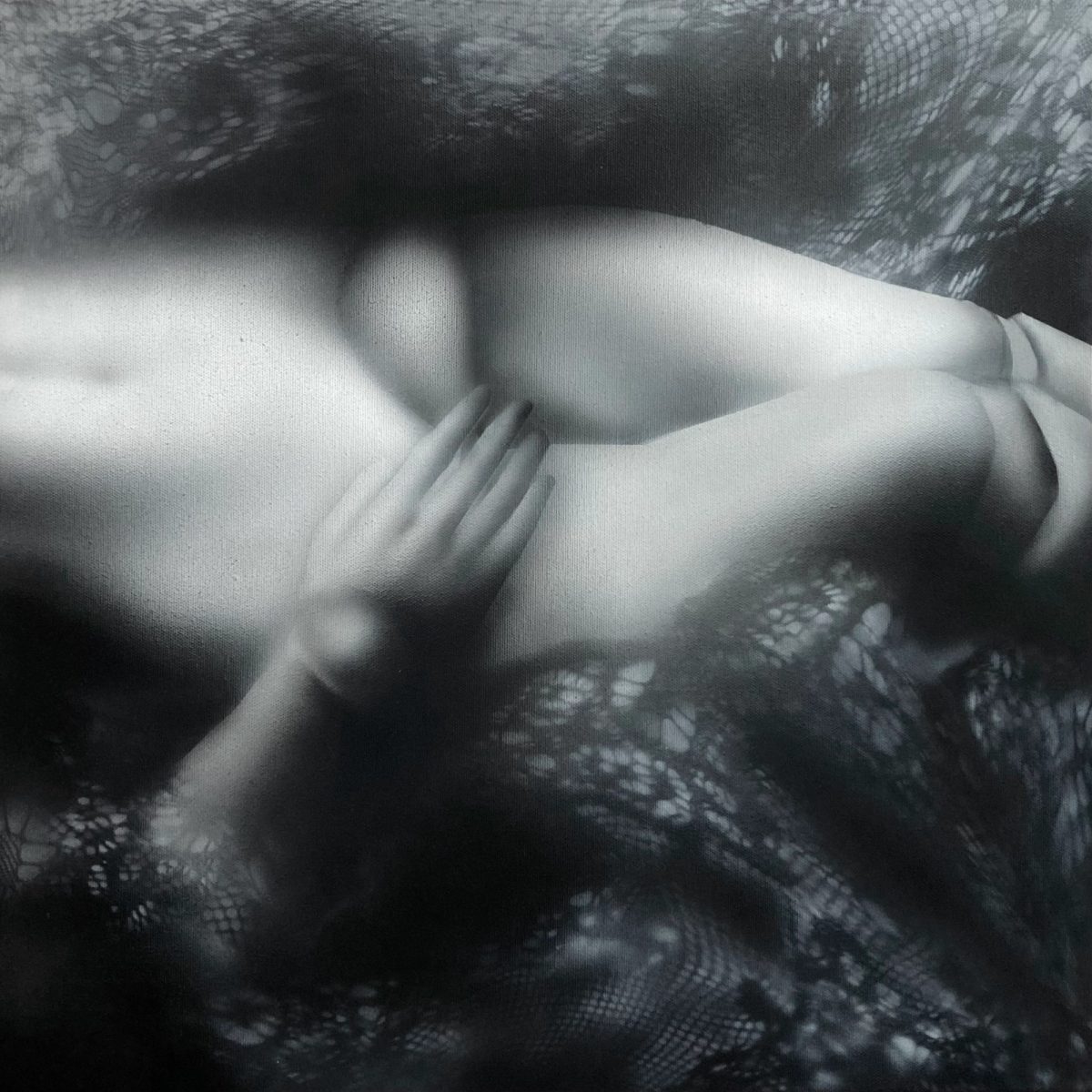
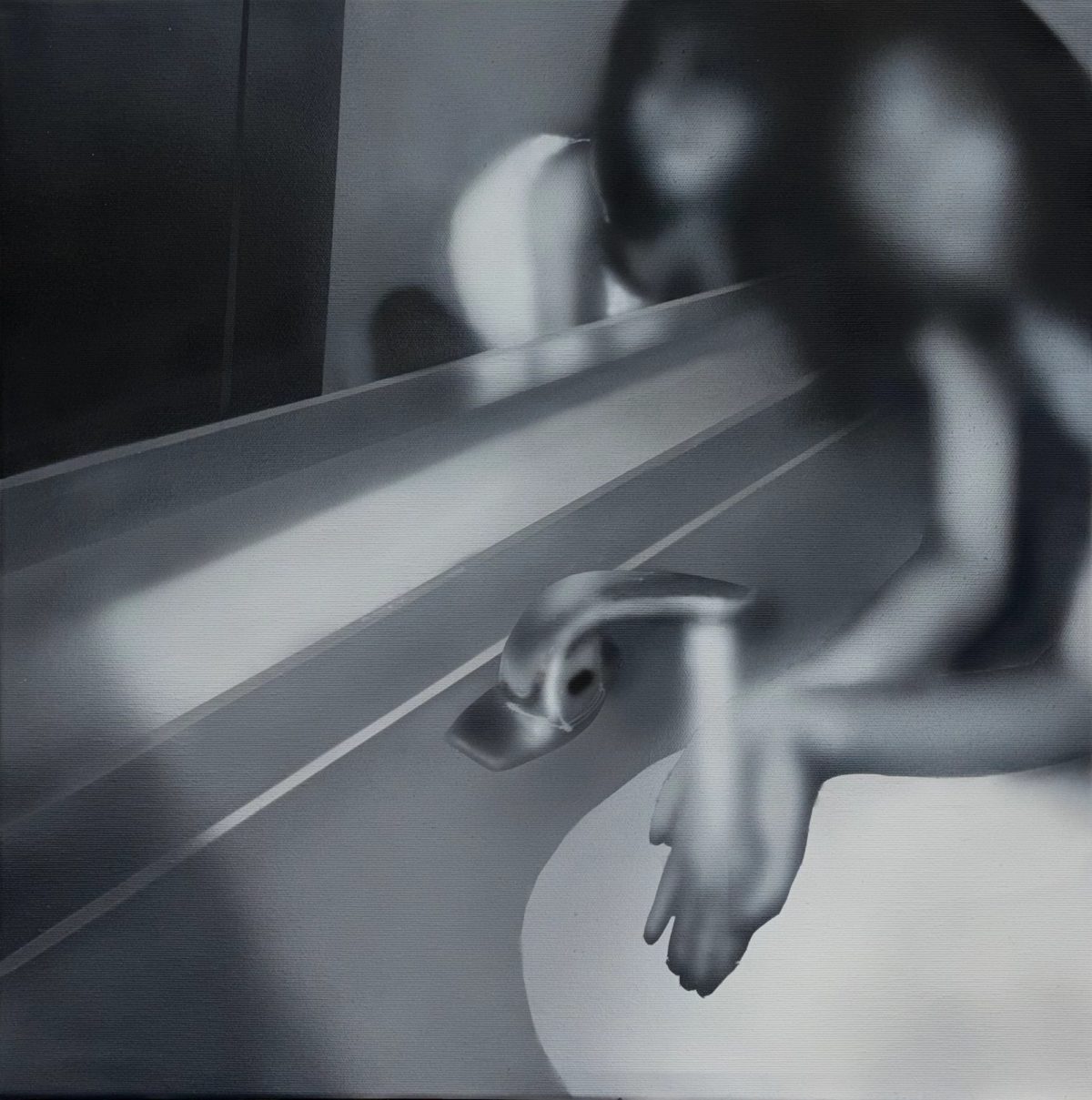
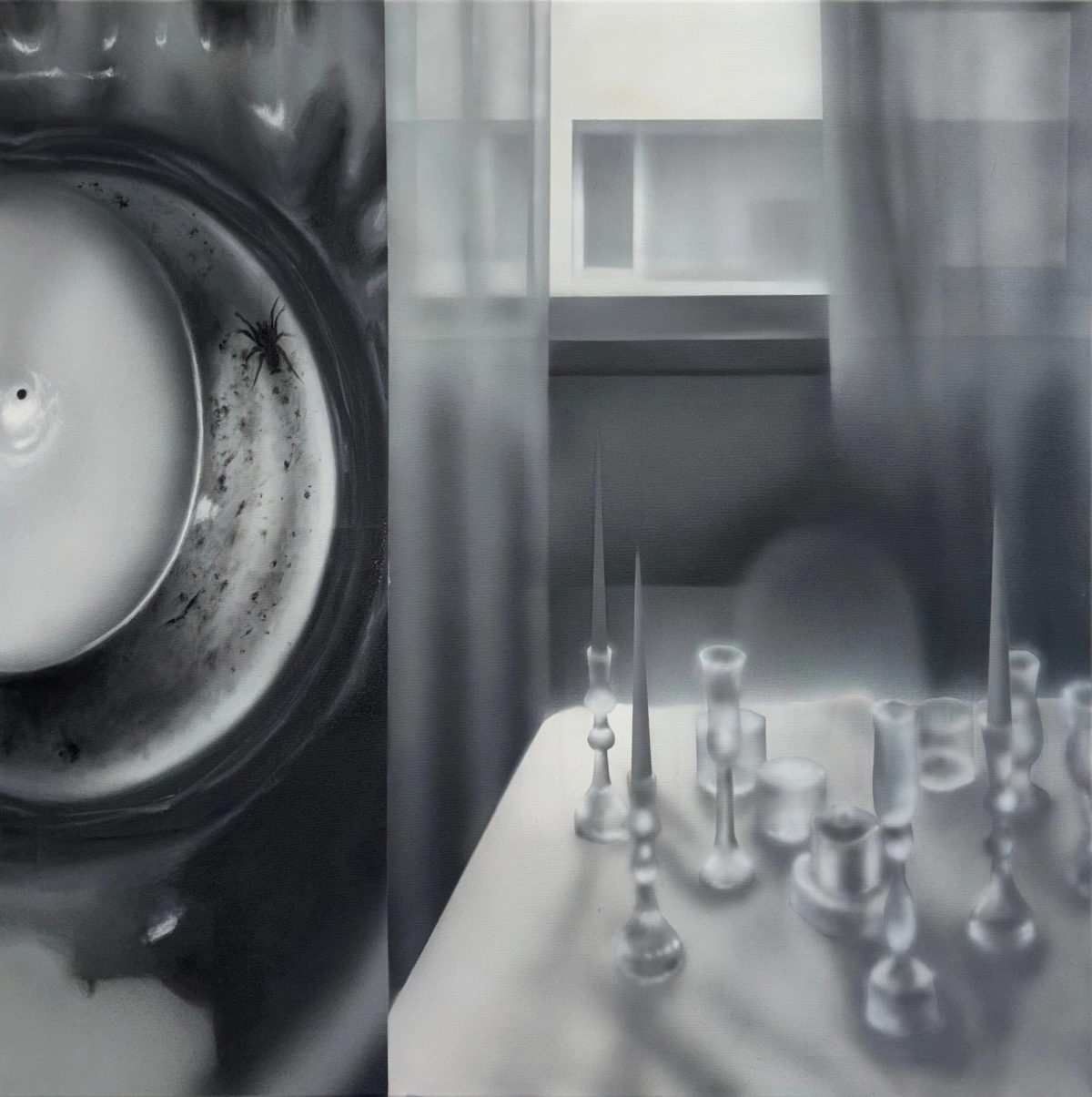
Left: Lorena Buta, perfect details like my skin...., 2024, acrylic on canvas, 50 × 50 cm. From the series UNREAL.
Right: Lorena Buta, One Last Attempt at Purification, acrylic on canvas, 50 × 50 cm.
Your long-term project "UNREAL" (2023–present) sits at the centre of your practice, a practice that deepens rather than finishes. What does it mean to you to work within a project that refuses closure? Is "UNREAL" something you're building toward, or something you're living inside of?
"UNREAL" is definitely something I'm living inside of rather than building toward. It became a form of escapism, but also a psychological space that completely consumes me at times. With each work, I try to discover new perspectives of these experiences because depersonalization and derealization are incredibly complex states. They constantly shift, distort, and reappear in different forms.
Since the project comes from personal experience, I still go through these feelings from time to time. Whenever it happens, I instinctively stop and ask myself how I could visually represent what I'm feeling. Painting became a way of processing these states, almost translating something intangible into an image. In that sense, the work functions both as documentation and as emotional processing.
Almost everything you make exists in monochrome. The absence of colour is radical in a contemporary art landscape saturated with it. Is the refusal of colour a conceptual decision tied to depersonalisation's flattening of experience, or did it arrive more intuitively, and does the distinction matter to you?
I feel that the absence of colour is the perfect way of translating this psychological state into visual language. Usually, when someone is feeling disconnected from themselves or from their surroundings, they have this gut feeling that something is not right. In a matter of seconds, everything starts fading away, the colours of life become less saturated and blurry, and it gets really hard to draw the line between reality and the imaginary. The shades of black, white, and grey create a kind of emptiness and silence that reflects the way these experiences feel internally, pushing the viewer to actually feel and perceive the depth of this mental state.
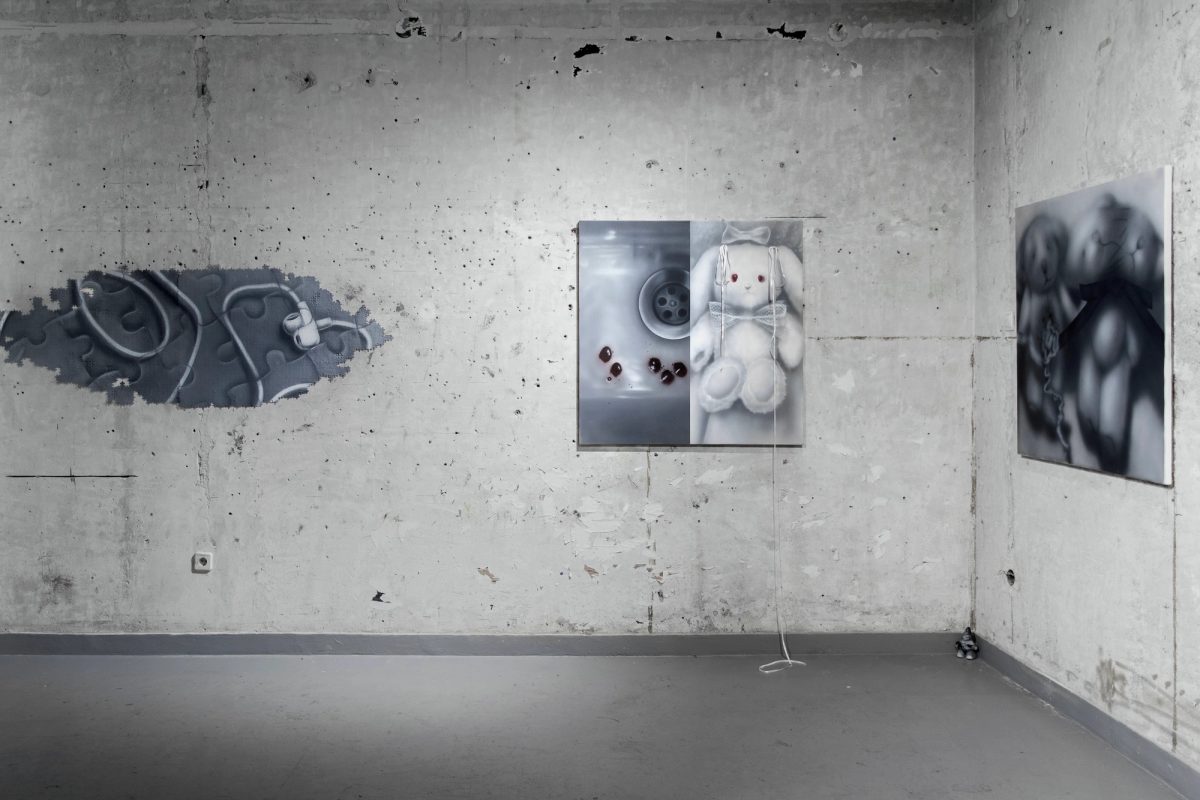
Lorena Buta, Magic Misery, 2025, solo exhibition, Atelier 35, Bucharest.
"The shades of black, white, and grey create a kind of emptiness and silence that reflects the way these experiences feel internally, pushing the viewer to actually feel and perceive the depth of this mental state."
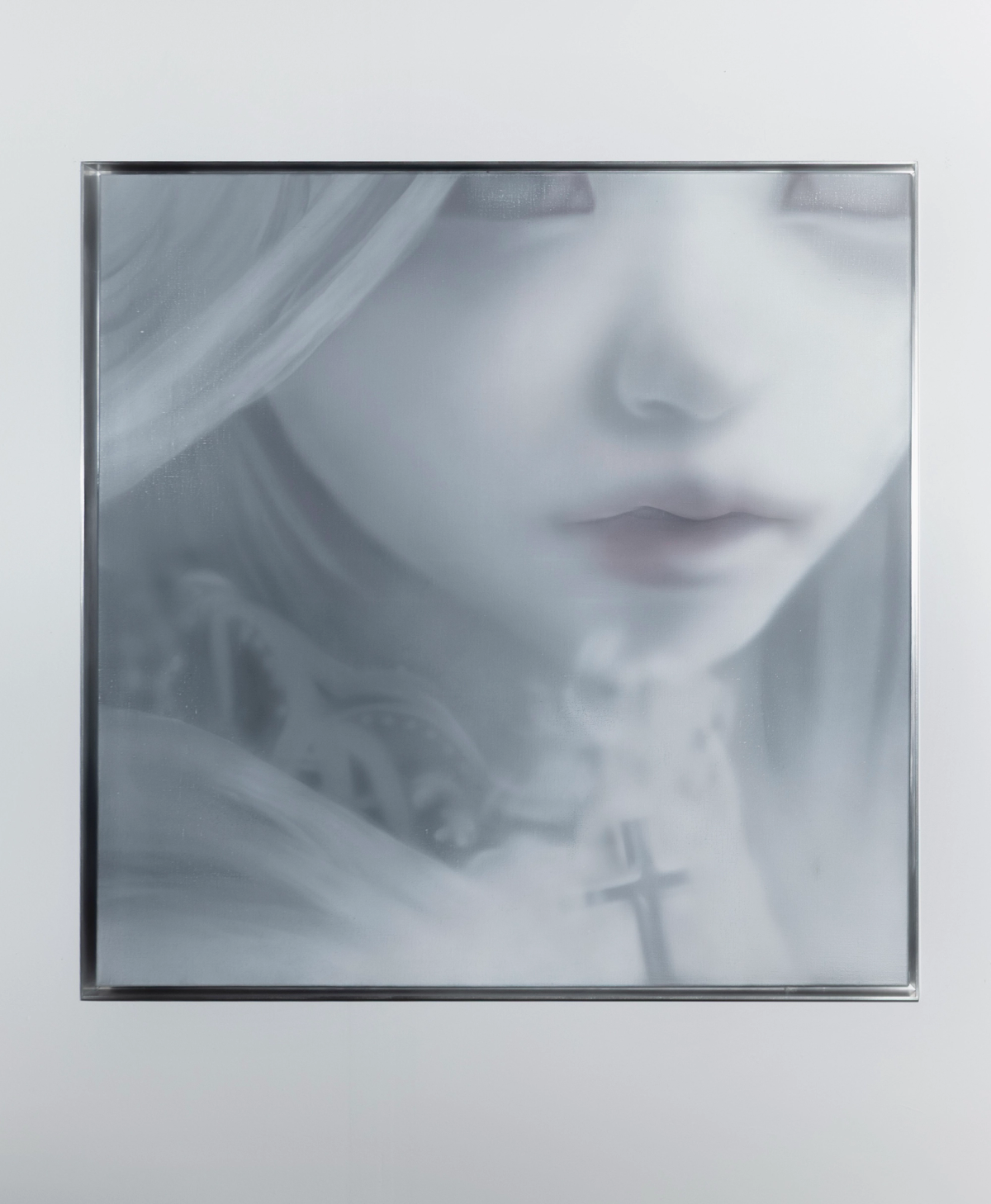
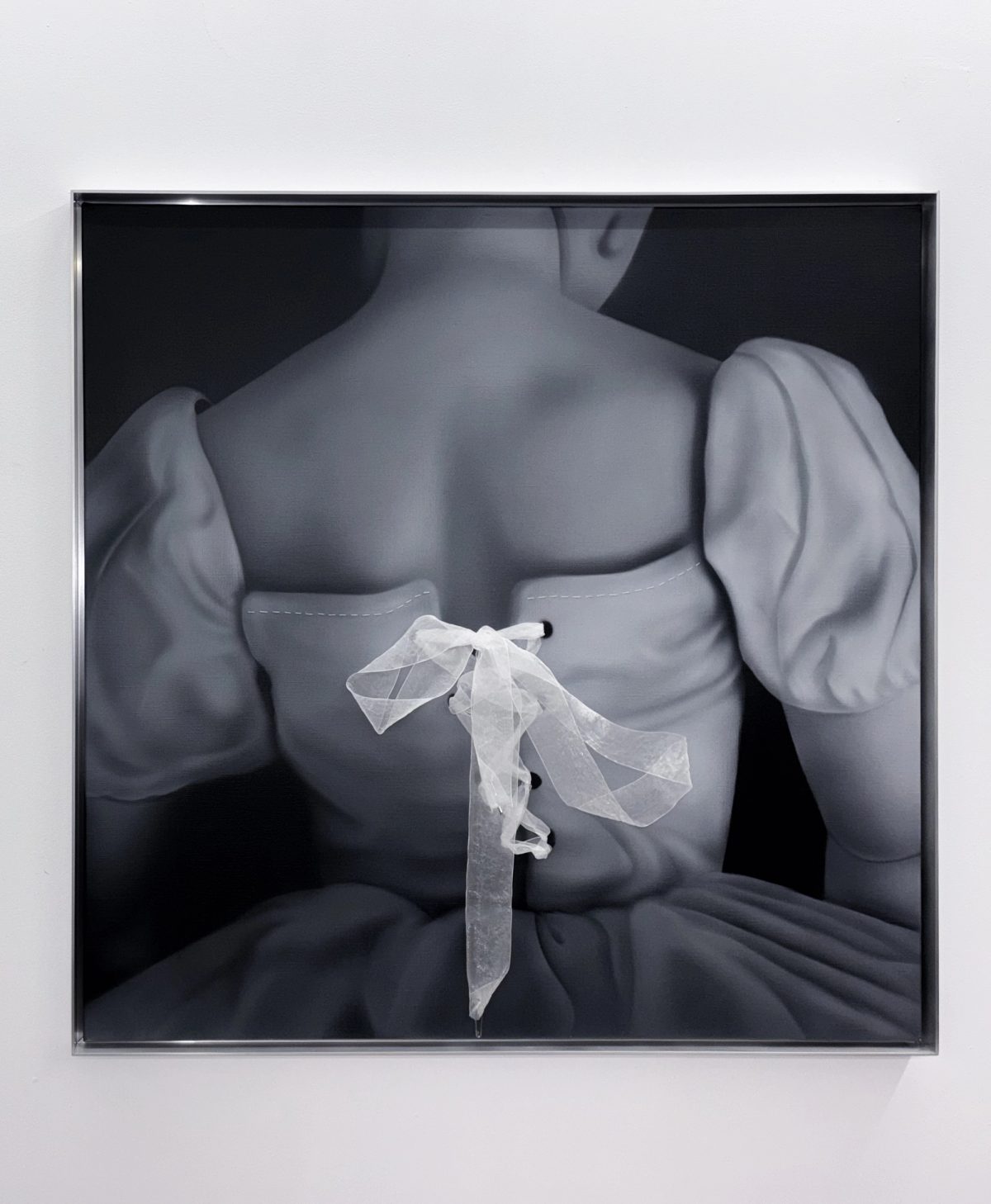
Left: Lorena Buta, Solitary, 2026, acrylic on canvas, aluminium frame, 100 × 100 cm.
Right: Lorena Buta, Dear Dollmaker, 2026, mixed media, aluminium frame, 100 × 100 cm.
Your paintings carry an uncanny tension; the subjects such as dolls, animals, porcelain figures, and human fragments are rendered with hyperrealistic precision, yet the overall image feels blurred, dreamlike, slightly out of reach. How do you calibrate that threshold between clarity and dissolution, and what happens when a painting tips too far in either direction?
The line between focus and blur becomes very thin, because when you're perceiving things visually while in a state of depersonalisation/derealisation, you're perceiving them as being artificial and blurry. In those moments, it feels like you're living in third person and it becomes really hard to distinguish the real from the imaginary, the clear from the distorted.
That blurriness is not just visual but also mental. There's a constant fogginess; a feeling that you are not fully here, not fully connected. Like you're just a vessel or an object somehow controlled from far away. Just a piece of flesh performing existence. Like you're watching a film instead of actually living your own life. A spectator. This is where the symbols in my work come from: dolls, porcelain figures, objects that imitate life but are emotionally absent. A body without a soul, an empty shell. So, if a painting turns out either too blurry or too hyper-clear, I feel that I'm at ease, since it actually mirrors the duality of depersonalisation/derealisation. Sometimes reality feels extremely distant and foggy, and other times everything becomes sharp, hyperaware. Both extremes belong to the same experience, and I try to embrace them both in my work.
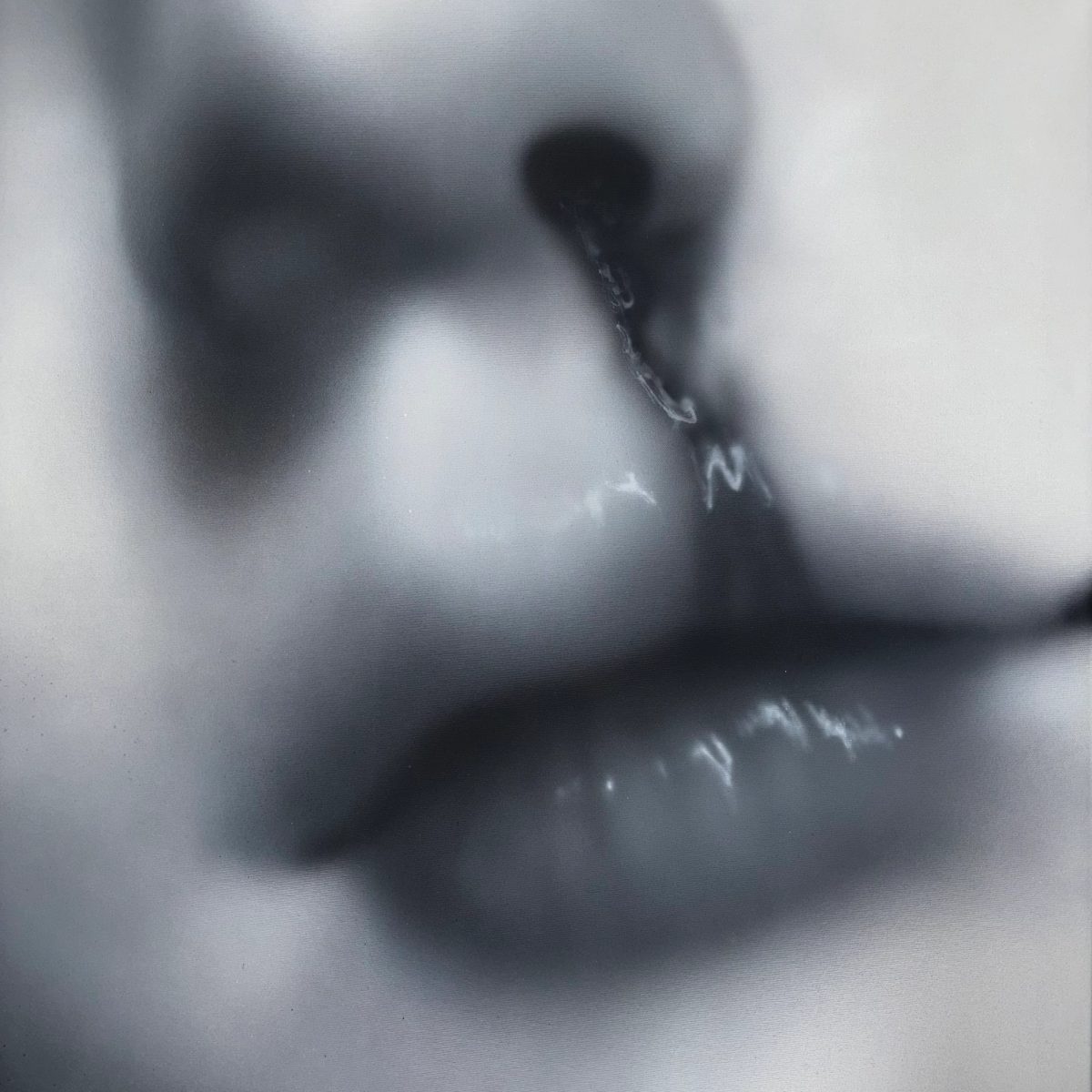
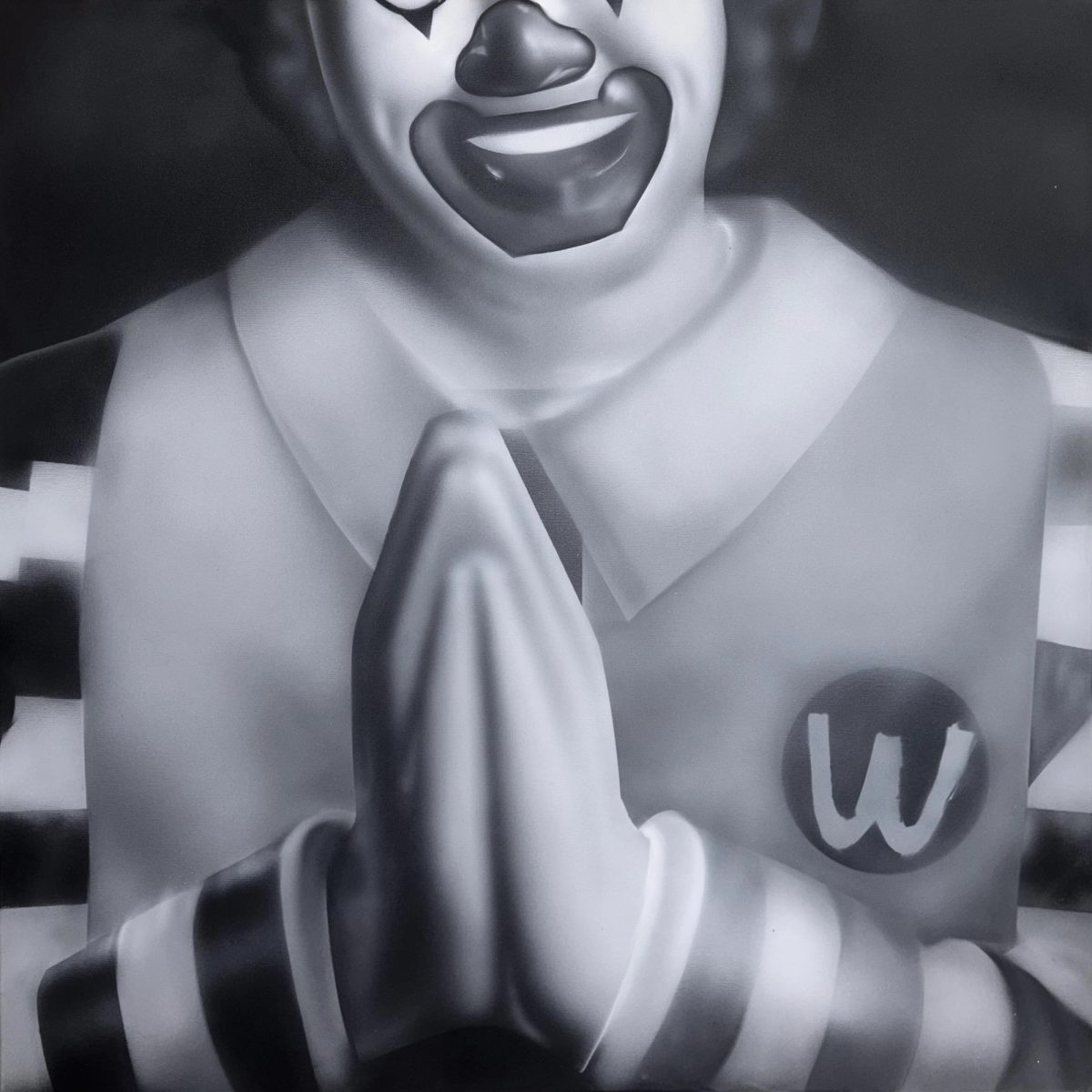
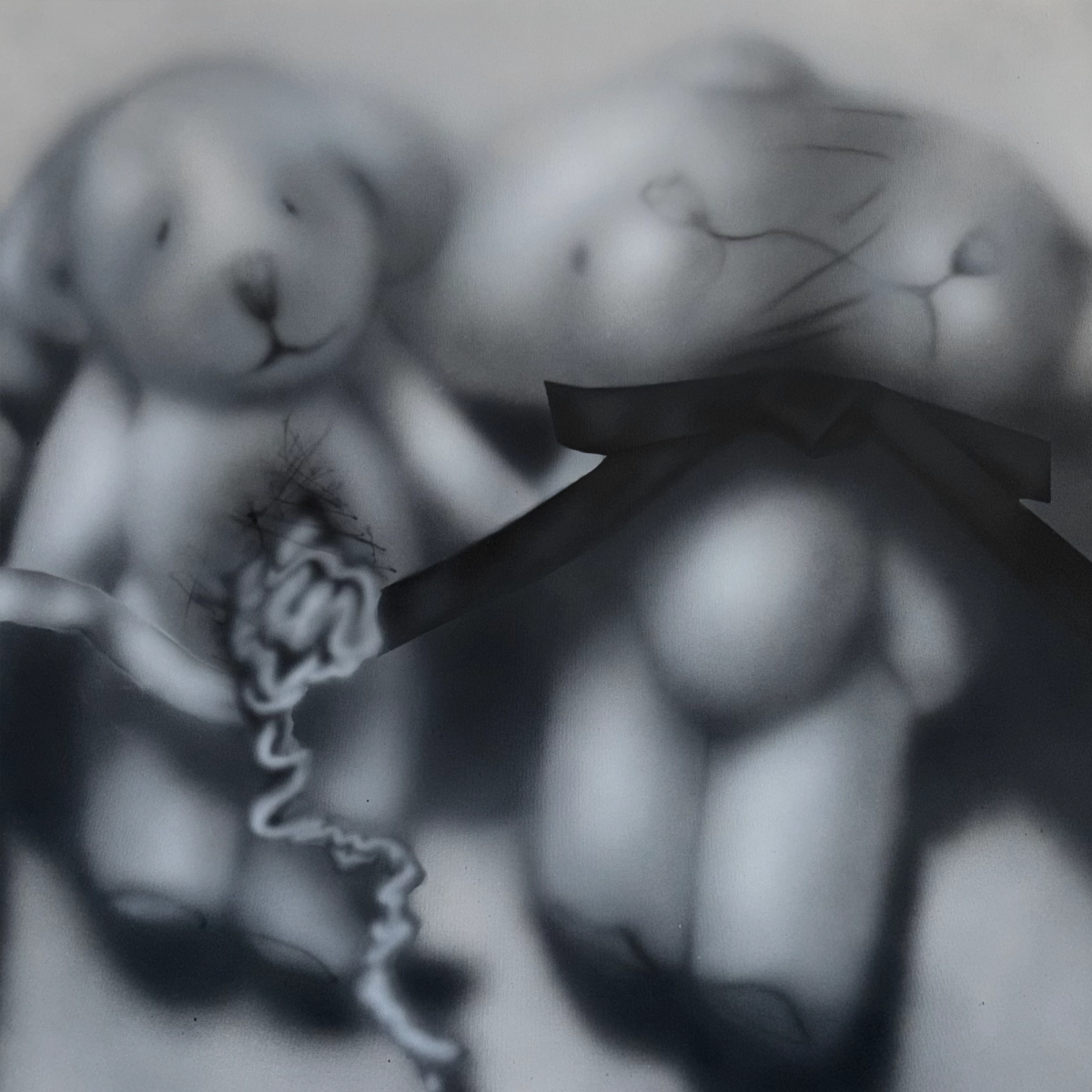
Left: Lorena Buta, Acid and Bleach, 2025, acrylic on canvas, 100 × 100 cm.
Middle: Lorena Buta, Sad Meal, 2025, acrylic on canvas, 100 × 100 cm.
Right: Lorena Buta, Heal Me, Decompose Me, acrylic on canvas, 100 × 100 cm.
"Magic Misery," your solo show at Atelier 35, combined large-scale paintings with a sculptural installation: a black draped form adorned with white objects, candles, and small figures. The show expanded "UNREAL" into physical space. What can installation do that painting cannot, and how do you think about the relationship between the two when they share a room?
"Magic Misery" was the moment when "UNREAL" stopped feeling like just a series of paintings and started becoming a physical extension of the atmosphere behind the works. I wanted the entire exhibition to make the viewer experience that feeling of disconnection through multiple senses and not only through painting.
The tent installation itself was a reference to childhood, to the improvised spaces where children hide and build their own realities, surrounded by toys, technological objects, and small rituals. In the exhibition, that innocence became slightly uncanny. I was interested in creating a parallel between comfort and unease, between nostalgia and emotional alienation. The porcelain figures, candles, toys, and technological elements all existed together like fragments from an eerie, distant memory. I also added sound (white noise) because I wanted the show to feel mentally consuming, for the viewer to escape reality and enter a dissociative state of mind.
I think installation can do things painting alone cannot, because you don't just observe the work anymore: you enter it and it surrounds you. The space of Atelier 35 was perfect for this. Its structure and the harsh, brutal walls allowed the whole exhibition to feel like you were stepping inside a hidden mental space that exists somewhere between memory and dream.
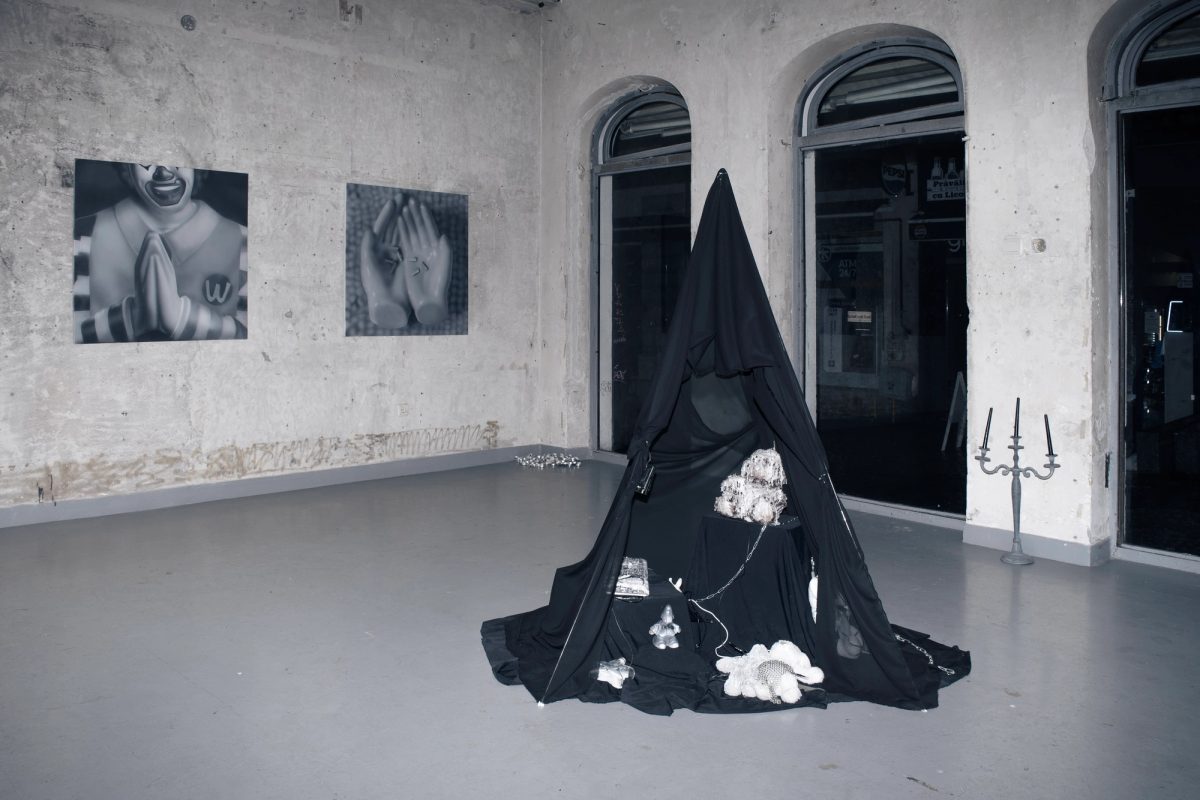
Lorena Buta, Magic Misery, 2025, solo exhibition, Atelier 35, Bucharest.
"I try to leave enough openness for the viewer to enter them emotionally and project their own experiences onto them. In that sense, the work becomes complete through perception."
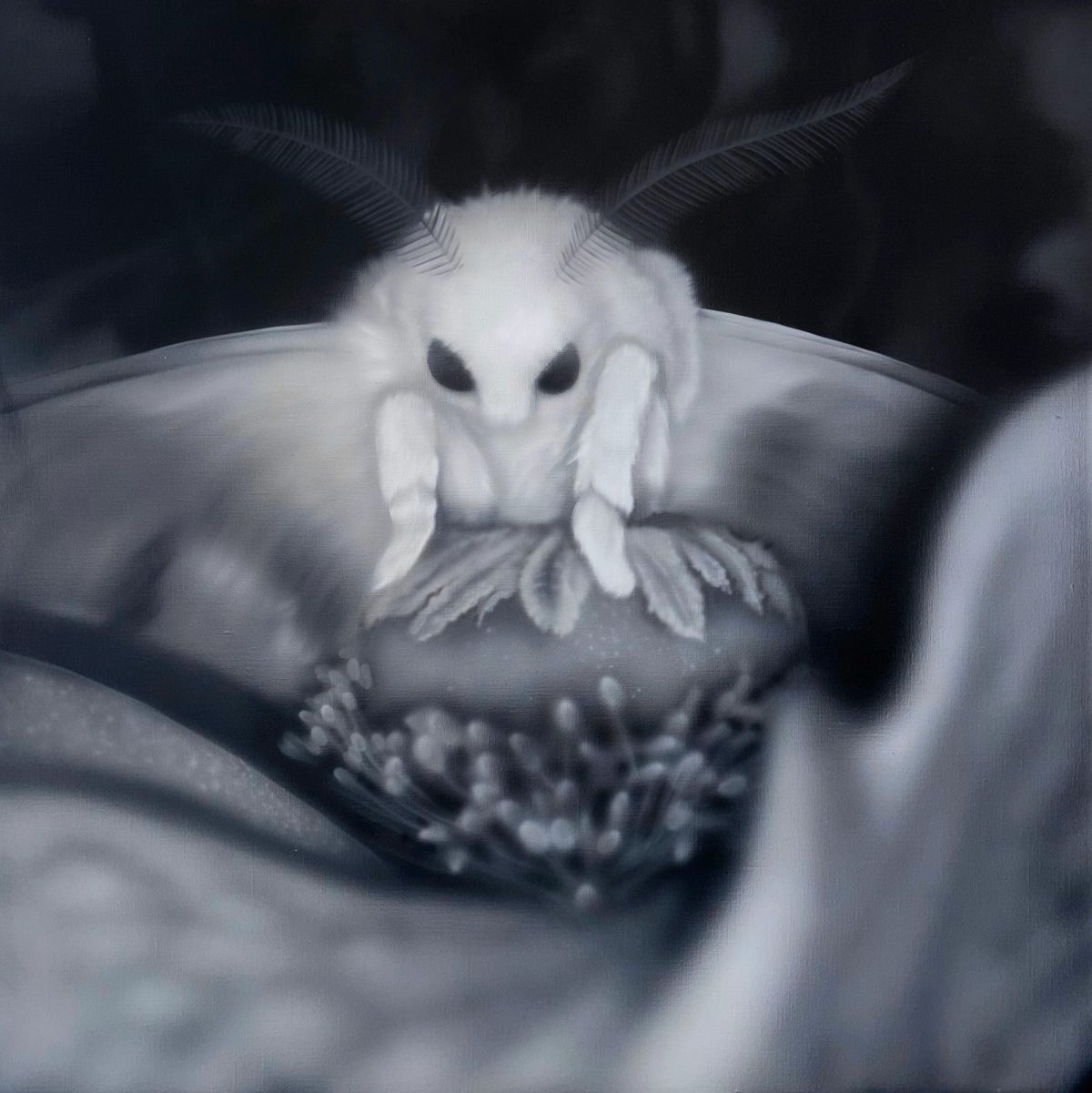
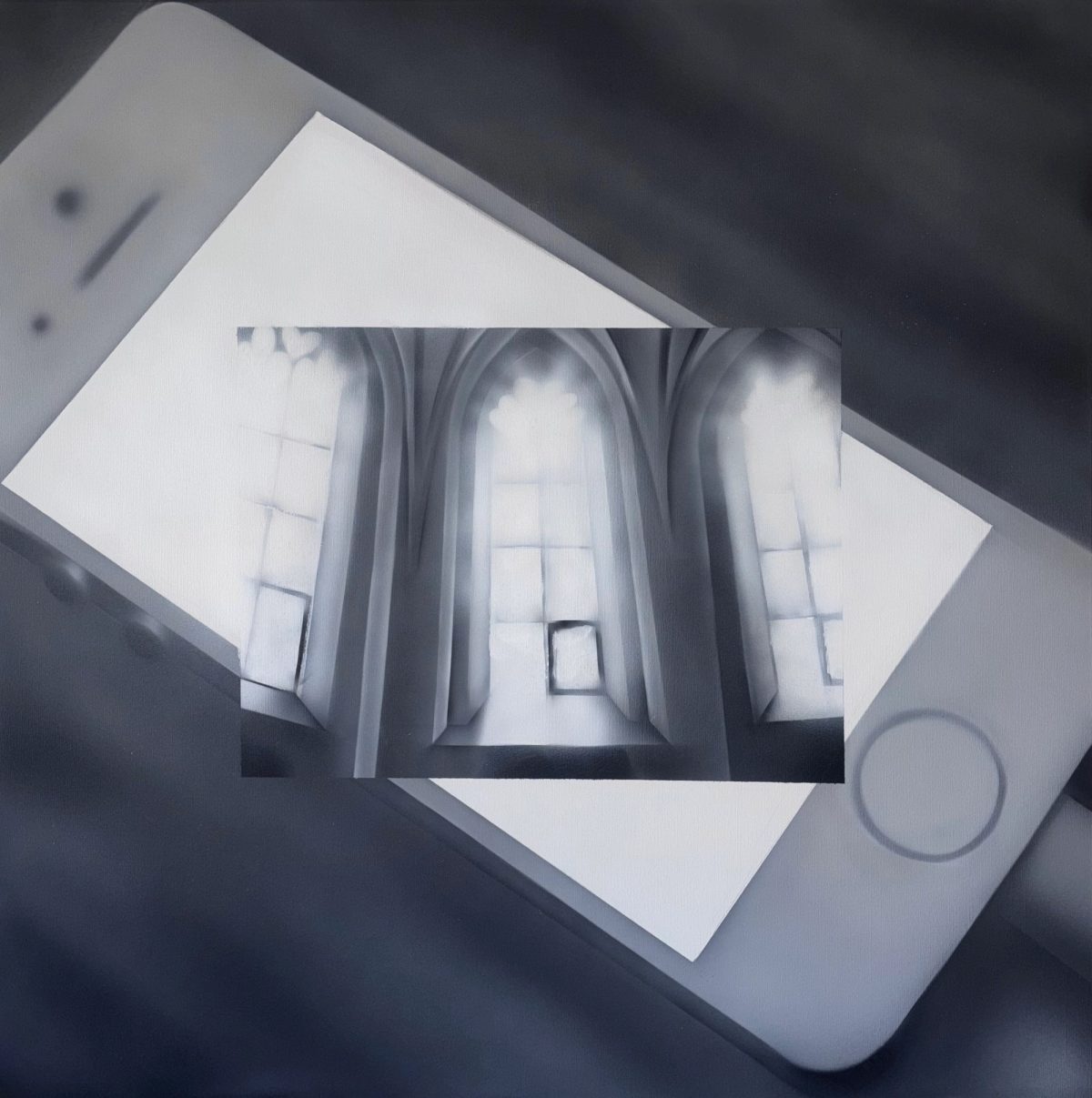
Left: Lorena Buta, Monolith, 2026, acrylic on canvas, 100 × 100 cm.
Right: Lorena Buta, Light of God, 2025, acrylic on canvas, 100 × 100 cm.
Several of your works, "White Ghosts Watching," "2 B in Ur Computer," and "Monolith," suggest a fluency with cultural registers beyond fine art: internet aesthetics, toy culture, the soft horror of children's imagery. Where do you locate your visual influences, and how consciously do you draw from popular or subcultural sources alongside art historical ones?
I locate my visual influences in both internet culture and painting itself. I grew up surrounded by digital imagery, especially Tumblr aesthetic blogs, which I still use, and online image archives, so those platforms shaped the way I perceive and construct images. I'm very drawn to visuals that feel eerie, innocent, and cute but slightly unsettling at the same time, nostalgic.
My work is all about creating symbols that express the feeling of disconnection from your own body or surroundings. That's why I'm interested in objects like dolls, porcelain figures, toys, and digitally coded imagery: comforting and uncanny, human and nonhuman, alive and artificial. At the same time, I'm deeply interested in painting materialities and textures, the illusion of three-dimensionality, reflective surfaces, skin, porcelain, plastic, fur.
Even though many of my influences come from contemporary digital culture, I still approach them through a very traditional painting approach in terms of composition, creating depth, perspective, and chiaroscuro.
Your work has been described as exploring the way stress, trauma, and technology-driven hyperstimulation can trigger a phantasmagoric alienation: a state that dissolves identity and distorts perception of reality. Do you think technology is a cause of these states, a mirror for them, or something else, and has making art about this changed how you relate to screens yourself?
Oh, definitely. I feel like I'm constantly caught in a fight between reality and technology, always being connected, always there, even when I'm mentally far away. Making art about these states made me realise how deeply technology can alienate us, not only from each other but also from ourselves and from the real world, our surroundings. I surely am alienated and disconnected because of it. And it's not even personal anymore; we're conditioned one way or another to use technology and live through it. For me, it feels like a second dimension that I'm always craving to immerse myself in. It's bittersweet, always living suspended between worlds, never being fully present in either of them. I became very interested in what constant hyperconnection does to perception and identity.
Of course, technology isn't the only cause; trauma and everyday stress have the same effect as well. When the mind drowns in anxieties, sorrows, and worries, it shuts down for brief moments, just to have some time to escape. The brain creates distance, working like an anaesthetic, causing a loss of feeling and emotional numbness. Feeling too much for too long results in the brain no longer being able to process it.
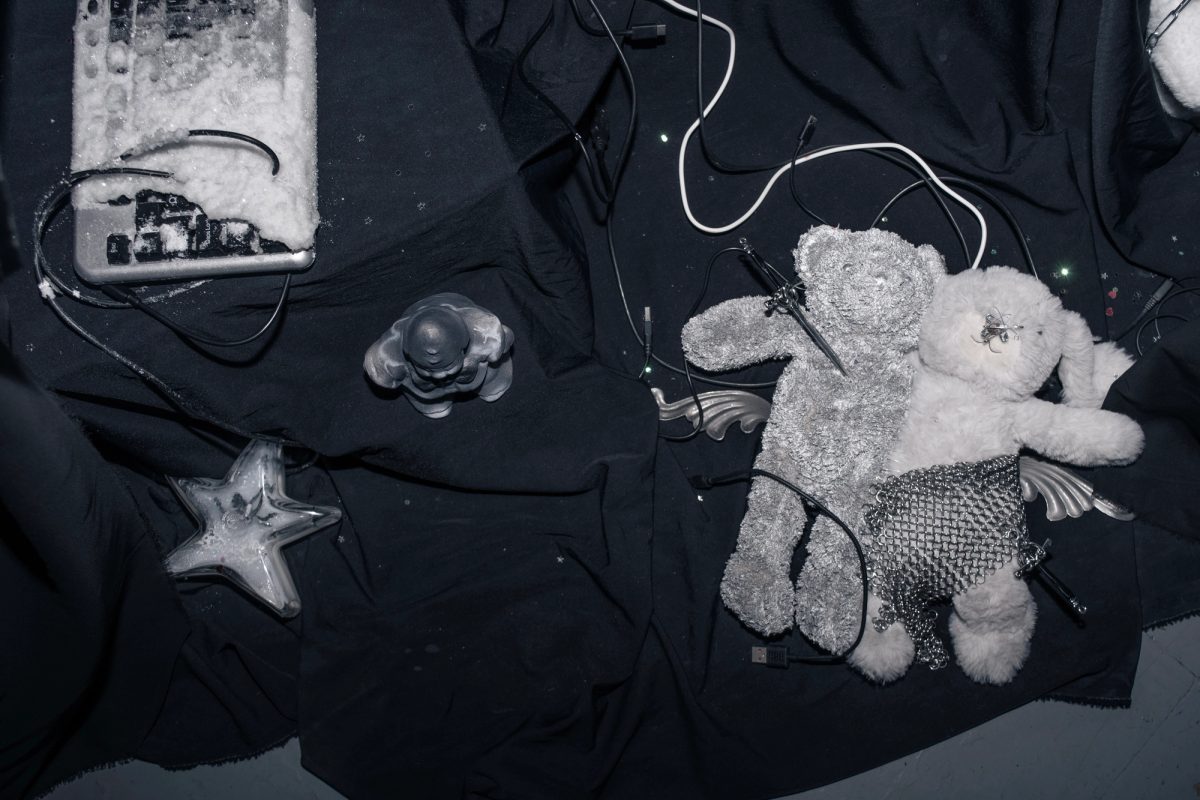
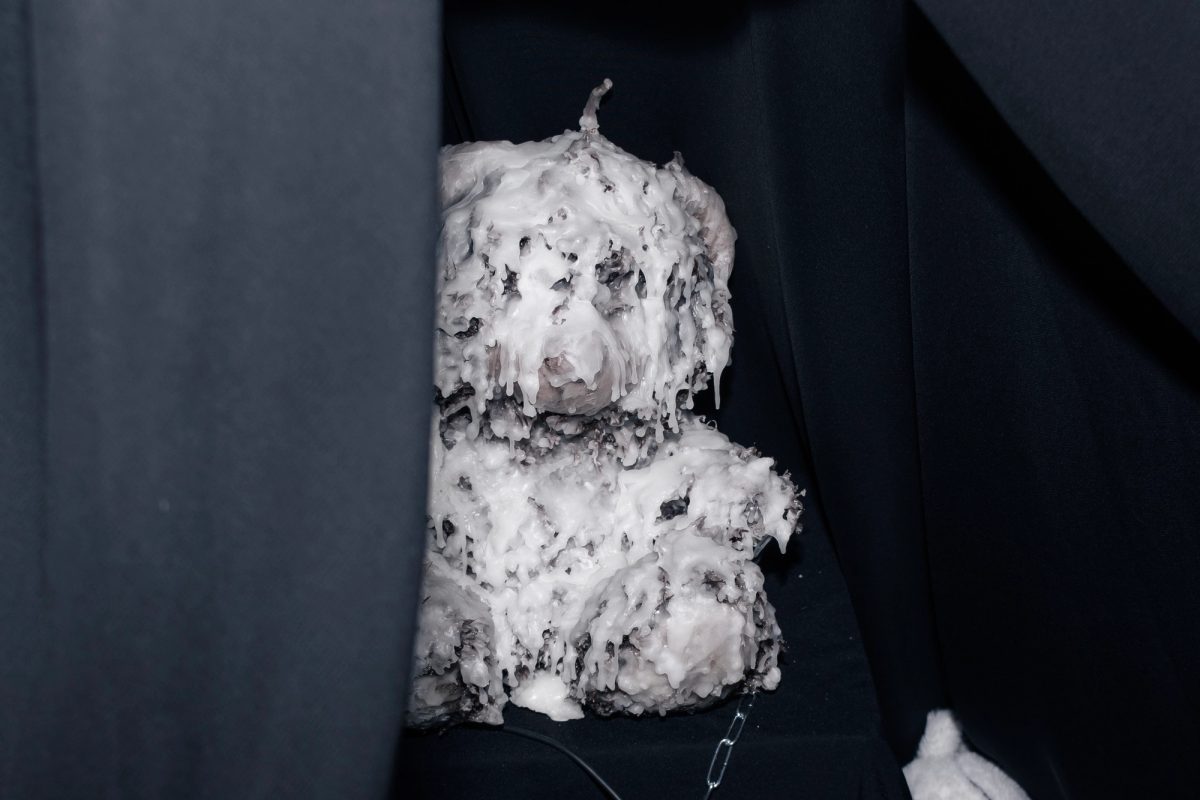
Lorena Buta, Magic Misery, 2025, solo exhibition, Atelier 35, Bucharest.
"Even though many of my influences come from contemporary digital culture, I still approach them through a very traditional painting approach in terms of composition, creating depth, perspective, and chiaroscuro."
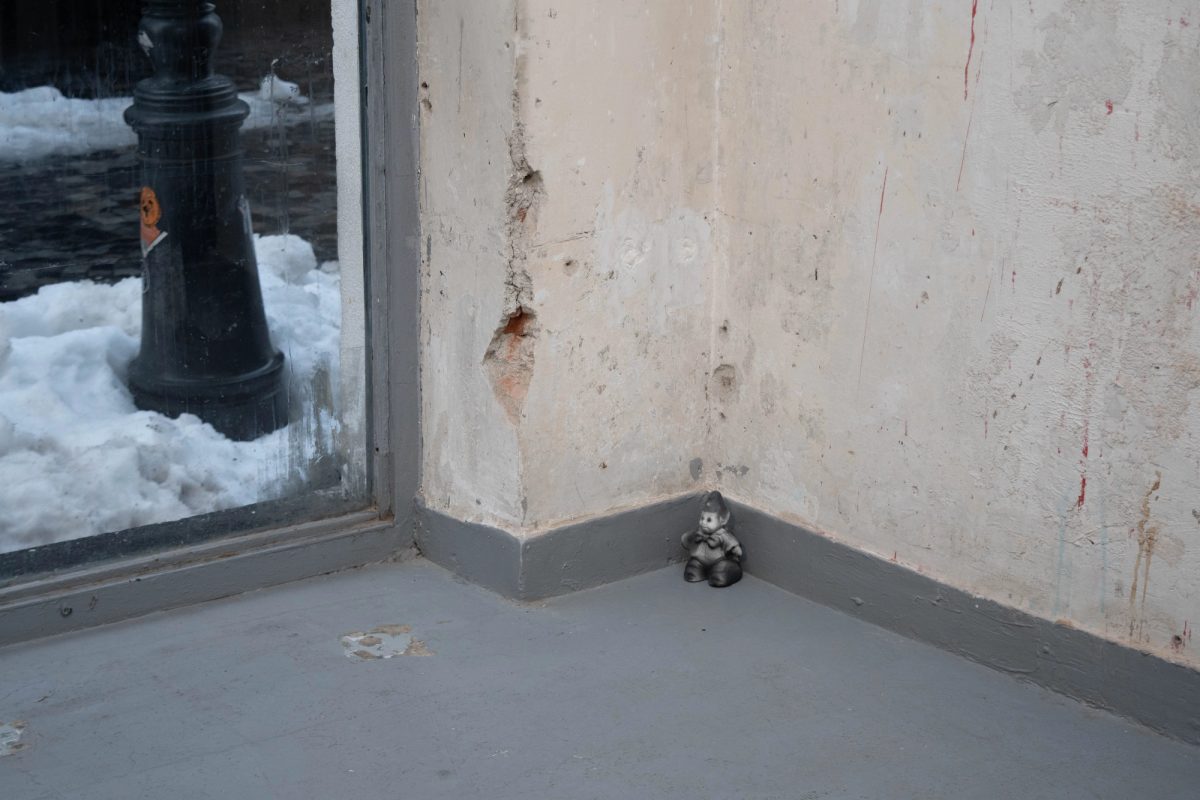
Lorena Buta, Magic Misery, 2025, solo exhibition, Atelier 35, Bucharest.
At such a young age, you are already exhibiting widely across Romania and beyond, with a show list that reflects both institutional recognition and gallery contexts. Yet your work is deeply interior, even private in its concerns. How do you negotiate the public life of an artwork, its circulation, its reception, its commercial dimension, with the vulnerability of the psychological territory it comes from?
I think once an artwork leaves the studio, it no longer belongs entirely to me, and I resonate with that. My intention is for the works to be emotionally felt by the viewer, not observed intellectually. I want the viewer to confront their own emotional landscape through the work, to recognise their own memories or feelings they don't usually sit with. Even though the images come from a personal psychological territory, I don't see them as autobiographical. I try to leave enough openness for the viewer to enter them emotionally and project their own experiences onto them. In that sense, the work becomes complete through perception. Ideally, the paintings create a kind of introspective sanctuary that can lead toward catharsis: a purification of emotion. I'm interested in art's ability to linger, to allow people to access parts of themselves that are buried.
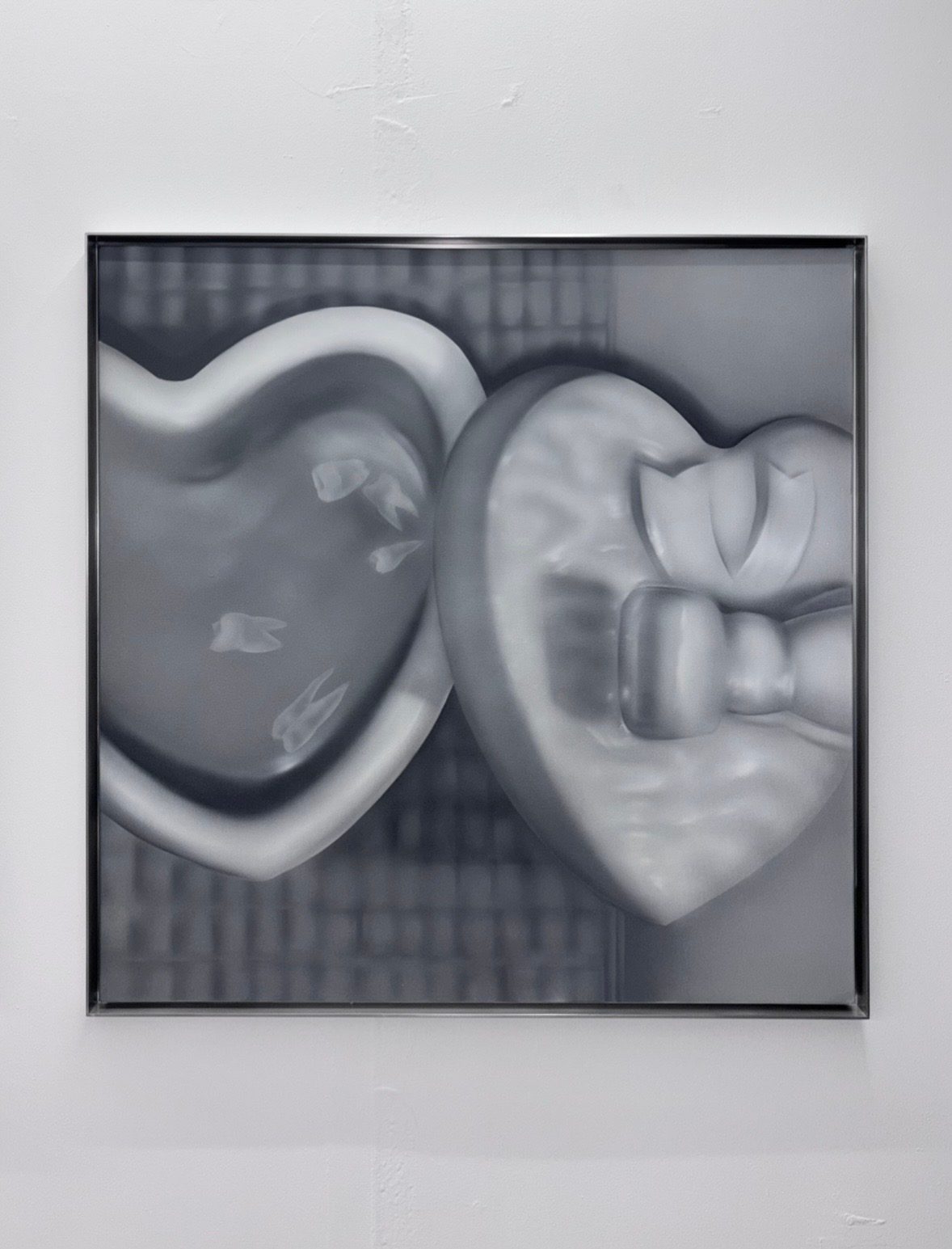
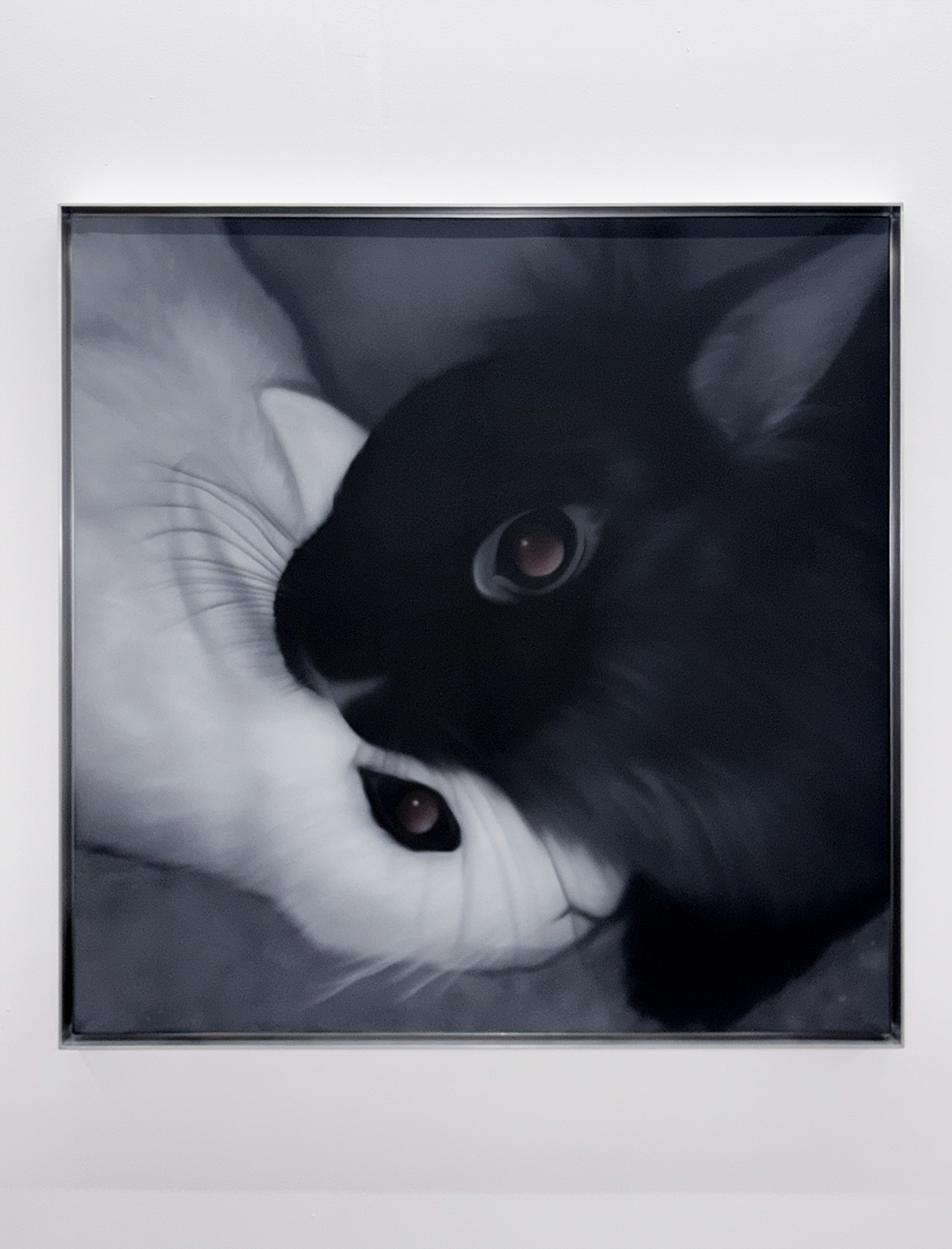
Left: Lorena Buta, In Silent Memory of You, 2026, acrylic on canvas, aluminium frame, 100 × 100 cm.
Right: Lorena Buta, Symbiosis, 2026, acrylic on canvas, aluminium frame, 100 × 100 cm. Exhibited at RAD Fair with Atelier 35, Bucharest.
You are currently pursuing a Master's degree at the Bucharest National University of Arts while maintaining an active exhibition practice. The academy and the art world ask different things of a person. What does the institution give you that the studio cannot, and is there anything the institution asks of you that you find yourself quietly resisting?
At the National University of Arts Bucharest, especially within the Painting Master's programme, the structure is actually very open. Most of our time is spent in the studio, and we work with the same professor throughout the programme, which creates a much more personal and continuous form of guidance. I've been very lucky to study under Petru Lucaci's guidance, who is himself oriented toward unconventional artistic practices. He gives us a lot of freedom to develop our own personal projects and encourages each of us toward our individual direction rather than imposing a rigid framework.
At the same time, I did feel certain limitations within the institution more broadly, especially because it still remains quite attached to traditional painting approaches. Since I use an airbrush, I often felt somewhat excluded or perceived as outside the conventional language of painting. But these tensions are inevitable during periods of transition. Our local young artists' scene is really experimental, provocative, and open to hybrid practices, so I believe these structures will gradually evolve as well. In a way, that feeling of being slightly outside the norm also pushed me to define my own visual language more clearly.
12:34
Claude responded: Lorena Buta, Portals, 2026, acrylic on canvas, 100 × 100 cm.
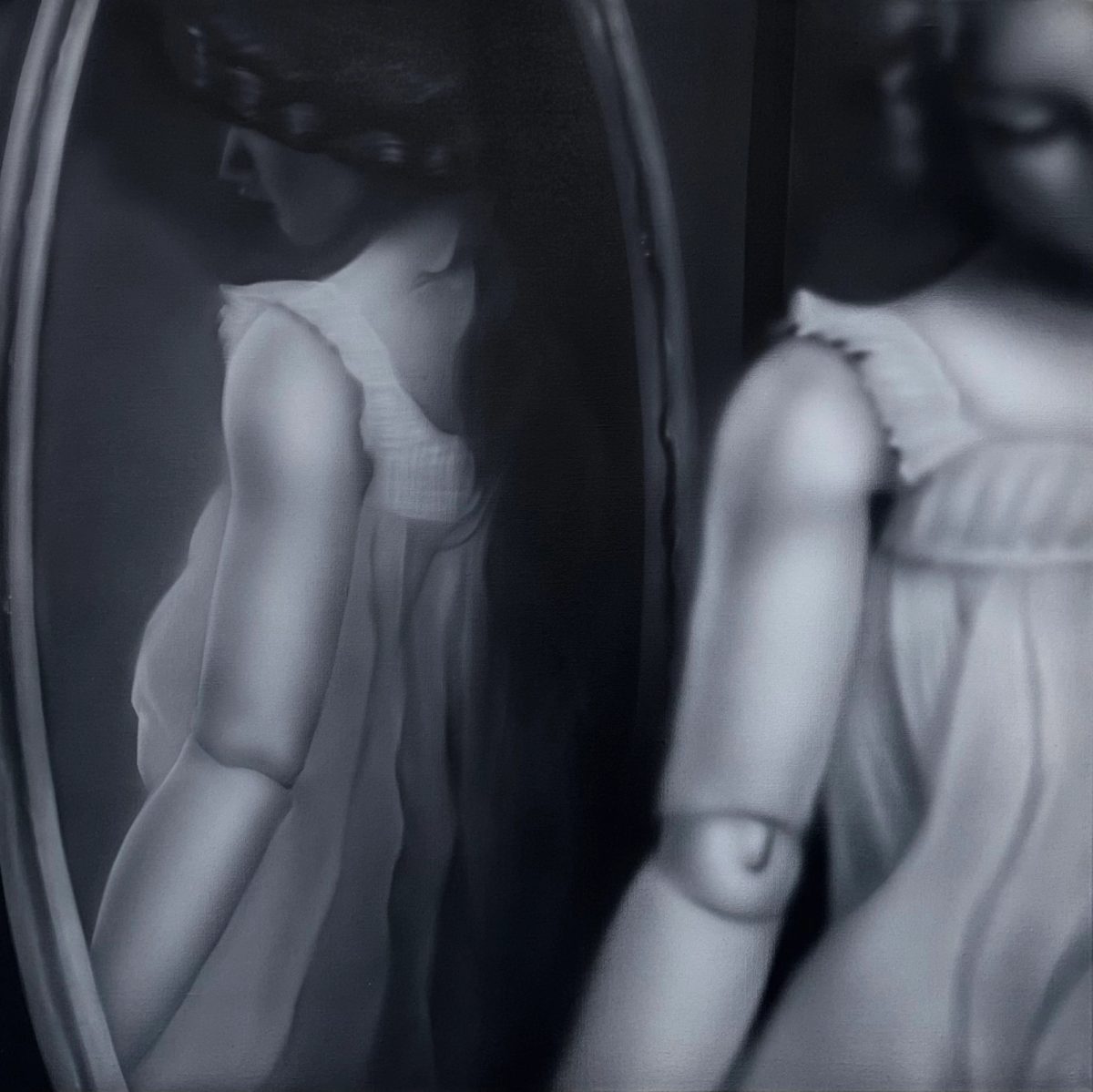
Lorena Buta, Portals, 2026, acrylic on canvas, 100 × 100 cm.
Cover Image: Lorena Buta, Born to Love, Forced to Grieve, 2024, oil and acrylic on canvas, 100 × 100 cm.